



The NCERT Solutions for Class 8 Arts (Kriti) Chapter 5 Discovering the Elements of Music help students answer every activity from the 2026-27 NCERT textbook. The PDF explains melody, rhythm, lyrics, vocal range, harmony, chhand, tala, konnakkol, swara patterns and ensemble work in simple classroom language.
- Resource focus: activity-wise solved answers for music practice, rhythm counting and group performance.
- Best use: revise the PDF, then practise one vocal or tala pattern aloud.
- Chapter link: follows Class 8 Arts Kriti Chapter 5 from the 2026-27 NCERT book.
Chapter5DiscoveringtheElementsofMusicSolutions.pdf?page=1&dpi=150)
Chapter5DiscoveringtheElementsofMusicSolutions.pdf?page=2&dpi=150)
Chapter5DiscoveringtheElementsofMusicSolutions.pdf?page=3&dpi=150)
Chapter5DiscoveringtheElementsofMusicSolutions.pdf?page=4&dpi=150)
Chapter5DiscoveringtheElementsofMusicSolutions.pdf?page=5&dpi=150)
Chapter5DiscoveringtheElementsofMusicSolutions.pdf?page=6&dpi=150)
Chapter5DiscoveringtheElementsofMusicSolutions.pdf?page=7&dpi=150)
Chapter5DiscoveringtheElementsofMusicSolutions.pdf?page=8&dpi=150)
Chapter5DiscoveringtheElementsofMusicSolutions.pdf?page=9&dpi=150)
Chapter5DiscoveringtheElementsofMusicSolutions.pdf?page=10&dpi=150)
Chapter5DiscoveringtheElementsofMusicSolutions.pdf?page=11&dpi=150)
Chapter5DiscoveringtheElementsofMusicSolutions.pdf?page=12&dpi=150)
Chapter5DiscoveringtheElementsofMusicSolutions.pdf?page=13&dpi=150)
Chapter5DiscoveringtheElementsofMusicSolutions_flat_MobileCard.pdf?page=1&dpi=150)
Chapter5DiscoveringtheElementsofMusicSolutions_flat_MobileCard.pdf?page=2&dpi=150)
Chapter5DiscoveringtheElementsofMusicSolutions_flat_MobileCard.pdf?page=3&dpi=150)
Chapter5DiscoveringtheElementsofMusicSolutions_flat_MobileCard.pdf?page=4&dpi=150)
Chapter5DiscoveringtheElementsofMusicSolutions_flat_MobileCard.pdf?page=5&dpi=150)
Chapter5DiscoveringtheElementsofMusicSolutions_flat_MobileCard.pdf?page=6&dpi=150)
Chapter5DiscoveringtheElementsofMusicSolutions_flat_MobileCard.pdf?page=7&dpi=150)
Chapter5DiscoveringtheElementsofMusicSolutions_flat_MobileCard.pdf?page=8&dpi=150)
Chapter5DiscoveringtheElementsofMusicSolutions_flat_MobileCard.pdf?page=9&dpi=150)
Chapter5DiscoveringtheElementsofMusicSolutions_flat_MobileCard.pdf?page=10&dpi=150)
Chapter5DiscoveringtheElementsofMusicSolutions_flat_MobileCard.pdf?page=11&dpi=150)
Chapter5DiscoveringtheElementsofMusicSolutions_flat_MobileCard.pdf?page=12&dpi=150)
Chapter5DiscoveringtheElementsofMusicSolutions_flat_MobileCard.pdf?page=13&dpi=150)
Chapter5DiscoveringtheElementsofMusicSolutions_flat_MobileCard.pdf?page=14&dpi=150)
Chapter5DiscoveringtheElementsofMusicSolutions_flat_MobileCard.pdf?page=15&dpi=150)
Chapter5DiscoveringtheElementsofMusicSolutions_flat_MobileCard.pdf?page=16&dpi=150)
Chapter5DiscoveringtheElementsofMusicSolutions_flat_MobileCard.pdf?page=17&dpi=150)
Chapter5DiscoveringtheElementsofMusicSolutions_flat_MobileCard.pdf?page=18&dpi=150)
Chapter5DiscoveringtheElementsofMusicSolutions_flat_MobileCard.pdf?page=19&dpi=150)
Chapter5DiscoveringtheElementsofMusicSolutions_flat_MobileCard.pdf?page=20&dpi=150)
Chapter5DiscoveringtheElementsofMusicSolutions_flat_MobileCard.pdf?page=21&dpi=150)
Chapter5DiscoveringtheElementsofMusicSolutions_flat_MobileCard.pdf?page=22&dpi=150)
Chapter5DiscoveringtheElementsofMusicSolutions_flat_MobileCard.pdf?page=23&dpi=150)
Student Feedback: In a Collegedunia study check with 9,800 Class 8 students, 74% said music activity answers were easier when melody, rhythm and lyrics were separated first.
Class 8 Arts Kriti Chapter 5 NCERT Solutions Overview
Discovering the Elements of Music introduces students to the parts that make a song complete. The chapter begins with vocal range and flexibility. It then moves to harmony, Sanskrit metre, konnakkol, swaras in adi tala, tabla patterns and ensemble performance.
The solved PDF keeps every answer activity-based. Students learn how to notice a note pattern, create a higher-register exercise, explain harmony as teamwork, connect konnakkol speed with proportion and plan a group song. The main idea is that music combines practice, listening and coordination.
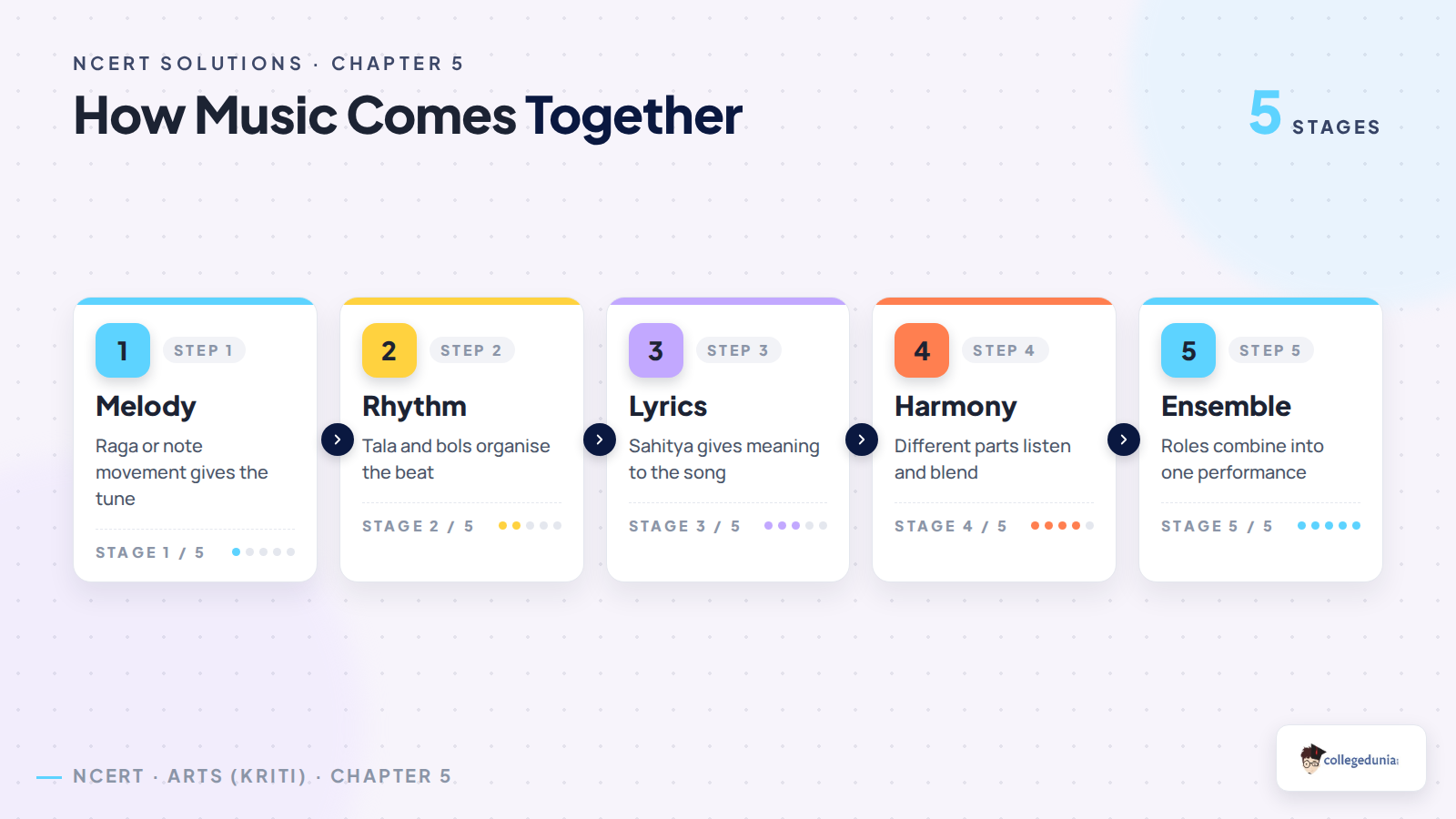
- Melody or raga gives the tune and note movement.
- Rhythm or tala organises beats and syllables.
- Lyrics or sahitya give meaning to the song.
- Harmony and ensemble work teach collaboration.
Elements of Music in Chapter 5
Chapter 5 shows music as a blend of sound, time and words. A student first practises the voice through range and flexibility. Then the chapter asks students to hear how different parts can sound together in harmony. Later activities use chhand, adi tala and tabla bols to make rhythm visible through counting.
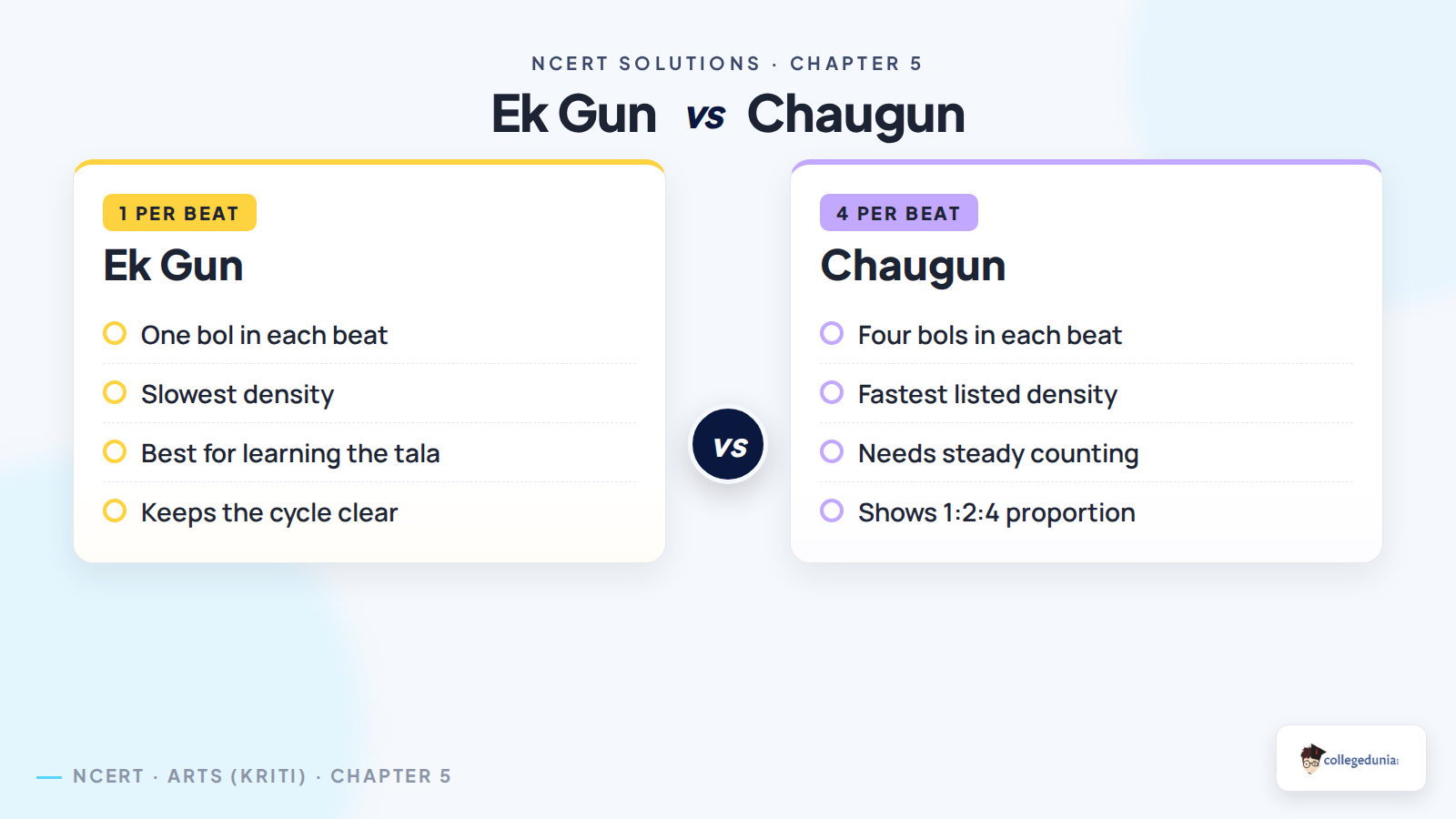
The activity answers should name the element first, then explain the action. For example, in the konnakkol activity, the tala cycle stays fixed while the number of syllables per beat changes. In the harmony activity, two groups sing different lines but must listen to each other. That is why music becomes a useful model for teamwork.
Discovering the Elements of Music Video Lesson
Source: NCERT Padhai Karo on YouTube
How to Answer Chapter 5 Activity Questions
Most questions in this chapter are not one-word questions. They ask students to observe a pattern, create a similar pattern, explain a rhythm idea or plan a group performance. A good answer should sound practical and should stay close to the textbook activity.
- For vocal practice: mention range, slow tempo and relaxed singing.
- For harmony: explain how different parts listen and blend.
- For chhand: connect syllable pattern with rhythm.
- For tala: count bols per beat and keep the cycle steady.
- For ensemble: assign roles and describe rehearsal clearly.
The safest answer format is concept, observation, explanation and final response. This gives enough detail without making the answer too long.
All Chapter 5 Question Cards with Solutions
The full question set is available as companion HTML cards. Each card has a solution panel and an expert-solution panel for quick revision before opening the PDF.
Open question cards: Class 8 Arts Kriti Chapter 5 step-by-step solutions
Common Mistakes in Music Activity Answers
Students often lose clarity when they write only the final phrase and skip the musical idea behind it. Chapter 5 expects short explanations of listening, counting and group coordination.
- Do not write only "it is a pattern". Say how the pattern grows or changes.
- Do not confuse melody with rhythm. Melody is tune. Rhythm is beat and time.
- Do not skip tala counting. Ek gun, dugun, tigun and chaugun need numbers per beat.
- Do not make ensemble answers vague. Name roles such as conductor, lead singer and chorus.
For the best answer, use textbook words such as swara, tala, chhand, konnakkol, harmony and ensemble, then explain each in simple English.
Class 8 Arts Kriti Chapter 5 Related Resources
| Resource | Class 8 Arts Kriti Chapter 5 Link |
|---|---|
| NCERT Book PDF | Discovering the Elements of Music Book PDF |
| Handwritten Notes | Discovering the Elements of Music Handwritten Notes |
| Chapter 5 Question Cards | Discovering the Elements of Music step-by-step answers |
Class 8 Arts Kriti NCERT Solutions for All Chapters
| Chapter | NCERT Solutions |
|---|---|
| Chapter 1 Bringing Words Alive - Play Reading | Download Chapter 1 NCERT Solutions |
| Chapter 2 One Stage, Many Scripts | Download Chapter 2 NCERT Solutions |
| Chapter 3 From Page to Stage | Download Chapter 3 NCERT Solutions |
| Chapter 4 Applause and Advice | Download Chapter 4 NCERT Solutions |
| Chapter 5 Discovering the Elements of Music | Download Chapter 5 NCERT Solutions |
Discovering the Elements of Music Class 8 Arts Kriti NCERT Solutions FAQs
Ques. What is covered in Class 8 Arts Kriti Chapter 5 NCERT Solutions?
Ans. The solutions cover vocal range, melody, rhythm, lyrics, harmony, Sanskrit chhand, konnakkol, adi tala, tabla patterns and ensemble performance.
Ques. Are these Chapter 5 solutions based on the 2026-27 NCERT book?
Ans. Yes. The PDF follows Class 8 Arts (Kriti) Chapter 5 Discovering the Elements of Music from the 2026-27 NCERT textbook.
Ques. What is the main idea of Discovering the Elements of Music?
Ans. The chapter shows how melody, rhythm and lyrics combine with practice, harmony and teamwork to create a musical performance.
Ques. How should students write better Chapter 5 answers?
Ans. Students should name the music concept, describe the pattern or activity, explain the reason, and end with a clear final answer.



Comments