



The NCERT Solutions for Class 8 Mathematics Part 1 Chapter 3 cover A Story of Numbers for the 2026-27 Ganita Prakash textbook. Students can download the PDF for step-by-step answers on counting methods, Roman numerals, Egyptian numerals, base systems, place value and zero.
- Resource: Class 8 Maths Part 1 Chapter 3 NCERT Solutions PDF.
- Chapter focus: number systems, landmark numbers, bases and place value.
- Question type: Figure it Out, Math Talk and representation answers.
Chapter3AStoryofNumbersSolutions.pdf?page=1&dpi=150)
Chapter3AStoryofNumbersSolutions.pdf?page=2&dpi=150)
Chapter3AStoryofNumbersSolutions.pdf?page=3&dpi=150)
Chapter3AStoryofNumbersSolutions.pdf?page=4&dpi=150)
Chapter3AStoryofNumbersSolutions.pdf?page=5&dpi=150)
Chapter3AStoryofNumbersSolutions.pdf?page=6&dpi=150)
Chapter3AStoryofNumbersSolutions.pdf?page=7&dpi=150)
Chapter3AStoryofNumbersSolutions.pdf?page=8&dpi=150)
Chapter3AStoryofNumbersSolutions.pdf?page=9&dpi=150)
Chapter3AStoryofNumbersSolutions.pdf?page=10&dpi=150)
Chapter3AStoryofNumbersSolutions.pdf?page=11&dpi=150)
Chapter3AStoryofNumbersSolutions.pdf?page=12&dpi=150)
Chapter3AStoryofNumbersSolutions.pdf?page=13&dpi=150)
Chapter3AStoryofNumbersSolutions.pdf?page=14&dpi=150)
Chapter3AStoryofNumbersSolutions.pdf?page=15&dpi=150)
Chapter3AStoryofNumbersSolutions.pdf?page=16&dpi=150)
Chapter3AStoryofNumbersSolutions.pdf?page=17&dpi=150)
Chapter3AStoryofNumbersSolutions.pdf?page=18&dpi=150)
Chapter3AStoryofNumbersSolutions.pdf?page=19&dpi=150)
Chapter3AStoryofNumbersSolutions.pdf?page=20&dpi=150)
Chapter3AStoryofNumbersSolutions.pdf?page=21&dpi=150)
Chapter3AStoryofNumbersSolutions.pdf?page=22&dpi=150)
Chapter3AStoryofNumbersSolutions.pdf?page=23&dpi=150)
Chapter3AStoryofNumbersSolutions.pdf?page=24&dpi=150)
Chapter3AStoryofNumbersSolutions.pdf?page=25&dpi=150)
Chapter3AStoryofNumbersSolutions.pdf?page=26&dpi=150)
Chapter3AStoryofNumbersSolutions.pdf?page=27&dpi=150)
Chapter3AStoryofNumbersSolutions_flat_MobileCard.pdf?page=1&dpi=150)
Chapter3AStoryofNumbersSolutions_flat_MobileCard.pdf?page=2&dpi=150)
Chapter3AStoryofNumbersSolutions_flat_MobileCard.pdf?page=3&dpi=150)
Chapter3AStoryofNumbersSolutions_flat_MobileCard.pdf?page=4&dpi=150)
Chapter3AStoryofNumbersSolutions_flat_MobileCard.pdf?page=5&dpi=150)
Chapter3AStoryofNumbersSolutions_flat_MobileCard.pdf?page=6&dpi=150)
Chapter3AStoryofNumbersSolutions_flat_MobileCard.pdf?page=7&dpi=150)
Chapter3AStoryofNumbersSolutions_flat_MobileCard.pdf?page=8&dpi=150)
Chapter3AStoryofNumbersSolutions_flat_MobileCard.pdf?page=9&dpi=150)
Chapter3AStoryofNumbersSolutions_flat_MobileCard.pdf?page=10&dpi=150)
Chapter3AStoryofNumbersSolutions_flat_MobileCard.pdf?page=11&dpi=150)
Chapter3AStoryofNumbersSolutions_flat_MobileCard.pdf?page=12&dpi=150)
Chapter3AStoryofNumbersSolutions_flat_MobileCard.pdf?page=13&dpi=150)
Chapter3AStoryofNumbersSolutions_flat_MobileCard.pdf?page=14&dpi=150)
Chapter3AStoryofNumbersSolutions_flat_MobileCard.pdf?page=15&dpi=150)
Chapter3AStoryofNumbersSolutions_flat_MobileCard.pdf?page=16&dpi=150)
Chapter3AStoryofNumbersSolutions_flat_MobileCard.pdf?page=17&dpi=150)
Chapter3AStoryofNumbersSolutions_flat_MobileCard.pdf?page=18&dpi=150)
Chapter3AStoryofNumbersSolutions_flat_MobileCard.pdf?page=19&dpi=150)
Chapter3AStoryofNumbersSolutions_flat_MobileCard.pdf?page=20&dpi=150)
Chapter3AStoryofNumbersSolutions_flat_MobileCard.pdf?page=21&dpi=150)
Chapter3AStoryofNumbersSolutions_flat_MobileCard.pdf?page=22&dpi=150)
Chapter3AStoryofNumbersSolutions_flat_MobileCard.pdf?page=23&dpi=150)
Chapter3AStoryofNumbersSolutions_flat_MobileCard.pdf?page=24&dpi=150)
Chapter3AStoryofNumbersSolutions_flat_MobileCard.pdf?page=25&dpi=150)
Chapter3AStoryofNumbersSolutions_flat_MobileCard.pdf?page=26&dpi=150)
Chapter3AStoryofNumbersSolutions_flat_MobileCard.pdf?page=27&dpi=150)
Chapter3AStoryofNumbersSolutions_flat_MobileCard.pdf?page=28&dpi=150)
Chapter3AStoryofNumbersSolutions_flat_MobileCard.pdf?page=29&dpi=150)
Chapter3AStoryofNumbersSolutions_flat_MobileCard.pdf?page=30&dpi=150)
Chapter3AStoryofNumbersSolutions_flat_MobileCard.pdf?page=31&dpi=150)
Chapter3AStoryofNumbersSolutions_flat_MobileCard.pdf?page=32&dpi=150)
Chapter3AStoryofNumbersSolutions_flat_MobileCard.pdf?page=33&dpi=150)
Chapter3AStoryofNumbersSolutions_flat_MobileCard.pdf?page=34&dpi=150)
Chapter3AStoryofNumbersSolutions_flat_MobileCard.pdf?page=35&dpi=150)
Chapter3AStoryofNumbersSolutions_flat_MobileCard.pdf?page=36&dpi=150)
Chapter3AStoryofNumbersSolutions_flat_MobileCard.pdf?page=37&dpi=150)
Chapter3AStoryofNumbersSolutions_flat_MobileCard.pdf?page=38&dpi=150)
Chapter3AStoryofNumbersSolutions_flat_MobileCard.pdf?page=39&dpi=150)
Chapter3AStoryofNumbersSolutions_flat_MobileCard.pdf?page=40&dpi=150)
Chapter3AStoryofNumbersSolutions_flat_MobileCard.pdf?page=41&dpi=150)
Chapter3AStoryofNumbersSolutions_flat_MobileCard.pdf?page=42&dpi=150)
Chapter3AStoryofNumbersSolutions_flat_MobileCard.pdf?page=43&dpi=150)
Chapter3AStoryofNumbersSolutions_flat_MobileCard.pdf?page=44&dpi=150)
Chapter3AStoryofNumbersSolutions_flat_MobileCard.pdf?page=45&dpi=150)
Chapter3AStoryofNumbersSolutions_flat_MobileCard.pdf?page=46&dpi=150)
Chapter3AStoryofNumbersSolutions_flat_MobileCard.pdf?page=47&dpi=150)
Chapter3AStoryofNumbersSolutions_flat_MobileCard.pdf?page=48&dpi=150)
Chapter3AStoryofNumbersSolutions_flat_MobileCard.pdf?page=49&dpi=150)
Chapter3AStoryofNumbersSolutions_flat_MobileCard.pdf?page=50&dpi=150)
Chapter3AStoryofNumbersSolutions_flat_MobileCard.pdf?page=51&dpi=150)
Chapter3AStoryofNumbersSolutions_flat_MobileCard.pdf?page=52&dpi=150)
Chapter3AStoryofNumbersSolutions_flat_MobileCard.pdf?page=53&dpi=150)
Chapter3AStoryofNumbersSolutions_flat_MobileCard.pdf?page=54&dpi=150)
Chapter3AStoryofNumbersSolutions_flat_MobileCard.pdf?page=55&dpi=150)
Chapter3AStoryofNumbersSolutions_flat_MobileCard.pdf?page=56&dpi=150)
Chapter3AStoryofNumbersSolutions_flat_MobileCard.pdf?page=57&dpi=150)
Chapter3AStoryofNumbersSolutions_flat_MobileCard.pdf?page=58&dpi=150)
Chapter3AStoryofNumbersSolutions_flat_MobileCard.pdf?page=59&dpi=150)
Chapter3AStoryofNumbersSolutions_flat_MobileCard.pdf?page=60&dpi=150)
Chapter3AStoryofNumbersSolutions_flat_MobileCard.pdf?page=61&dpi=150)
Chapter3AStoryofNumbersSolutions_flat_MobileCard.pdf?page=62&dpi=150)
Chapter3AStoryofNumbersSolutions_flat_MobileCard.pdf?page=63&dpi=150)
Chapter3AStoryofNumbersSolutions_flat_MobileCard.pdf?page=64&dpi=150)
Chapter3AStoryofNumbersSolutions_flat_MobileCard.pdf?page=65&dpi=150)
Chapter3AStoryofNumbersSolutions_flat_MobileCard.pdf?page=66&dpi=150)
Chapter3AStoryofNumbersSolutions_flat_MobileCard.pdf?page=67&dpi=150)
Chapter3AStoryofNumbersSolutions_flat_MobileCard.pdf?page=68&dpi=150)
Student Feedback: These solutions help students compare old number systems without losing the rule behind each symbol.
In This Article
Chapter 3 Solutions Overview
Class 8 Mathematics Part 1 Chapter 3 begins with the need to count and then follows how humans made number systems more efficient. The PDF explains one-to-one mapping, tally marks, Roman numerals, Egyptian grouping, Mesopotamian base 60, Mayan place value, Chinese rod numerals and the Hindu number system.
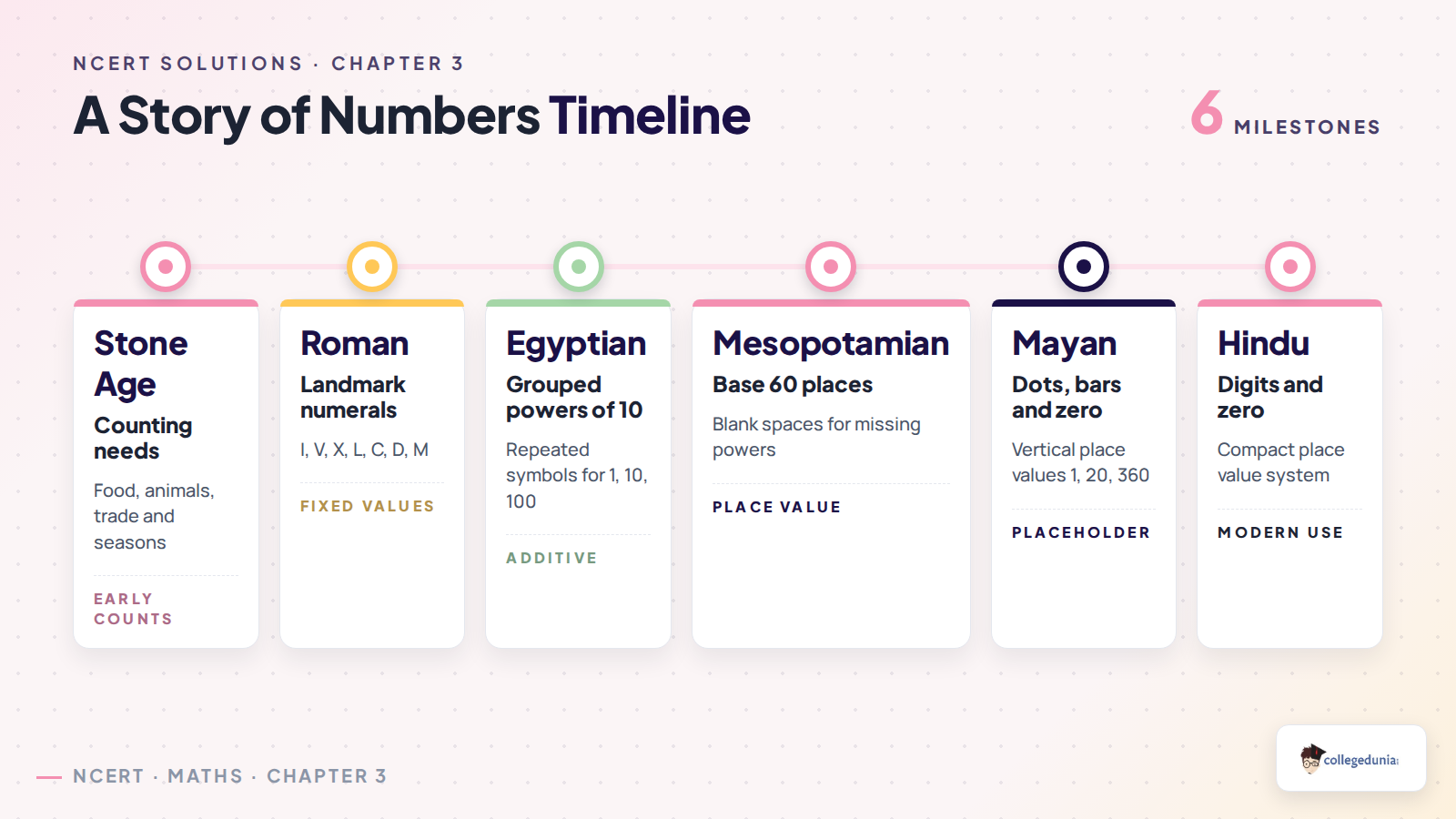
The most important idea is that a numeral is not the number itself. A numeral is a way of writing a quantity using agreed symbols. Place value and zero make the Hindu number system compact and useful for calculation.
Key Methods for A Story of Numbers Questions
Most questions in A Story of Numbers become simple once students identify the rule of the system. Some systems match objects one-to-one, some repeat landmark symbols, and some use position to show place value. The answers in the PDF keep this rule visible before the final numeral is written.
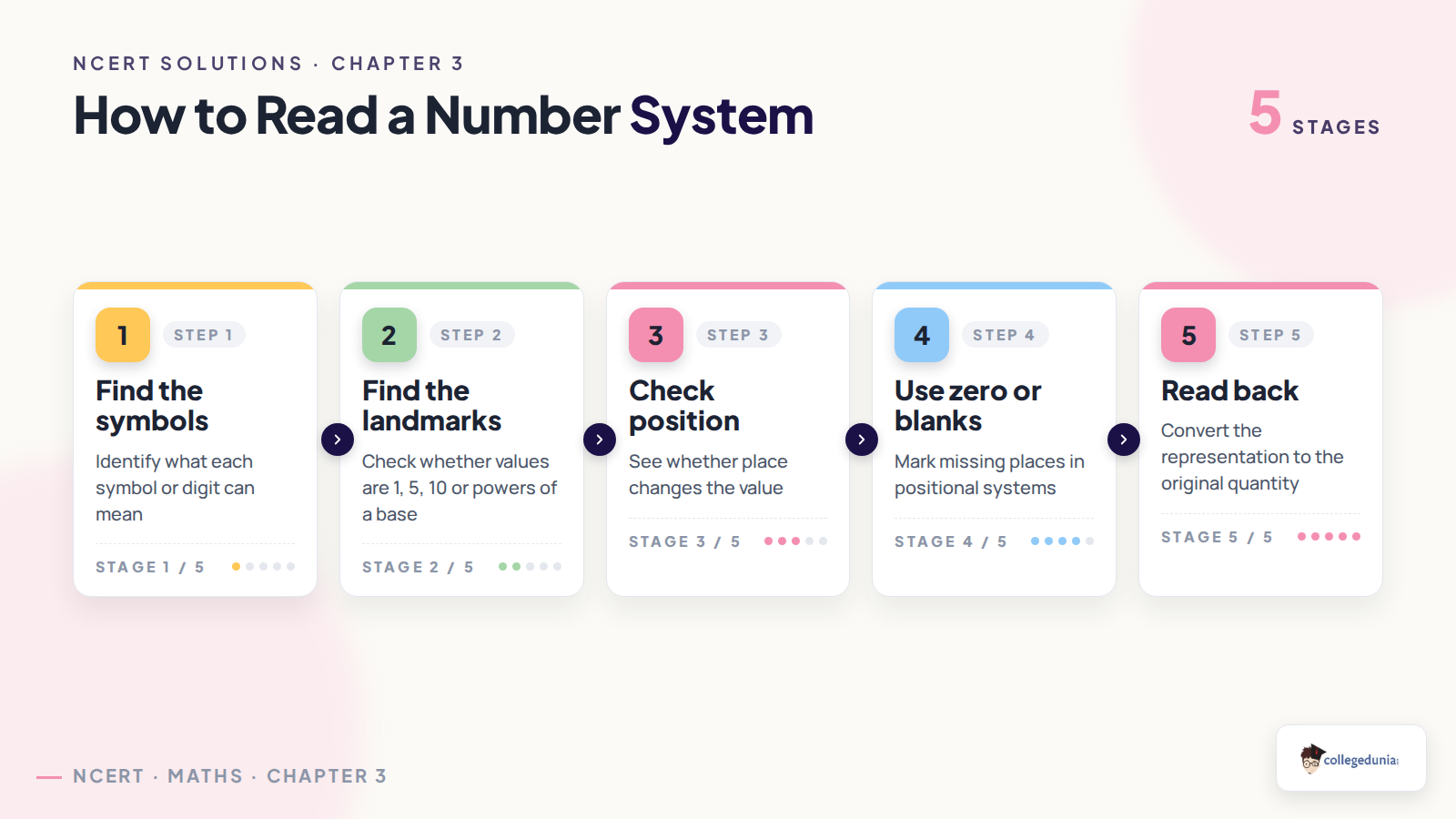
- Use one-to-one matching for sticks, tally marks and early counting tasks.
- Use landmark numbers for Roman and Egyptian numerals.
- Use powers of the base for base-5, base-7 and base-60 questions.
- Use zero as a placeholder when a positional system has an empty place.
Class 8 Maths Chapter 3 A Story of Numbers Video Lesson
Source: Magnet Brains on YouTube
All NCERT Solutions for Class 8 Mathematics Part 1 Chapter 3 A Story of Numbers with Step-by-Step Solutions
The complete solution PDF covers 23 major prompts from the chapter. Use the question-card page for quick revision after reading the PDF.
Practice with expandable question cards
Open the chapter questions with Check Solution and Expert Solution tabs.
Class 8 Maths Part 1 Chapter 3 Resource Links
Use these related resources when you want the same chapter in another format.
| Resource | Best use | Link |
|---|---|---|
| NCERT Solutions | Step-by-step answers for chapter prompts | Open solutions |
| Notes | Concept summary and quick revision | Open notes |
| Handwritten Notes | Fast visual revision before class tests | Open handwritten notes |
| NCERT Book PDF | Official textbook chapter | Open book PDF |
All NCERT Solutions for Class 8 Mathematics Part 1 Chapters
| Chapter | Title | Solutions link |
|---|---|---|
| Chapter 1 | A Square and A Cube | NCERT Solutions Chapter 1 |
| Chapter 2 | Power Play | NCERT Solutions Chapter 2 |
| Chapter 3 | A Story of Numbers | NCERT Solutions Chapter 3 |
A Story of Numbers Class 8 Maths NCERT Solutions FAQs
Ques. What does Class 8 Maths Chapter 3 A Story of Numbers explain?
Ans. It explains how number systems developed from counting objects to place value systems with zero.
Ques. Why is zero important in Chapter 3?
Ans. Zero works as a number and as a placeholder, so positional numerals can represent quantities without ambiguity.
Ques. What is the main difference between Roman and Hindu numerals?
Ans. Roman numerals use fixed landmark symbols, while Hindu numerals use place value and zero for compact calculation.



Comments