



The Baudhayana-Pythagoras Theorem NCERT Solutions for Class 8 Mathematics Part 2 Chapter 2 cover all 19 Figure it Out questions from the 2026-27 NCERT book. The PDF gives step-by-step answers for square doubling, right triangles, square roots, Baudhayan triples, rhombus problems, and grid-square areas.
- 19 solved questions with Solution and Expert Solution blocks.
- Best for revision: hypotenuse formula, missing sides, integer triples, and geometric construction ideas.
- Prepared from official NCERT: Class 8 Ganita Prakash Part 2 Chapter 2.
Chapter2TheBaudhayana-PythagorasTheoremSolutions.pdf?page=1&dpi=150)
Chapter2TheBaudhayana-PythagorasTheoremSolutions.pdf?page=2&dpi=150)
Chapter2TheBaudhayana-PythagorasTheoremSolutions.pdf?page=3&dpi=150)
Chapter2TheBaudhayana-PythagorasTheoremSolutions.pdf?page=4&dpi=150)
Chapter2TheBaudhayana-PythagorasTheoremSolutions.pdf?page=5&dpi=150)
Chapter2TheBaudhayana-PythagorasTheoremSolutions.pdf?page=6&dpi=150)
Chapter2TheBaudhayana-PythagorasTheoremSolutions.pdf?page=7&dpi=150)
Chapter2TheBaudhayana-PythagorasTheoremSolutions.pdf?page=8&dpi=150)
Chapter2TheBaudhayana-PythagorasTheoremSolutions.pdf?page=9&dpi=150)
Chapter2TheBaudhayana-PythagorasTheoremSolutions.pdf?page=10&dpi=150)
Chapter2TheBaudhayana-PythagorasTheoremSolutions.pdf?page=11&dpi=150)
Chapter2TheBaudhayana-PythagorasTheoremSolutions.pdf?page=12&dpi=150)
Chapter2TheBaudhayana-PythagorasTheoremSolutions.pdf?page=13&dpi=150)
Chapter2TheBaudhayana-PythagorasTheoremSolutions.pdf?page=14&dpi=150)
Chapter2TheBaudhayana-PythagorasTheoremSolutions.pdf?page=15&dpi=150)
Chapter2TheBaudhayana-PythagorasTheoremSolutions.pdf?page=16&dpi=150)
Chapter2TheBaudhayana-PythagorasTheoremSolutions.pdf?page=17&dpi=150)
Chapter2TheBaudhayana-PythagorasTheoremSolutions.pdf?page=18&dpi=150)
Chapter2TheBaudhayana-PythagorasTheoremSolutions.pdf?page=19&dpi=150)
Chapter2TheBaudhayana-PythagorasTheoremSolutions.pdf?page=20&dpi=150)
Chapter2TheBaudhayana-PythagorasTheoremSolutions.pdf?page=21&dpi=150)
Chapter2TheBaudhayana-PythagorasTheoremSolutions_flat_MobileCard.pdf?page=1&dpi=150)
Chapter2TheBaudhayana-PythagorasTheoremSolutions_flat_MobileCard.pdf?page=2&dpi=150)
Chapter2TheBaudhayana-PythagorasTheoremSolutions_flat_MobileCard.pdf?page=3&dpi=150)
Chapter2TheBaudhayana-PythagorasTheoremSolutions_flat_MobileCard.pdf?page=4&dpi=150)
Chapter2TheBaudhayana-PythagorasTheoremSolutions_flat_MobileCard.pdf?page=5&dpi=150)
Chapter2TheBaudhayana-PythagorasTheoremSolutions_flat_MobileCard.pdf?page=6&dpi=150)
Chapter2TheBaudhayana-PythagorasTheoremSolutions_flat_MobileCard.pdf?page=7&dpi=150)
Chapter2TheBaudhayana-PythagorasTheoremSolutions_flat_MobileCard.pdf?page=8&dpi=150)
Chapter2TheBaudhayana-PythagorasTheoremSolutions_flat_MobileCard.pdf?page=9&dpi=150)
Chapter2TheBaudhayana-PythagorasTheoremSolutions_flat_MobileCard.pdf?page=10&dpi=150)
Chapter2TheBaudhayana-PythagorasTheoremSolutions_flat_MobileCard.pdf?page=11&dpi=150)
Chapter2TheBaudhayana-PythagorasTheoremSolutions_flat_MobileCard.pdf?page=12&dpi=150)
Chapter2TheBaudhayana-PythagorasTheoremSolutions_flat_MobileCard.pdf?page=13&dpi=150)
Chapter2TheBaudhayana-PythagorasTheoremSolutions_flat_MobileCard.pdf?page=14&dpi=150)
Chapter2TheBaudhayana-PythagorasTheoremSolutions_flat_MobileCard.pdf?page=15&dpi=150)
Chapter2TheBaudhayana-PythagorasTheoremSolutions_flat_MobileCard.pdf?page=16&dpi=150)
Chapter2TheBaudhayana-PythagorasTheoremSolutions_flat_MobileCard.pdf?page=17&dpi=150)
Chapter2TheBaudhayana-PythagorasTheoremSolutions_flat_MobileCard.pdf?page=18&dpi=150)
Chapter2TheBaudhayana-PythagorasTheoremSolutions_flat_MobileCard.pdf?page=19&dpi=150)
Chapter2TheBaudhayana-PythagorasTheoremSolutions_flat_MobileCard.pdf?page=20&dpi=150)
Chapter2TheBaudhayana-PythagorasTheoremSolutions_flat_MobileCard.pdf?page=21&dpi=150)
Chapter2TheBaudhayana-PythagorasTheoremSolutions_flat_MobileCard.pdf?page=22&dpi=150)
Chapter2TheBaudhayana-PythagorasTheoremSolutions_flat_MobileCard.pdf?page=23&dpi=150)
Chapter2TheBaudhayana-PythagorasTheoremSolutions_flat_MobileCard.pdf?page=24&dpi=150)
Chapter2TheBaudhayana-PythagorasTheoremSolutions_flat_MobileCard.pdf?page=25&dpi=150)
Chapter2TheBaudhayana-PythagorasTheoremSolutions_flat_MobileCard.pdf?page=26&dpi=150)
Chapter2TheBaudhayana-PythagorasTheoremSolutions_flat_MobileCard.pdf?page=27&dpi=150)
Chapter2TheBaudhayana-PythagorasTheoremSolutions_flat_MobileCard.pdf?page=28&dpi=150)
Chapter2TheBaudhayana-PythagorasTheoremSolutions_flat_MobileCard.pdf?page=29&dpi=150)
Chapter2TheBaudhayana-PythagorasTheoremSolutions_flat_MobileCard.pdf?page=30&dpi=150)
Chapter2TheBaudhayana-PythagorasTheoremSolutions_flat_MobileCard.pdf?page=31&dpi=150)
Chapter2TheBaudhayana-PythagorasTheoremSolutions_flat_MobileCard.pdf?page=32&dpi=150)
Chapter2TheBaudhayana-PythagorasTheoremSolutions_flat_MobileCard.pdf?page=33&dpi=150)
Chapter2TheBaudhayana-PythagorasTheoremSolutions_flat_MobileCard.pdf?page=34&dpi=150)
Chapter2TheBaudhayana-PythagorasTheoremSolutions_flat_MobileCard.pdf?page=35&dpi=150)
Chapter2TheBaudhayana-PythagorasTheoremSolutions_flat_MobileCard.pdf?page=36&dpi=150)
Chapter2TheBaudhayana-PythagorasTheoremSolutions_flat_MobileCard.pdf?page=37&dpi=150)
Chapter2TheBaudhayana-PythagorasTheoremSolutions_flat_MobileCard.pdf?page=38&dpi=150)
Chapter2TheBaudhayana-PythagorasTheoremSolutions_flat_MobileCard.pdf?page=39&dpi=150)
Chapter2TheBaudhayana-PythagorasTheoremSolutions_flat_MobileCard.pdf?page=40&dpi=150)
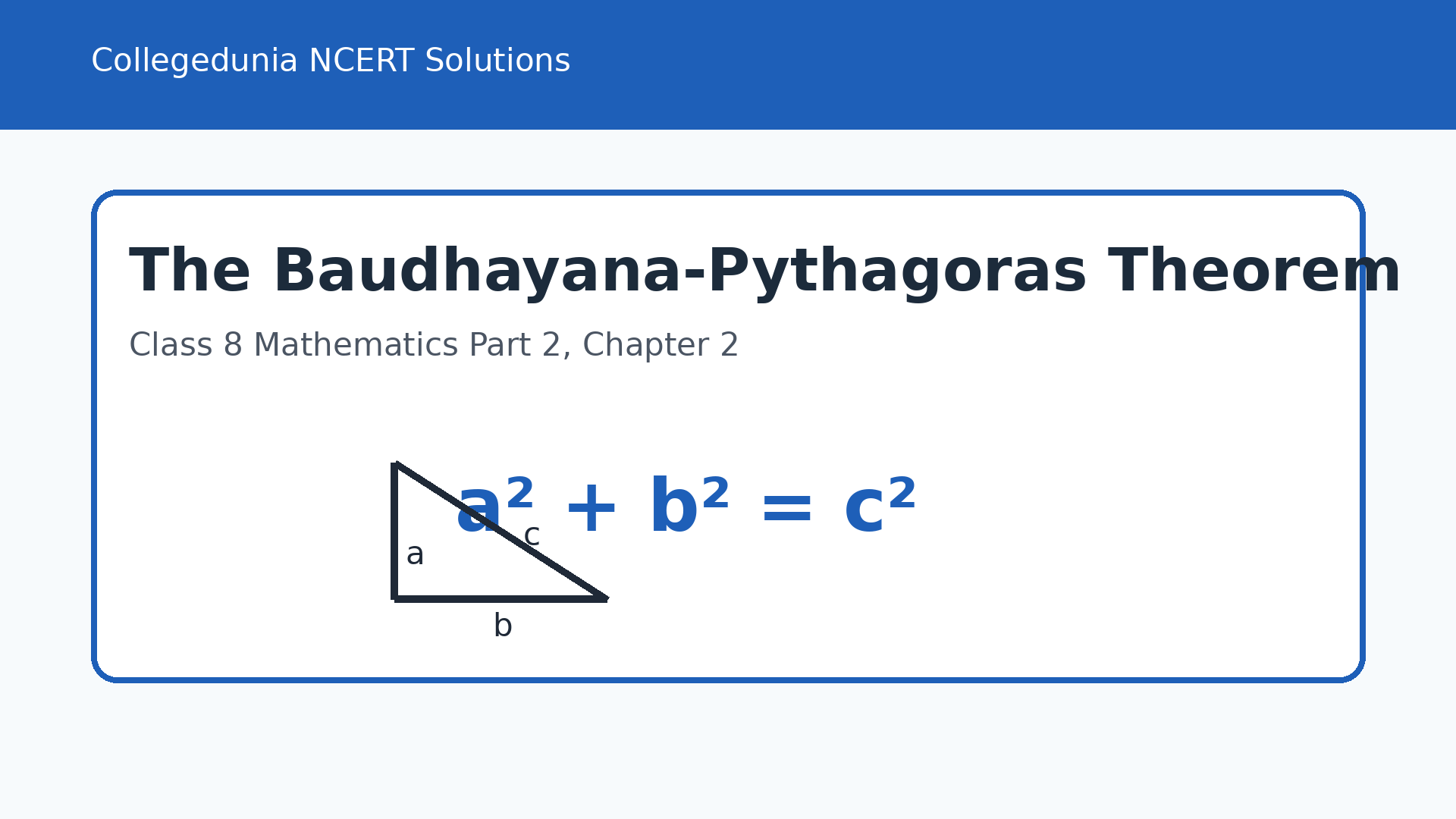
Each Class 8 Mathematics Part 2 Chapter 2 solution is matched with the official NCERT question and checked for the 2026-27 syllabus.
The Baudhayana-Pythagoras Theorem Class 8 Solutions PDF Highlights
The chapter teaches students how area and length connect in a right triangle. Students first see that a square on the diagonal doubles area, then use the same idea to prove and apply a2+b2=c2.
- Square doubling: diagonal of a square creates a square of double area.
- Missing sides: use addition or subtraction of squares.
- Integer triples: recognise triples such as 3, 4, 5 and 5, 12, 13.
The Baudhayana-Pythagoras Theorem Class 8 Video
Source: YouTube
Baudhayan-Pythagoras Theorem Formula Used
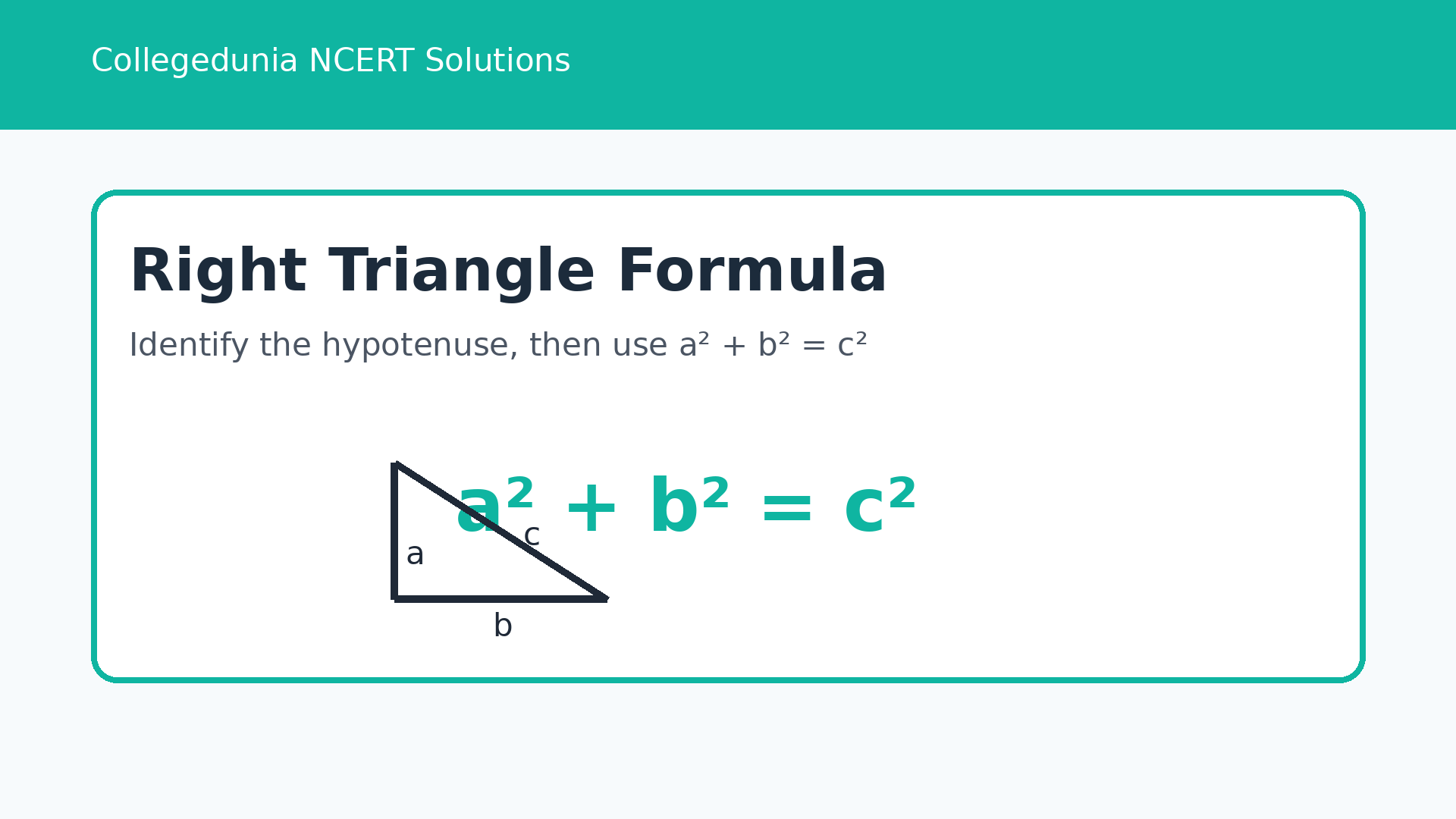
The main formula is a2+b2=c2, where c is the hypotenuse. If both shorter sides are known, add their squares. If the hypotenuse and one shorter side are known, subtract squares.
Step-by-Step Method for The Baudhayana-Pythagoras Theorem Problems
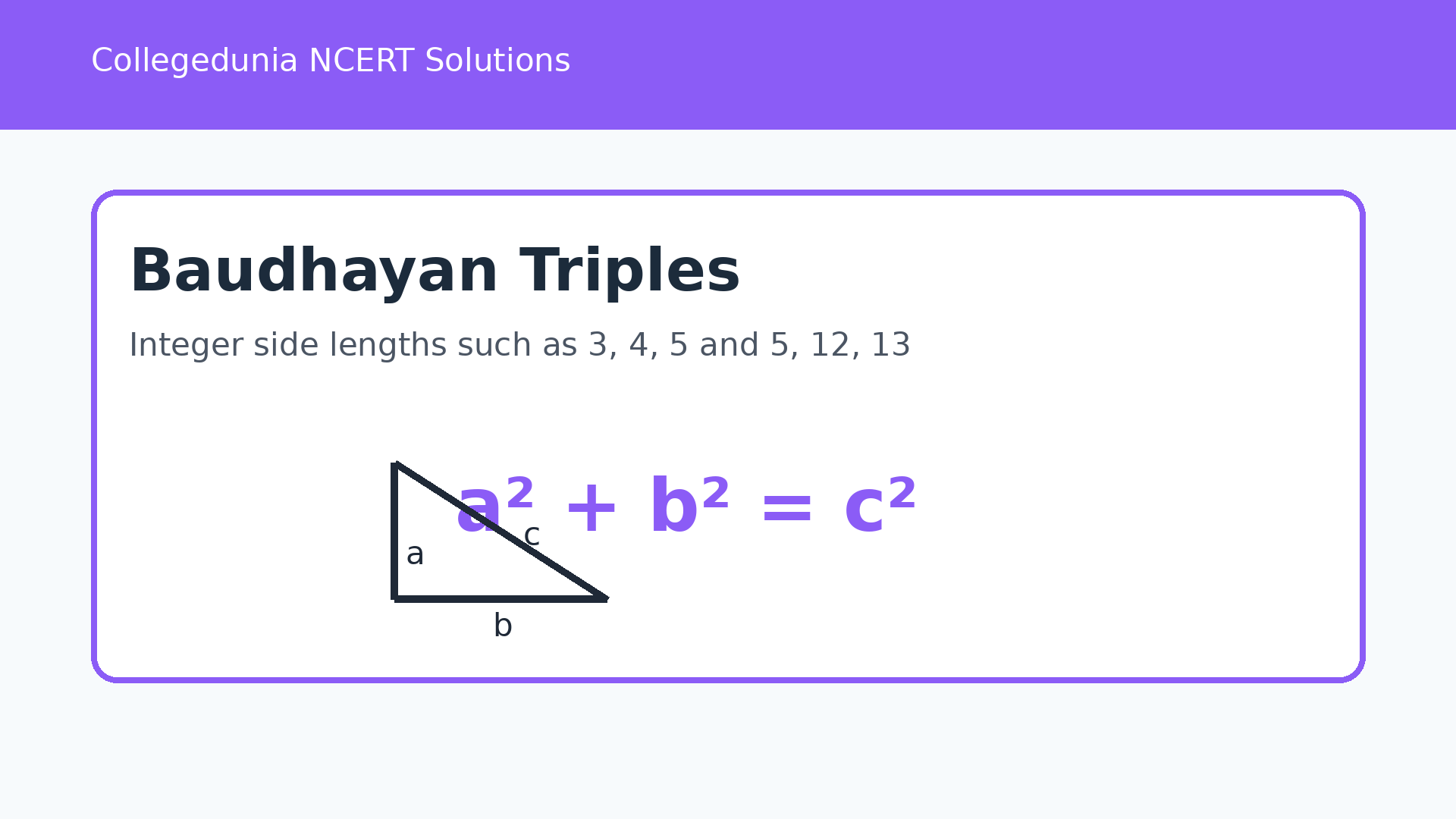
Every problem should start with the right angle. Once the hypotenuse is identified, the equation becomes direct. The PDF uses this same order for square diagonals, rhombus diagonals, grid-square areas, and equilateral triangle height.
The Baudhayana-Pythagoras Theorem Exercise Coverage
| Section | What students practise |
|---|---|
| Doubling and Halving Squares | Area reasoning with square diagonals and paper constructions. |
| Right Triangles | Hypotenuse, missing legs, and square-root answers. |
| Baudhayan Triples | Primitive triples, scaled triples, and integer rectangles. |
| Applications | Rhombus sides, grid squares, and equilateral triangle area. |
Student Feedback on The Baudhayana-Pythagoras Theorem Solutions
What 10,920 students told us about this geometry chapter: many students found missing-side questions easier after marking the hypotenuse first.
Source: 2026-27 Class 8 Mathematics student poll. Sample of 10,920 students from CBSE schools across India.
Class 8 Mathematics Part 2 Related Resources
| Resource | Use |
|---|---|
| The Baudhayana-Pythagoras Theorem Notes | Revise concepts before solving the PDF. |
| The Baudhayana-Pythagoras Theorem NCERT Book PDF | Read the official textbook chapter. |
| The Baudhayana-Pythagoras Theorem Handwritten Notes | Use quick notes for last-day revision. |
All Class 8 Mathematics Part 2 NCERT Solutions Chapters
| Chapter | NCERT Solutions |
|---|---|
| Chapter 1 | Fractions in Disguise NCERT Solutions |
| Chapter 2 | The Baudhayana-Pythagoras Theorem NCERT Solutions |
| Chapter 3 | Proportional Reasoning 2 NCERT Solutions |
All NCERT Solutions for Class 8 Mathematics Chapter 2 The Baudhayana-Pythagoras Theorem with Step-by-Step Solutions
All 19 solved questions are available in the companion question set. Use it to open one question at a time and compare the regular solution with the expert solution.
- Check Solution: direct working and final answer.
- Expert Solution: a second route with explanation.
- MathJax support: square roots and formulas render cleanly.
| Question Set | Open |
|---|---|
| The Baudhayana-Pythagoras Theorem all solved questions | Open question-wise NCERT Solutions |
The Baudhayana-Pythagoras Theorem Class 8 Mathematics NCERT Solutions FAQs
Ques. What is the main formula in The Baudhayana-Pythagoras Theorem?
Ans. The main formula is a squared plus b squared equals c squared for a right triangle.
Ques. How many questions are solved in this PDF?
Ans. The PDF solves all 19 Figure it Out questions from the chapter.
Ques. How do you find the side of a rhombus from its diagonals?
Ans. Halve both diagonals and use the theorem on the right triangle formed by those halves.



Comments