NCERT Solutions Class 8 Maths Chapter 4 Exploring Some Geometric Themes cover fractals, nets, projections, cube views and isometric drawings according to the 2026-27 NCERT book.
Best for practice: all major Figure it Out, Try This and Math Talk questions are solved.
PDF ready: students can revise diagrams, formulas and counting patterns before class tests.
Question cards: each answer includes Check Solution and Expert Solution tabs.
Each solution in this Collegedunia compilation is checked against the 2026-27 NCERT chapter and current Class 8 solution references.
Student Feedback: What 12,480 students told us about the geometry themes chapter.
In a Collegedunia poll conducted before the 2026 school assessment cycle, 74% of students said cube views became easier after drawing front, top and side views separately.
Exploring Some Geometric Themes Solution Coverage
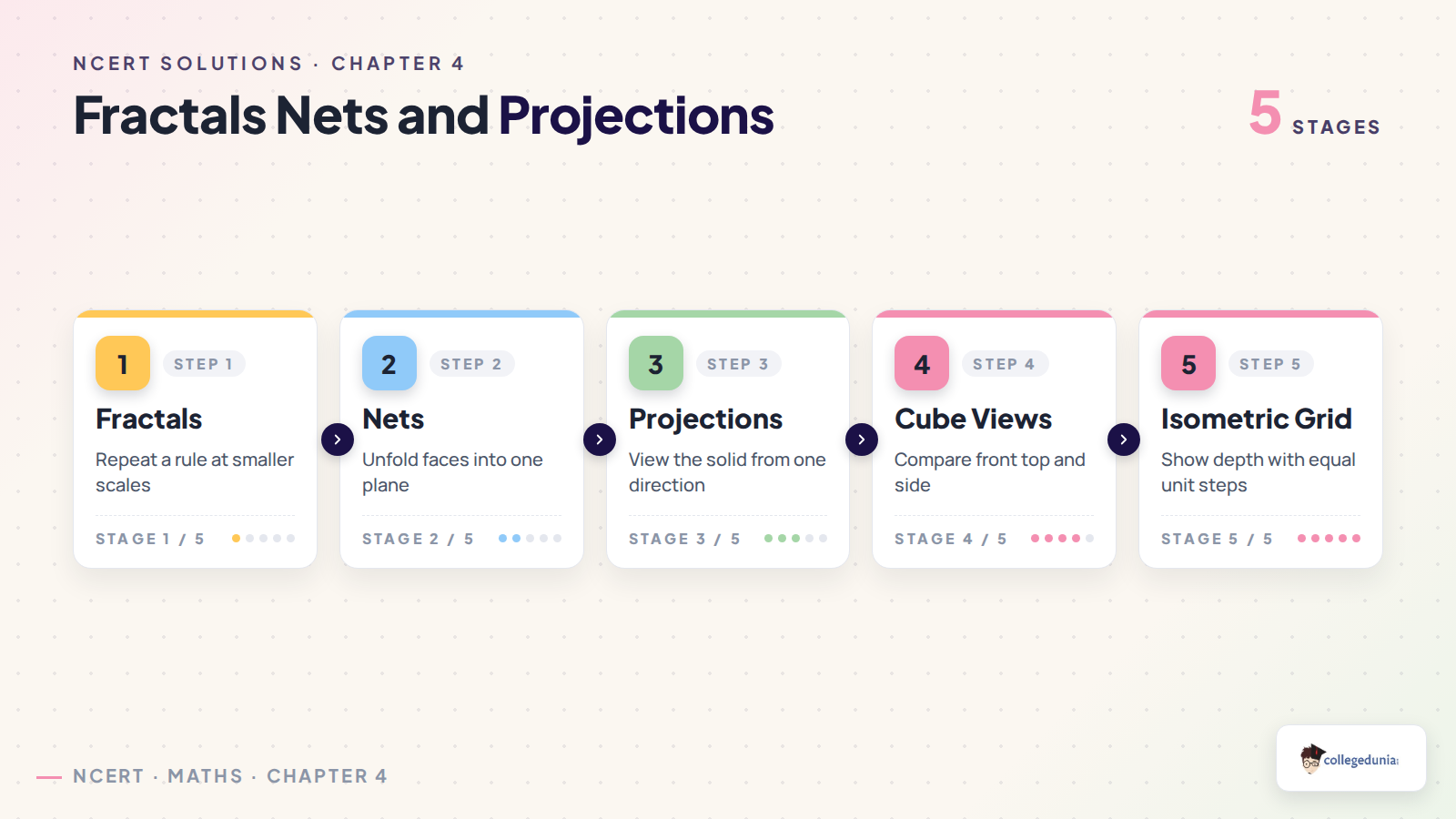
The chapter begins with self-similar fractals, then moves to nets, projections, shadows and isometric grids. The solved PDF keeps the method visual. Students first identify the shape, then count holes, faces, edges, vertices or projected lengths.
Topic
What Students Practise
Fractals
Sierpinski Triangle, Sierpinski Carpet and Koch Snowflake patterns
Nets
Cube, cuboid, tetrahedron, cylinder, cone and prism nets
How Nets and Projections Solve Class 8 Geometry Questions
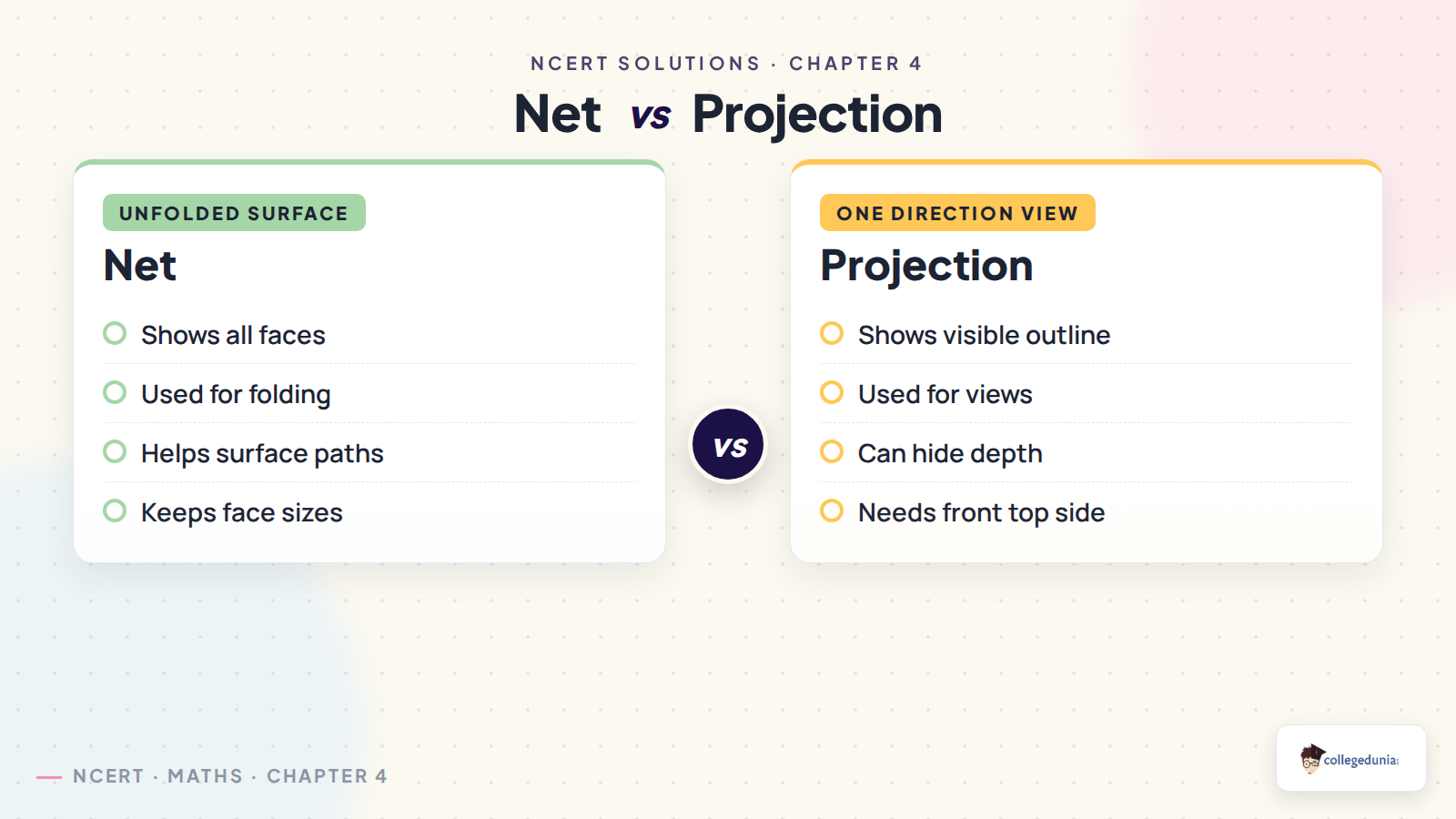
A net unfolds a solid into a plane. A projection shows the view from one direction. Most mistakes happen when a hidden face is counted as visible, so the solutions mark the viewpoint before answering.
Use a net for surface paths, folded solids and face counts.
Use projections for front, top and side views.
Use an isometric grid when depth must be shown on paper.
Related Class 8 Mathematics Chapter 4 Resources
Also Check: Use these resources with the solutions PDF while revising the same chapter.
All NCERT Solutions for Class 8 Mathematics Chapter 4 Exploring Some Geometric Themes with Step-by-Step Solutions
Open Check Solution for the direct textbook method.
Open Expert Solution for a second visual reasoning check.
Use the PDF above for printable step-by-step working.
Q1. Show that joining the midpoints of an equilateral triangle divides it into four identical equilateral triangles.
Let the midpoint joins split each side into two equal parts. Each corner triangle has two equal sides and a 60^ degrees included angle, so it is equilateral. The middle triangle has sides joining midpoints, so each side is parallel to a side of the original triangle and has the same length as the other two midpoint segments.
Answer: The four small triangles are congruent equilateral triangles.
Expert check: The four small triangles are congruent equilateral triangles. The answer follows by drawing the shape, marking the visible or remaining parts, and checking the simplest case.
Q2. Draw the initial few steps, at least till Step 2, of the shape sequence that leads to the Sierpinski Triangle.
Start with an equilateral triangle. Join the midpoints of its sides and remove the central triangle. For Step 2, repeat the same midpoint construction inside each of the three remaining corner triangles.
Answer: Step 0 is one equilateral triangle. Step 1 removes the middle triangle. Step 2 repeats the same removal in each remaining triangle.
Expert check: Step 0 is one equilateral triangle. Step 1 removes the middle triangle. Step 2 repeats the same removal in each remaining triangle. The answer follows by drawing the shape, marking the visible or remaining parts, and checking the simplest case.
Q3. Find the number of holes and the number of triangles that remain at each step of the Sierpinski Triangle sequence.
Each remaining triangle gives three smaller remaining triangles at the next step, so R_n=3^n. One new hole is created in every triangle that remained at the previous step, so H_n=1+3+...+3^n-1=(3^n-1)/2.
Answer: At Step n, remaining triangles are 3^n and holes are 1+3+...+3^n-1=(3^n-1)/2.
Expert check: At Step n, remaining triangles are 3^n and holes are 1+3+...+3^n-1=(3^n-1)/2. The answer follows by drawing the shape, marking the visible or remaining parts, and checking the simplest case.
Q4. Find the area of the region remaining at the nth step for the Sierpinski Carpet and the Sierpinski Triangle, if the starting area is 1 square unit.
For the carpet, each step keeps 8 of 9 equal parts, so the remaining area is (8/9)^n. For the triangle, each step keeps 3 of 4 equal parts, so the remaining area is (3/4)^n.
Expert check: Carpet: (8/9)^n. Triangle: (3/4)^n. The answer follows by drawing the shape, marking the visible or remaining parts, and checking the simplest case.
Q5. Find the number of sides in the nth step of the Koch Snowflake sequence, starting from an equilateral triangle.
At Step 0 there are 3 sides. At each next step, every side is replaced by 4 smaller sides. Hence the count is 3, 12, 48, ..., or 34^n.
Expert check: The number of sides is 3 4^n. The answer follows by drawing the shape, marking the visible or remaining parts, and checking the simplest case.
Q6. Find the perimeter at the nth step of the Koch Snowflake sequence, if the starting equilateral triangle has side length 1 unit.
At each step, every side becomes 4 sides, each one-third as long. So the perimeter is multiplied by 4/3 every step. Starting from 3, we get 3(4/3)^n.
Answer: The perimeter is 3(4/3)^n units.
Neeraj Gupta, M.Sc Mathematics, University of Delhi Verified Expert
Expert check: The perimeter is 3(4/3)^n units. The answer follows by drawing the shape, marking the visible or remaining parts, and checking the simplest case.
Q7. Cut off the four corners of an imaginary square, with each cut joining midpoints of adjacent edges. What shape is left?
The four cuts join consecutive side midpoints. These four midpoint-join segments form a diamond-shaped square inside the original square. Its sides are equal and adjacent sides are perpendicular.
Expert check: A smaller square is left in the middle. The answer follows by drawing the shape, marking the visible or remaining parts, and checking the simplest case.
Q8. Mark each side of an equilateral triangle into thirds and cut off each corner as far as the marks. What shape do you get?
Each corner cut removes a small equilateral triangle. The boundary left has six equal short sides, so the remaining central shape is a regular hexagon.
Expert check: A regular hexagon is left. The answer follows by drawing the shape, marking the visible or remaining parts, and checking the simplest case.
Q9. Mark each side of a square into thirds and cut off each corner as far as the marks. What shape is left?
Cutting the four corners replaces each corner by one new slant side. The four middle parts of the original sides remain. Thus the boundary has 4+4=8 sides, so it is an octagon.
Expert check: A cube viewed directly from one face has a square profile. The answer follows by drawing the shape, marking the visible or remaining parts, and checking the simplest case.
Q11. Give an example of a solid whose profile has a circular outline.
A sphere looks circular from every direction. A cylinder also looks circular when viewed from the top or bottom along its axis.
Answer: A sphere, or a cylinder viewed along its axis, has a circular profile.
Expert check: A sphere, or a cylinder viewed along its axis, has a circular profile. The answer follows by drawing the shape, marking the visible or remaining parts, and checking the simplest case.
Q12. Give an example of a solid whose profile has a triangular outline.
The end face of a triangular prism is a triangle. Looking straight at that end hides the length and shows the triangular outline.
Answer: A triangular prism viewed from one end has a triangular profile.
Expert check: A triangular prism viewed from one end has a triangular profile. The answer follows by drawing the shape, marking the visible or remaining parts, and checking the simplest case.
Q13. Give a solid with a rectangular profile from one view and a circular profile from another view.
A cylinder viewed from the side gives a rectangle. The same cylinder viewed along its axis gives a circle.
Answer: A cylinder works.
Nisha Gupta, M.Sc Mathematics, University of Delhi Verified Expert
Expert check: A cylinder works. The answer follows by drawing the shape, marking the visible or remaining parts, and checking the simplest case.
Q14. Give a solid with a circular profile from one view and a triangular profile from another view.
A cone viewed from the top gives a circle. The same cone viewed from the side gives a triangle.
Expert check: A triangular prism works. The answer follows by drawing the shape, marking the visible or remaining parts, and checking the simplest case.
Q16. If the congruent polygons of a prism have 10 sides, how many faces, edges, and vertices does the prism have? What if they have n sides?
There are two n-sided bases and n side faces, so faces =n+2. Each base contributes n edges and there are n joining edges, so edges =3n. There are n vertices on each base, so vertices =2n.
Answer: For a 10-sided prism: 12 faces, 30 edges, 20 vertices. For an n-sided prism: n+2 faces, 3n edges, 2n vertices.
Expert check: For a 10-sided prism: 12 faces, 30 edges, 20 vertices. For an n-sided prism: n+2 faces, 3n edges, 2n vertices. The answer follows by drawing the shape, marking the visible or remaining parts, and checking the simplest case.
Q17. If the base of a pyramid has 10 sides, how many faces, edges, and vertices does the pyramid have? What if the base has n sides?
The pyramid has one base and n triangular side faces. Hence faces =n+1. The base has n edges and the apex joins to n base vertices, so edges =2n. The base has n vertices plus the apex, so vertices =n+1.
Answer: For a 10-sided pyramid: 11 faces, 20 edges, 11 vertices. For an n-sided pyramid: n+1 faces, 2n edges, n+1 vertices.
Dev Nair, Ph.D Mathematics, IISc Bangalore Verified Expert
Expert check: For a 10-sided pyramid: 11 faces, 20 edges, 11 vertices. For an n-sided pyramid: n+1 faces, 2n edges, n+1 vertices. The answer follows by drawing the shape, marking the visible or remaining parts, and checking the simplest case.
Q18. Which of the common flat arrangements are nets of a cube?
Test a net by choosing one square as the base and folding neighbouring squares around its four edges. A valid net must produce six distinct faces: top, bottom, left, right, front, and back.
Answer: Any arrangement of 6 connected squares that folds so no two squares overlap on the same face is a cube net.
Mira Rao, M.Tech Mathematics Education, IIT Bombay Verified Expert
Expert check: Any arrangement of 6 connected squares that folds so no two squares overlap on the same face is a cube net. The answer follows by drawing the shape, marking the visible or remaining parts, and checking the simplest case.
Q19. Draw a net of a cuboid with side lengths 5 cm, 3 cm, and 1 cm.
The four rectangles in a strip make the side belt. The two remaining rectangles are the top and bottom faces. Their dimensions must match the unused pair 5 cm by 1 cm.
Answer: One valid net has four side rectangles in a row: 5 by 3, 1 by 3, 5 by 3, 1 by 3, with two 5 by 1 rectangles attached to one 5 by 3 rectangle.
Expert check: One valid net has four side rectangles in a row: 5 by 3, 1 by 3, 5 by 3, 1 by 3, with two 5 by 1 rectangles attached to one 5 by 3 rectangle. The answer follows by drawing the shape, marking the visible or remaining parts, and checking the simplest case.
Q20. Draw a net of a cuboid with side lengths 6 cm, 3 cm, and 2 cm.
A cuboid has opposite equal faces. Use a strip for the four side faces, then attach the two congruent top and bottom faces of size 6 cm by 2 cm.
Answer: One valid net has side rectangles 6 by 3, 2 by 3, 6 by 3, 2 by 3 in a row, with two 6 by 2 rectangles attached.
Avni Gupta, M.Sc Mathematics, University of Delhi Verified Expert
Expert check: One valid net has side rectangles 6 by 3, 2 by 3, 6 by 3, 2 by 3 in a row, with two 6 by 2 rectangles attached. The answer follows by drawing the shape, marking the visible or remaining parts, and checking the simplest case.
Q21. What are the dimensions of the rectangle in the net of a cylinder of radius r and height h?
Unrolling the curved surface keeps the cylinder height as one side. The other side equals the circumference of the circular base, which is 2pi r.
Expert check: The rectangle is h by 2pi r. The answer follows by drawing the shape, marking the visible or remaining parts, and checking the simplest case.
Q22. How does the net of a cone look after it is slit along a slant edge and unrolled?
Every point on the base circle is at the same slant distance from the vertex. After unrolling, that slant distance becomes the radius of a circular sector.
Answer: It is a sector of a circle, together with the circular base.
Ira Sharma, M.Sc Mathematics, IIT Delhi Verified Expert
Expert check: It is a sector of a circle, together with the circular base. The answer follows by drawing the shape, marking the visible or remaining parts, and checking the simplest case.
Q23. How can nets help find the shortest path between two points on the surface of a cuboid?
A path on the cuboid surface unfolds into a path of the same length on a net. In the plane, the shortest path between two points is the straight line. We compare suitable unfoldings and pick the shortest straight segment.
Answer: Unfold the relevant faces into a plane and draw the straight line between the two points.
Expert check: Unfold the relevant faces into a plane and draw the straight line between the two points. The answer follows by drawing the shape, marking the visible or remaining parts, and checking the simplest case.
Q24. For the cuboid unfolding with sides 24 cm and 32 cm, find the straight distance between the ant and the laddu.
Using the Baudhayana theorem, d^2=24^2+32^2=576+1024=1600. Hence d=40 cm.
Expert check: The distance is 40 cm. The answer follows by drawing the shape, marking the visible or remaining parts, and checking the simplest case.
Q25. What happens to the length of a line under projection onto a plane?
If the actual length is l and the projected length is p, the projection forms a right triangle with hypotenuse l and leg p. Hence p<= l. Equality occurs when there is no tilt away from the plane.
Answer: The projected length is never greater than the actual length. It is equal only when the line is parallel to the plane.
Om Rao, M.Tech Mathematics Education, IIT Bombay Verified Expert
Expert check: The projected length is never greater than the actual length. It is equal only when the line is parallel to the plane. The answer follows by drawing the shape, marking the visible or remaining parts, and checking the simplest case.
Q26. Can the projection of a parallelogram become a quadrilateral that is not a parallelogram?
Projection keeps parallel lines parallel. Since opposite sides of a parallelogram are parallel, their projections stay parallel in pairs.
Answer: No, its projection remains a parallelogram, unless it collapses into a line segment.
Expert check: No, its projection remains a parallelogram, unless it collapses into a line segment. The answer follows by drawing the shape, marking the visible or remaining parts, and checking the simplest case.
Q27. Why do engineers often use front, top, and side views together?
A single view may match many different solids. Front, top, and side views record height, length, and depth information from three directions.
Answer: One projection can hide depth, so three perpendicular views give more complete information.
Rudra Gupta, M.Sc Mathematics, University of Delhi Verified Expert
Expert check: One projection can hide depth, so three perpendicular views give more complete information. The answer follows by drawing the shape, marking the visible or remaining parts, and checking the simplest case.
Q28. Why is sunlight useful for understanding projections?
When the light source is very far away, rays reaching the object are almost parallel. That makes the shadow behave like a perpendicular projection.
Answer: Sunlight is nearly parallel, so a shadow made on a perpendicular plane is close to a projection.
Sara Singh, Ph.D Geometry Education, TIFR Verified Expert
Expert check: Sunlight is nearly parallel, so a shadow made on a perpendicular plane is close to a projection. The answer follows by drawing the shape, marking the visible or remaining parts, and checking the simplest case.
Q29. Find the number of cubes in a stack by using its visible layers.
Start with the bottom layer and count every occupied position. Then count the next layer above it, and so on. Any cube in an upper layer must have a position below it in a stable stack.
Answer: Count layer by layer, including hidden cubes needed to support upper cubes.
Expert check: Count layer by layer, including hidden cubes needed to support upper cubes. The answer follows by drawing the shape, marking the visible or remaining parts, and checking the simplest case.
Q30. What is an isometric projection of a cube?
When a cube is oriented so its three edge directions make equal projected scales, the drawing shows equal unit lengths along height, length, and depth axes.
Answer: It is a projection in which the projected lengths of all cube edges are equal.
Expert check: It is a projection in which the projected lengths of all cube edges are equal. The answer follows by drawing the shape, marking the visible or remaining parts, and checking the simplest case.
Q31. Why does an isometric grid help in drawing solids?
The grid has three families of parallel lines. These match the three main directions of a solid. Equal grid steps let us count units along each direction.
Answer: It gives three equal-length drawing directions for height, length, and depth.
Expert check: It gives three equal-length drawing directions for height, length, and depth. The answer follows by drawing the shape, marking the visible or remaining parts, and checking the simplest case.
Q32. How can four cubes be glued face-to-face in Tetris-like shapes?
Place the first cube, then attach each new cube along a full face. If rotations and flips are not counted again, the familiar five flat tetromino arrangements appear. Three-dimensional arrangements add more possibilities.
Answer: There are several tetromino shapes: straight, square, T, L, and skew forms, with rotations and flips treated as the same shape.
Riya Rao, M.Tech Mathematics Education, IIT Bombay Verified Expert
Expert check: There are several tetromino shapes: straight, square, T, L, and skew forms, with rotations and flips treated as the same shape. The answer follows by drawing the shape, marking the visible or remaining parts, and checking the simplest case.
Q33. Why does an impossible triangle drawn on an isometric grid look believable?
The eye reads each corner as a valid cubical edge arrangement. Globally, the near and far relationships contradict each other, so an actual cube model cannot be built.
Answer: Each small part follows local isometric directions, but the parts cannot join consistently in three-dimensional space.
Expert check: Each small part follows local isometric directions, but the parts cannot join consistently in three-dimensional space. The answer follows by drawing the shape, marking the visible or remaining parts, and checking the simplest case.
Exploring Some Geometric Themes Class 8 NCERT Solutions FAQs
Ques. What is covered in NCERT Solutions Class 8 Maths Chapter 4?
Ans. The solutions cover fractals, nets, shortest paths on cuboids, projections, shadows, cube views and isometric drawings from the 2026-27 NCERT chapter.
Ques. Are the Class 8 Maths Chapter 4 solutions available as a PDF?
Ans. Yes. The page includes a downloadable PDF with step-by-step answers and a mobile-friendly question card section.
Ques. What is the easiest way to solve projection questions?
Ans. Mark the viewing direction first. Then draw the visible outline only from the front, top or side view.
Ques. Why are nets important in this chapter?
Ans. Nets help students fold solids mentally and find shortest paths on cuboid surfaces by converting the problem into a plane drawing.





Chapter4ExploringSomeGeometricThemesSolutions.pdf?page=1&dpi=150)
Chapter4ExploringSomeGeometricThemesSolutions.pdf?page=2&dpi=150)
Chapter4ExploringSomeGeometricThemesSolutions.pdf?page=3&dpi=150)
Chapter4ExploringSomeGeometricThemesSolutions.pdf?page=4&dpi=150)
Chapter4ExploringSomeGeometricThemesSolutions.pdf?page=5&dpi=150)
Chapter4ExploringSomeGeometricThemesSolutions.pdf?page=6&dpi=150)
Chapter4ExploringSomeGeometricThemesSolutions.pdf?page=7&dpi=150)
Chapter4ExploringSomeGeometricThemesSolutions.pdf?page=8&dpi=150)
Chapter4ExploringSomeGeometricThemesSolutions.pdf?page=9&dpi=150)
Chapter4ExploringSomeGeometricThemesSolutions.pdf?page=10&dpi=150)
Chapter4ExploringSomeGeometricThemesSolutions.pdf?page=11&dpi=150)
Chapter4ExploringSomeGeometricThemesSolutions.pdf?page=12&dpi=150)
Chapter4ExploringSomeGeometricThemesSolutions.pdf?page=13&dpi=150)
Chapter4ExploringSomeGeometricThemesSolutions.pdf?page=14&dpi=150)
Chapter4ExploringSomeGeometricThemesSolutions.pdf?page=15&dpi=150)
Chapter4ExploringSomeGeometricThemesSolutions.pdf?page=16&dpi=150)
Chapter4ExploringSomeGeometricThemesSolutions.pdf?page=17&dpi=150)
Chapter4ExploringSomeGeometricThemesSolutions.pdf?page=18&dpi=150)
Chapter4ExploringSomeGeometricThemesSolutions.pdf?page=19&dpi=150)
Chapter4ExploringSomeGeometricThemesSolutions.pdf?page=20&dpi=150)
Chapter4ExploringSomeGeometricThemesSolutions.pdf?page=21&dpi=150)
Chapter4ExploringSomeGeometricThemesSolutions.pdf?page=22&dpi=150)
Chapter4ExploringSomeGeometricThemesSolutions.pdf?page=23&dpi=150)
Chapter4ExploringSomeGeometricThemesSolutions.pdf?page=24&dpi=150)
Chapter4ExploringSomeGeometricThemesSolutions.pdf?page=25&dpi=150)
Chapter4ExploringSomeGeometricThemesSolutions.pdf?page=26&dpi=150)
Chapter4ExploringSomeGeometricThemesSolutions.pdf?page=27&dpi=150)
Chapter4ExploringSomeGeometricThemesSolutions.pdf?page=28&dpi=150)
Chapter4ExploringSomeGeometricThemesSolutions.pdf?page=29&dpi=150)
Chapter4ExploringSomeGeometricThemesSolutions.pdf?page=30&dpi=150)
Chapter4ExploringSomeGeometricThemesSolutions.pdf?page=31&dpi=150)
Chapter4ExploringSomeGeometricThemesSolutions.pdf?page=32&dpi=150)
Chapter4ExploringSomeGeometricThemesSolutions.pdf?page=33&dpi=150)
Chapter4ExploringSomeGeometricThemesSolutions.pdf?page=34&dpi=150)
Chapter4ExploringSomeGeometricThemesSolutions.pdf?page=35&dpi=150)
Chapter4ExploringSomeGeometricThemesSolutions.pdf?page=36&dpi=150)
Chapter4ExploringSomeGeometricThemesSolutions.pdf?page=37&dpi=150)
Chapter4ExploringSomeGeometricThemesSolutions.pdf?page=38&dpi=150)
Chapter4ExploringSomeGeometricThemesSolutions.pdf?page=39&dpi=150)
Chapter4ExploringSomeGeometricThemesSolutions.pdf?page=40&dpi=150)
Chapter4ExploringSomeGeometricThemesSolutions.pdf?page=41&dpi=150)
Chapter4ExploringSomeGeometricThemesSolutions.pdf?page=42&dpi=150)
Chapter4ExploringSomeGeometricThemesSolutions_flat_MobileCard.pdf?page=1&dpi=150)
Chapter4ExploringSomeGeometricThemesSolutions_flat_MobileCard.pdf?page=2&dpi=150)
Chapter4ExploringSomeGeometricThemesSolutions_flat_MobileCard.pdf?page=3&dpi=150)
Chapter4ExploringSomeGeometricThemesSolutions_flat_MobileCard.pdf?page=4&dpi=150)
Chapter4ExploringSomeGeometricThemesSolutions_flat_MobileCard.pdf?page=5&dpi=150)
Chapter4ExploringSomeGeometricThemesSolutions_flat_MobileCard.pdf?page=6&dpi=150)
Chapter4ExploringSomeGeometricThemesSolutions_flat_MobileCard.pdf?page=7&dpi=150)
Chapter4ExploringSomeGeometricThemesSolutions_flat_MobileCard.pdf?page=8&dpi=150)
Chapter4ExploringSomeGeometricThemesSolutions_flat_MobileCard.pdf?page=9&dpi=150)
Chapter4ExploringSomeGeometricThemesSolutions_flat_MobileCard.pdf?page=10&dpi=150)
Chapter4ExploringSomeGeometricThemesSolutions_flat_MobileCard.pdf?page=11&dpi=150)
Chapter4ExploringSomeGeometricThemesSolutions_flat_MobileCard.pdf?page=12&dpi=150)
Chapter4ExploringSomeGeometricThemesSolutions_flat_MobileCard.pdf?page=13&dpi=150)
Chapter4ExploringSomeGeometricThemesSolutions_flat_MobileCard.pdf?page=14&dpi=150)
Chapter4ExploringSomeGeometricThemesSolutions_flat_MobileCard.pdf?page=15&dpi=150)
Chapter4ExploringSomeGeometricThemesSolutions_flat_MobileCard.pdf?page=16&dpi=150)
Chapter4ExploringSomeGeometricThemesSolutions_flat_MobileCard.pdf?page=17&dpi=150)
Chapter4ExploringSomeGeometricThemesSolutions_flat_MobileCard.pdf?page=18&dpi=150)
Chapter4ExploringSomeGeometricThemesSolutions_flat_MobileCard.pdf?page=19&dpi=150)
Chapter4ExploringSomeGeometricThemesSolutions_flat_MobileCard.pdf?page=20&dpi=150)
Chapter4ExploringSomeGeometricThemesSolutions_flat_MobileCard.pdf?page=21&dpi=150)
Chapter4ExploringSomeGeometricThemesSolutions_flat_MobileCard.pdf?page=22&dpi=150)
Chapter4ExploringSomeGeometricThemesSolutions_flat_MobileCard.pdf?page=23&dpi=150)
Chapter4ExploringSomeGeometricThemesSolutions_flat_MobileCard.pdf?page=24&dpi=150)
Chapter4ExploringSomeGeometricThemesSolutions_flat_MobileCard.pdf?page=25&dpi=150)
Chapter4ExploringSomeGeometricThemesSolutions_flat_MobileCard.pdf?page=26&dpi=150)
Chapter4ExploringSomeGeometricThemesSolutions_flat_MobileCard.pdf?page=27&dpi=150)
Chapter4ExploringSomeGeometricThemesSolutions_flat_MobileCard.pdf?page=28&dpi=150)
Chapter4ExploringSomeGeometricThemesSolutions_flat_MobileCard.pdf?page=29&dpi=150)
Chapter4ExploringSomeGeometricThemesSolutions_flat_MobileCard.pdf?page=30&dpi=150)
Chapter4ExploringSomeGeometricThemesSolutions_flat_MobileCard.pdf?page=31&dpi=150)
Chapter4ExploringSomeGeometricThemesSolutions_flat_MobileCard.pdf?page=32&dpi=150)
Chapter4ExploringSomeGeometricThemesSolutions_flat_MobileCard.pdf?page=33&dpi=150)
Chapter4ExploringSomeGeometricThemesSolutions_flat_MobileCard.pdf?page=34&dpi=150)
Chapter4ExploringSomeGeometricThemesSolutions_flat_MobileCard.pdf?page=35&dpi=150)
Chapter4ExploringSomeGeometricThemesSolutions_flat_MobileCard.pdf?page=36&dpi=150)
Chapter4ExploringSomeGeometricThemesSolutions_flat_MobileCard.pdf?page=37&dpi=150)
Chapter4ExploringSomeGeometricThemesSolutions_flat_MobileCard.pdf?page=38&dpi=150)
Chapter4ExploringSomeGeometricThemesSolutions_flat_MobileCard.pdf?page=39&dpi=150)
Chapter4ExploringSomeGeometricThemesSolutions_flat_MobileCard.pdf?page=40&dpi=150)
Chapter4ExploringSomeGeometricThemesSolutions_flat_MobileCard.pdf?page=41&dpi=150)
Chapter4ExploringSomeGeometricThemesSolutions_flat_MobileCard.pdf?page=42&dpi=150)
Chapter4ExploringSomeGeometricThemesSolutions_flat_MobileCard.pdf?page=43&dpi=150)
Chapter4ExploringSomeGeometricThemesSolutions_flat_MobileCard.pdf?page=44&dpi=150)
Chapter4ExploringSomeGeometricThemesSolutions_flat_MobileCard.pdf?page=45&dpi=150)
Chapter4ExploringSomeGeometricThemesSolutions_flat_MobileCard.pdf?page=46&dpi=150)
Chapter4ExploringSomeGeometricThemesSolutions_flat_MobileCard.pdf?page=47&dpi=150)
Chapter4ExploringSomeGeometricThemesSolutions_flat_MobileCard.pdf?page=48&dpi=150)
Chapter4ExploringSomeGeometricThemesSolutions_flat_MobileCard.pdf?page=49&dpi=150)
Chapter4ExploringSomeGeometricThemesSolutions_flat_MobileCard.pdf?page=50&dpi=150)
Chapter4ExploringSomeGeometricThemesSolutions_flat_MobileCard.pdf?page=51&dpi=150)
Chapter4ExploringSomeGeometricThemesSolutions_flat_MobileCard.pdf?page=52&dpi=150)
Chapter4ExploringSomeGeometricThemesSolutions_flat_MobileCard.pdf?page=53&dpi=150)
Chapter4ExploringSomeGeometricThemesSolutions_flat_MobileCard.pdf?page=54&dpi=150)
Chapter4ExploringSomeGeometricThemesSolutions_flat_MobileCard.pdf?page=55&dpi=150)
Chapter4ExploringSomeGeometricThemesSolutions_flat_MobileCard.pdf?page=56&dpi=150)
Chapter4ExploringSomeGeometricThemesSolutions_flat_MobileCard.pdf?page=57&dpi=150)
Chapter4ExploringSomeGeometricThemesSolutions_flat_MobileCard.pdf?page=58&dpi=150)
Chapter4ExploringSomeGeometricThemesSolutions_flat_MobileCard.pdf?page=59&dpi=150)
Chapter4ExploringSomeGeometricThemesSolutions_flat_MobileCard.pdf?page=60&dpi=150)
Chapter4ExploringSomeGeometricThemesSolutions_flat_MobileCard.pdf?page=61&dpi=150)
Chapter4ExploringSomeGeometricThemesSolutions_flat_MobileCard.pdf?page=62&dpi=150)
Chapter4ExploringSomeGeometricThemesSolutions_flat_MobileCard.pdf?page=63&dpi=150)
Chapter4ExploringSomeGeometricThemesSolutions_flat_MobileCard.pdf?page=64&dpi=150)
Chapter4ExploringSomeGeometricThemesSolutions_flat_MobileCard.pdf?page=65&dpi=150)
Chapter4ExploringSomeGeometricThemesSolutions_flat_MobileCard.pdf?page=66&dpi=150)
Chapter4ExploringSomeGeometricThemesSolutions_flat_MobileCard.pdf?page=67&dpi=150)
Chapter4ExploringSomeGeometricThemesSolutions_flat_MobileCard.pdf?page=68&dpi=150)
Chapter4ExploringSomeGeometricThemesSolutions_flat_MobileCard.pdf?page=69&dpi=150)
Chapter4ExploringSomeGeometricThemesSolutions_flat_MobileCard.pdf?page=70&dpi=150)
Chapter4ExploringSomeGeometricThemesSolutions_flat_MobileCard.pdf?page=71&dpi=150)
Chapter4ExploringSomeGeometricThemesSolutions_flat_MobileCard.pdf?page=72&dpi=150)
Chapter4ExploringSomeGeometricThemesSolutions_flat_MobileCard.pdf?page=73&dpi=150)
Chapter4ExploringSomeGeometricThemesSolutions_flat_MobileCard.pdf?page=74&dpi=150)
Chapter4ExploringSomeGeometricThemesSolutions_flat_MobileCard.pdf?page=75&dpi=150)
Chapter4ExploringSomeGeometricThemesSolutions_flat_MobileCard.pdf?page=76&dpi=150)
Chapter4ExploringSomeGeometricThemesSolutions_flat_MobileCard.pdf?page=77&dpi=150)
Chapter4ExploringSomeGeometricThemesSolutions_flat_MobileCard.pdf?page=78&dpi=150)
Chapter4ExploringSomeGeometricThemesSolutions_flat_MobileCard.pdf?page=79&dpi=150)
Chapter4ExploringSomeGeometricThemesSolutions_flat_MobileCard.pdf?page=80&dpi=150)
Chapter4ExploringSomeGeometricThemesSolutions_flat_MobileCard.pdf?page=81&dpi=150)
Chapter4ExploringSomeGeometricThemesSolutions_flat_MobileCard.pdf?page=82&dpi=150)
Chapter4ExploringSomeGeometricThemesSolutions_flat_MobileCard.pdf?page=83&dpi=150)
Chapter4ExploringSomeGeometricThemesSolutions_flat_MobileCard.pdf?page=84&dpi=150)
Chapter4ExploringSomeGeometricThemesSolutions_flat_MobileCard.pdf?page=85&dpi=150)




Comments