



Study Abroad Content Specialist | Updated On - Sep 23, 2026
MS in Denmark is one of the most strategically powerful postgraduate options for Indian students targeting Europe's green technology, life sciences, and engineering sectors. Denmark is home to Vestas (world's largest wind turbine manufacturer), Ørsted (world's largest offshore wind developer), Novo Nordisk (world's most valuable European company in 2026), and A.P. Møller-Mærsk — all headquartered here and all actively recruiting MS graduates. MS in Denmark fees for non-EU students range from EUR 14,900 (INR 16.41 lakh) total at Aalborg University to EUR 34,600 (INR 38.11 lakh) total at Aarhus University for a 2-year programme. MS in Denmark requirements include a relevant bachelor's degree, IELTS 6.5, and a motivation letter — no GRE or GMAT is required at any Danish university. The Danish State Scholarship — automatically considered for every non-EU applicant — covers full tuition plus a monthly stipend of DKK 7,800/month (INR 1.15 lakh/month) for up to 22 months, making a Danish MS potentially free for the most competitive Indian applicants.
Here are the key facts before you apply:
- Top universities: University of Copenhagen (QS #90), DTU (QS #105), Aarhus University (QS #128), SDU (QS #283), Aalborg University (QS #329), Roskilde University (QS #1001 to #1200).
- Total programme fees: EUR 14,900 to EUR 34,600 (INR 16.41 to INR 38.11 lakh) for 2 years.
- Duration: 2 years (120 ECTS) at all 6 universities.
- GRE/GMAT: Not required at any Danish university.
- IELTS: 6.5 minimum at most universities; 6.0 at SDU.
- Post-study work: Up to 3 years job-seeking permit for STEM graduates — no employer sponsorship required.
- Work rights during study: Up to 20 hours/week during term; full-time during holidays.
- Autumn 2027 application deadline: January 15, 2027 at most universities.
- Spring 2027 deadline at DTU: September 15, 2026 — weeks away.
- Danish State Scholarship: Full tuition waiver plus DKK 7,800/month (INR 1.15 lakh/month) — automatically considered for all applicants.
- Healthcare: Free for all students once registered with a Danish CPR number.
Latest Updates — October 2026
- DTU Autumn 2027 portal opens December 1, 2026 — deadline is January 15, 2027 for non-EU students. Begin preparing documents now.
- UCPH, Aarhus, and most universities deadline is January 15, 2027 — portals open November to December 2026. Apply in the first week for best scholarship consideration.
- Aalborg University Spring 2027 deadline is October 15, 2026 — apply immediately if targeting a January 2027 start.
- Aarhus University Summer intake portal opens November 1, 2026 — deadline is January 15, 2027 for Autumn 2027.
- 3-year post-study job-seeking permit remains intact for graduates of state-approved programmes — all 6 universities in this guide are state-approved. This right is confirmed on nyidanmark.dk.
- New immigration rules from October 1, 2026 restrict dependents and post-study rights for students at non-state-approved institutions only — does not affect DTU, UCPH, Aarhus, SDU, Aalborg, or Roskilde students.
All fees are converted at EUR 1 = INR 110.14 and DKK 1 = INR 14.72 (August 2026).
Read More: Top 5 Countries to Study MS Abroad for Indian Students
- Why Study MS in Denmark?
- Top Universities for MS in Denmark
- Specialisations in MS in Denmark
- MS in Denmark Requirements
- MS in Denmark Fees
- Cost of Living for MS Students in Denmark
- Scholarships for MS in Denmark
- Jobs and Salary After MS in Denmark
8.1 Post-Study Work and PR Pathway
- MS in Denmark Intakes and Application Deadlines
- FAQs
Why Study MS in Denmark?
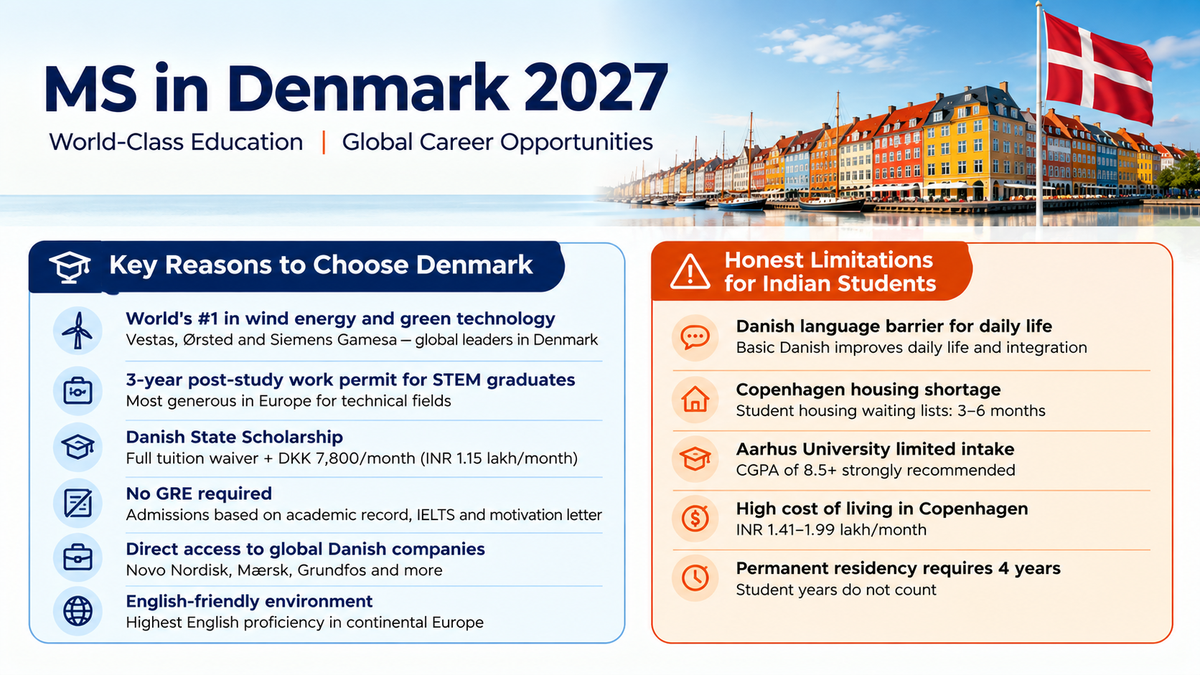
Denmark offers a unique combination of world-class research universities, direct access to global industry leaders, no GRE requirement, a 3-year post-study work permit for STEM graduates, and a Danish State Scholarship that is automatically considered for every applicant.
Key reasons to choose Denmark:
- World's #1 in wind energy and green technology: Vestas, Ørsted, and Siemens Gamesa are all headquartered in Denmark — no other country offers this combination of academic excellence and direct industry proximity in wind energy.
- 3-year post-study work permit for STEM graduates: The most generous post-study work right in Europe for technical fields — significantly more than UK (2 years), Germany (18 months), or Netherlands (1 year).
- Danish State Scholarship: Full tuition waiver plus DKK 7,800/month (INR 1.15 lakh/month) — automatically considered for every applicant with no separate application required.
- No GRE required: Admissions based on academic record, IELTS, and motivation letter — significantly more accessible than the USA.
- Free healthcare: All students receive free healthcare under the Danish public health system after CPR registration — no health insurance costs.
- Novo Nordisk, Mærsk, Grundfos: Direct access to global Danish companies with major India operations — a career advantage that studying in the USA or UK does not provide in the same way.
- India-Denmark Green Partnership: The India-Denmark Green Strategic Partnership (2020, expanded 2026) is creating a growing bilateral demand for professionals who understand both markets.
- English-friendly environment: Denmark has the highest English proficiency in continental Europe (EF EPI 2026: #3 globally) — virtually all professional interactions can be conducted in English.
Top Universities for MS in Denmark
Denmark has 6 universities offering English-taught MS programmes open to Indian students. The universities listed here are among the most well-known options, but they are not the only institutions offering MS programmes in Denmark. Indian students should explore all Danish universities based on their specific programme and career requirements.
| QS Rank 2027 | University | Location |
|---|---|---|
| #90 | University of Copenhagen (UCPH) | Copenhagen |
| #105 | Technical University of Denmark (DTU) | Kongens Lyngby |
| #128 | Aarhus University | Aarhus |
| #283 | University of Southern Denmark (SDU) | Odense |
| #329 | Aalborg University (AAU) | Aalborg |
| #1001 to #1200 | Roskilde University (RUC) | Roskilde |
Student Insight
According to Reddit discussions, Indian students from IITs and NITs consistently highlight DTU as the strongest choice for engineering and sustainability careers in Denmark. Students targeting life sciences and pharma recommend Aarhus University for its proximity to Novo Nordisk's R&D operations. Students on tighter budgets highlight Aalborg University for its low fees and strong PBL-based curriculum.
Also Read: Best Countries to Study Abroad for Indian Students
Specialisations in MS in Denmark
Denmark's MS programmes cover 6 key specialisations for Indian students. Wind Energy and Sustainable Technology is Denmark's single most unique academic offering globally — no other country offers this combination of academic excellence and direct industry proximity. Computer Science and AI is the most popular specialisation for Indian students, with strong demand from Denmark's growing tech ecosystem.
| Specialisation | Best Universities | Target Roles |
|---|---|---|
| Computer Science and AI | UCPH, DTU, Aarhus University | Software Engineer, ML Engineer, AI Researcher |
| Sustainable Energy and Wind Engineering | DTU, Aarhus University | Wind Energy Engineer, Sustainability Consultant, Energy Analyst |
| Data Science and Statistics | Aarhus University, UCPH | Data Scientist, Biostatistician, Quantitative Analyst |
| Biotechnology, Life Sciences and Pharma | DTU, Aarhus University | Biotech Researcher, Pharma Engineer, Clinical Data Analyst |
| Environmental Engineering and Sustainability | DTU, Aarhus University, Roskilde University | Environmental Engineer, Circular Economy Consultant, Climate Analyst |
| Mechanical and Electrical Engineering | DTU, Aalborg University | Mechanical Engineer, Electrical Engineer, Robotics Engineer |
Student Insight
According to Quora discussions, Indian students with mechanical and electrical engineering backgrounds from IIT and NIT consistently highlight DTU's Wind Energy and Sustainable Energy programmes as the most strategically valuable degrees for India's green energy transition. Students targeting pharma and life sciences recommend Aarhus University for its direct proximity to Novo Nordisk's R&D operations in Aarhus.
MS in Denmark Requirements
No GRE or GMAT is required at any Danish university. A relevant bachelor's degree and IELTS 6.5 are the standard requirements at most universities. Indian students who completed their bachelor's degree entirely in English may be exempt from submitting English test scores at some universities — verify on the official programme page.
| University | Academic Eligibility | IELTS Min. | TOEFL iBT Min. |
|---|---|---|---|
| University of Copenhagen | Relevant bachelor's degree (180 ECTS); programme-specific prerequisites (CS requires CS/Maths background; Life Sciences requires Biology/Chemistry) | 6.5 (min 6.0 each band) | 83 |
| DTU | Relevant bachelor's in engineering or science (min 180 ECTS); strong academic record; programme-specific prerequisites | 6.5 | 88 |
| Aarhus University | Relevant bachelor's degree; programme-specific prerequisites; limited intake — competitive even if requirements are met | 6.5 (min 6.0 each band) | 83 |
| SDU | Relevant bachelor's degree; programme-specific prerequisites vary by faculty | 6.0 | 80 |
| Aalborg University | Relevant bachelor's degree; programme-specific prerequisites; restricted admission for most programmes | 6.5 | 88 |
| Roskilde University | Relevant bachelor's degree; programme-specific prerequisites; problem-oriented project-based learning model | 6.5 | 88 |
Documents Required
- Bachelor's degree transcripts and certificates (attested and translated into English if in a regional language).
- IELTS Academic or TOEFL iBT score report.
- Motivation letter or statement of purpose (1 to 2 pages; programme-specific).
- CV (academic and professional background; research experience; projects).
- Valid Indian passport (valid for at least 18 months beyond programme start).
- Application fee payment receipt (UCPH: DKK 1,120 / INR 16,486; DTU: EUR 100 / INR 11,014; AU: EUR 150 / INR 16,521; AAU: EUR 150 / INR 16,521).
Key notes for Indian students:
- No GRE or GMAT is required at any Danish university — admissions are based on academic record, IELTS, and motivation letter.
- Indian 3-year and 4-year bachelor's degrees are accepted at all 6 universities as equivalent to 180 ECTS.
- Indian students from IITs, NITs, and BITS with 7.5+ CGPA are generally competitive for DTU and UCPH.
- Aarhus University has limited intake — even meeting requirements does not guarantee admission. A CGPA of 8.5+ is strongly recommended.
- English test exemption: Students who completed their bachelor's entirely in English may be exempt at some universities — verify on the official programme page before booking IELTS.
- The motivation letter is the most important document — tailor it specifically to each programme's curriculum, research focus, and industry connections.
Student Insight
According to Reddit discussions, Indian students consistently highlight the motivation letter as the deciding factor in Danish MS admissions. A specific, research-focused motivation letter referencing the programme's faculty, curriculum, and connections to Danish industry (Vestas, Novo Nordisk, Mærsk) is significantly more effective than a generic career statement.
MS in Denmark Fees
Annual tuition ranges from approximately EUR 7,450/yr (INR 8.20 lakh/yr) at Aalborg University to EUR 17,300/yr (INR 19.05 lakh/yr) at Aarhus University for STEM programmes. All fees are for non-EU/EEA (Indian) students. Fees for 2027 to 2028 may increase by 3 to 5% — verify exact fees on the official programme page before applying.
| University | Programme Examples | Duration | Total Fee (EUR, 2 yrs) | Total Fee (INR) |
|---|---|---|---|---|
| University of Copenhagen | MSc Computer Science; MSc Data Science; MSc Bioinformatics | 2 years | EUR 20,000 to EUR 34,000 | INR 22.03 to INR 37.45 lakh |
| DTU | MSc Computer Science and Engineering; MSc Sustainable Energy; MSc AI | 2 years | EUR 30,000 | INR 33.04 lakh |
| Aarhus University | MSc Computer Science; MSc Data Science; MSc Economics | 2 years | EUR 26,000 to EUR 34,600 | INR 28.64 to INR 38.11 lakh |
| SDU | MSc Engineering; MSc Computer Science; MSc Business | 2 years | EUR 21,600 | INR 23.79 lakh |
| Aalborg University | MSc Computer Science; MSc Electronics and IT; MSc Economics and Business | 2 years | EUR 14,900 | INR 16.41 lakh |
| Roskilde University | MSc Computer Science; MSc Environmental Science; MSc Business Administration | 2 years | EUR 20,000 to EUR 24,000 | INR 22.03 to INR 26.43 lakh |
Student Insight
According to Quora discussions, Indian students highlight Aalborg University as the best value option — strong PBL-based curriculum, total tuition of just INR 16.41 lakh for 2 years, and a 3-year post-study work permit. Students note that DTU's flat fee of EUR 15,000/yr (INR 16.52 lakh/yr) is predictable and significantly lower than comparable engineering programmes in the USA or UK.
Also Read: Cheapest Countries to Study Abroad for Indian Students
Cost of Living for MS Students in Denmark
Copenhagen is the most expensive city at DKK 9,600 to DKK 13,500/month (INR 1.41 to INR 1.99 lakh/month). Aalborg and Odense are the most affordable at DKK 6,000 to DKK 8,500/month (INR 88,320 to INR 1.25 lakh/month). Healthcare is free for all students once registered with a Danish CPR number — no health insurance costs.
| City | University | Monthly Cost (DKK) | Monthly Cost (INR) |
|---|---|---|---|
| Copenhagen | UCPH, DTU | DKK 9,600 to DKK 13,500 | INR 1.41 to INR 1.99 lakh |
| Aarhus | Aarhus University | DKK 6,500 to DKK 9,000 | INR 95,680 to INR 1.32 lakh |
| Odense | SDU | DKK 6,000 to DKK 8,500 | INR 88,320 to INR 1.25 lakh |
| Aalborg | Aalborg University | DKK 6,000 to DKK 8,500 | INR 88,320 to INR 1.25 lakh |
| Roskilde | Roskilde University | DKK 8,000 to DKK 11,000 | INR 1.18 to INR 1.62 lakh |
Key tips for Indian students:
- Apply for student housing (kollegium) immediately after receiving your admission offer — waiting lists in Copenhagen can be 3 to 6 months.
- Aalborg and Odense are significantly more affordable than Copenhagen — choosing these cities saves approximately DKK 42,000 to DKK 60,000/year (INR 6.18 to INR 8.83 lakh/year) in living costs.
- Students working 20 hours/week at DKK 130 to DKK 160/hour (typical student job rate) can earn approximately DKK 10,400 to DKK 12,800/month (INR 1.53 to INR 1.88 lakh/month) — significantly offsetting living costs.
- Free healthcare through the Danish CPR number saves approximately EUR 500 to EUR 800/year (INR 55,070 to INR 88,112/year) compared to Ireland or the UK.
Student Insight
According to Quora discussions, Indian students at Aalborg and Aarhus consistently highlight these as the most affordable cities in Denmark. Monthly costs of INR 88,320 to INR 1.32 lakh are significantly lower than Copenhagen — and both cities have growing Indian student communities with Indian grocery stores and cultural events.
Scholarships for MS in Denmark
The Danish State Scholarship is the most important scholarship for Indian students — it is automatically considered for every non-EU applicant with no separate application required. It covers full tuition plus a monthly stipend of DKK 7,800/month (INR 1.15 lakh/month) for up to 22 months. Competition is intense — typically awarded to the top 5 to 10% of non-EU applicants by academic performance.
| Scholarship | University | Value (DKK/EUR) | Value (INR) |
|---|---|---|---|
| Danish State Scholarship | All 6 universities | Full tuition waiver + DKK 7,800/month stipend | INR 1.15 lakh/month + full fees |
| DTU Tuition Fee Waiver | DTU | Full tuition waiver (EUR 30,000 total) | INR 33.04 lakh |
| Aarhus University Danish State Scholarship | Aarhus University | 100% tuition fee waiver (STEM/NAT/TECH faculties) | INR 28.64 to INR 38.11 lakh |
| RUC Tuition Fee Waiver and Scholarship | Roskilde University | Full tuition waiver + DKK 7,800/month (INR 1.15 lakh/month) | Full fees + INR 1.15 lakh/month |
| Denmark Scholarships | All universities | Full or partial tuition waiver | Up to INR 14.50 lakh |
| University of Copenhagen Scholarships | University of Copenhagen | Full or partial tuition waiver | Varies |
| ICCR Scholarship (India) | All universities | Full funding (tuition + stipend + airfare) | Full coverage |
| Inlaks Shivdasani Foundation | Top global universities | Up to USD 1,00,000 | INR 83.75 lakh |
| Narotam Sekhsaria Foundation | All universities | Up to INR 20 lakh | INR 20 lakh |
Key points:
- The Danish State Scholarship requires no separate application — every non-EU student who applies for admission is automatically considered. This is unique among all major study destinations.
- Indian students from IITs and NITs with 8.5+ CGPA are the most competitive candidates for the Danish State Scholarship.
- RUC Tuition Fee Waiver covers full tuition plus DKK 7,800/month (INR 1.15 lakh/month) for select programmes — one of the most generous university-specific awards in Denmark.
- DTU Tuition Fee Waiver covers the full EUR 30,000 (INR 33.04 lakh) tuition for 2 years — highly competitive and limited to Autumn intake only.
- Strategy: Apply early, maintain a strong academic record (8.0+ CGPA), write a compelling motivation letter, and apply to multiple universities to maximise scholarship chances.
Student Insight
According to Reddit discussions, Indian students who received the Danish State Scholarship consistently had outstanding academic records (8.5+ CGPA from IIT/NIT), a specific and well-researched motivation letter, and applied in the first week of the application window opening. Students note that the DKK 7,800/month (INR 1.15 lakh/month) stipend effectively covers most living costs in Aarhus, Odense, or Aalborg.
Jobs and Salary After MS in Denmark
Denmark's job market for international MS graduates is one of the most favourable in Europe in 2026. The country has a chronic shortage of STEM professionals — the Danish government's Positive List for Higher Education includes dozens of engineering, IT, and life sciences occupations where international graduates can obtain work permits without going through the standard quota system. Denmark's green transition is creating massive demand for engineers, data scientists, and sustainability specialists — Vestas, Ørsted, Siemens Gamesa, and hundreds of cleantech SMEs are actively hiring.
| Job Role | Average Annual Salary (DKK) | Average Annual Salary (INR) |
|---|---|---|
| Software Engineer (Entry to Mid) | DKK 4,80,000 to DKK 5,70,000 | INR 70.66 to INR 83.90 lakh |
| Software Engineer (Senior) | DKK 5,70,000 to DKK 8,30,000 | INR 83.90 to INR 1.22 crore |
| Data Scientist (Junior) | DKK 4,56,000 to DKK 5,40,000 | INR 67.12 to INR 79.49 lakh |
| Data Scientist (Mid to Senior) | DKK 5,47,422 average | INR 80.58 lakh |
| Mechanical or Electrical Engineer | DKK 4,20,000 to DKK 6,00,000 | INR 61.82 to INR 88.32 lakh |
| Wind Energy Engineer | DKK 4,80,000 to DKK 7,00,000 | INR 70.66 to INR 1.03 crore |
| Biotech or Pharma Researcher | DKK 4,50,000 to DKK 6,50,000 | INR 66.24 to INR 95.68 lakh |
| Business or Data Analyst | DKK 4,00,000 to DKK 5,50,000 | INR 58.88 to INR 80.96 lakh |
Student Insight
According to Reddit discussions, Indian graduates from DTU consistently highlight Vestas and Ørsted as the most sought-after employers for wind and energy engineering roles. Students note that the 3-year job-seeking permit gives exceptional time to build professional networks and find the right role — unlike the 1-year OPT in the USA, which creates significant time pressure.
MS in Denmark Intakes and Application Deadlines
Autumn (September) 2027 is the primary intake for all 6 universities. Spring (February) 2027 is available at DTU, SDU, and Aalborg University for select programmes — with deadlines closing in weeks. All applications are submitted directly through each university's own portal.
Spring 2027 Intake — URGENT
| University | Spring 2027 Available? | Application Deadline (Non-EU) | Notes |
|---|---|---|---|
| DTU | Yes — most programmes | September 15, 2026 | Portal already open — apply immediately. |
| SDU | Yes — select programmes | October 15, 2026 | Begin application now. |
| Aalborg University | Yes — select programmes | November 18, 2026 | Check en.aau.dk for available programmes. |
| UCPH | Limited | September 1, 2026 | Legal right of admission only — very limited. |
| Aarhus University | Yes — select programmes | January 15, 2027 | Portal opens approximately November 1, 2026. |
| Roskilde University | Yes — select programmes | Check ruc.dk | Verify on official website. |
Autumn 2027 Intake — Primary Target
| University | Portal Opens | Application Deadline (Non-EU) | Decision By | Application Fee |
|---|---|---|---|---|
| University of Copenhagen | November 15, 2026 | January 15, 2027 | March 13, 2027 | DKK 1,120 (INR 16,486) |
| DTU | December 1, 2026 | January 15, 2027 | March to April 2027 | EUR 100 (INR 11,014) |
| Aarhus University | November 1, 2026 | January 15, 2027 | March to April 2027 | EUR 150 (INR 16,521) |
| SDU | Check sdu.dk | January 15, 2027 (indicative) | March to April 2027 | Check sdu.dk |
| Aalborg University | December 2026 | April 10, 2027 (fee-paying) | April 20, 2027 | EUR 150 (INR 16,521) |
| Roskilde University | December 15, 2026 | January 15, 2027 (indicative) | March to April 2027 | Check ruc.dk |
Student Insight
According to Reddit discussions, Indian students strongly recommend applying to UCPH and DTU in the first week of the application window opening in November to December 2026. Both programmes are competitive for non-EU applicants — earlier applications receive better consideration. Students note that free healthcare through the Danish CPR number is available immediately upon registration — a significant financial benefit compared to Ireland or the UK.
Indian students in August 2026 have a clear and time-sensitive opportunity. The DTU Spring 2027 deadline closes on September 15, 2026 — just weeks away. For Autumn 2027, portals open in November to December 2026 with a deadline of January 15, 2027 at most universities. The Danish State Scholarship — covering full tuition plus DKK 7,800/month (INR 1.15 lakh/month) — requires no separate application and is automatically considered for every applicant. For Indian students from IITs and NITs with 8.5+ CGPA, a Danish MS could be entirely free. Denmark's total MS cost of INR 37 to INR 81 lakh is significantly lower than comparable programmes in the USA or UK — and the 3-year post-study work permit for STEM graduates gives exceptional time to build a career in one of Europe's most innovative economies. The time to act is now.
FAQs
Ques: What are the top universities for MS in Denmark for Indian students?
Ans: The most well-known QS-ranked universities for MS in Denmark include University of Copenhagen (QS #90), Technical University of Denmark or DTU (QS #105), Aarhus University (QS #128), University of Southern Denmark or SDU (QS #283), Aalborg University (QS #329), and Roskilde University (QS #1001 to #1200). DTU is Europe's leading technical university for engineering and sustainability research. Aarhus University has limited intake — a CGPA of 8.5+ is strongly recommended.
Ques: What are the fees for MS in Denmark for Indian students?
Ans: Total 2-year tuition ranges from EUR 14,900 (INR 16.41 lakh) at Aalborg University to EUR 34,600 (INR 38.11 lakh) at Aarhus University for STEM programmes. DTU charges a flat EUR 15,000/yr (INR 16.52 lakh/yr) for all non-EU students. Adding living costs of INR 10.60 to INR 23.85 lakh per year, the total 2-year investment ranges from approximately INR 37.60 lakh at Aalborg to INR 81 lakh at DTU in Copenhagen.
Ques: Is GRE required for MS in Denmark?
Ans: No. GRE is not required at any of the 6 Danish universities listed. Admissions are based on your bachelor's degree, transcripts, IELTS score, and motivation letter. This makes Denmark significantly more accessible than the USA for Indian MS graduates.
Ques: What is the IELTS requirement for MS in Denmark?
Ans: IELTS 6.5 minimum (minimum 6.0 in each band) is required at UCPH, DTU, Aarhus University, Aalborg University, and Roskilde University. SDU requires a minimum of IELTS 6.0. Indian students who completed their bachelor's entirely in English may be exempt at some universities — verify on the official programme page before booking IELTS.
Ques: What is the Danish State Scholarship and how do Indian students apply?
Ans: The Danish State Scholarship covers full tuition fees plus a monthly stipend of DKK 7,800/month (INR 1.15 lakh/month) for up to 22 months. Indian students do not need to apply separately — every non-EU student who applies for admission is automatically considered. Competition is intense — typically awarded to the top 5 to 10% of non-EU applicants. Indian students from IITs and NITs with 8.5+ CGPA are the most competitive candidates.
Ques: What is the post-study work permit for MS graduates in Denmark?
Ans: STEM MS graduates can apply for a Job-Seeking Residence Permit for up to 3 years after graduation — no employer sponsorship required. This is the most generous post-study work right in Europe for technical fields. Once a job is secured under the Positive List for Higher Education (covers most STEM occupations with no minimum salary), graduates transition to a Work Permit. After 4 years of continuous residence and employment, graduates can apply for Danish Permanent Residence.
Ques: What is the application deadline for MS in Denmark for Autumn 2027?
Ans: The main application deadline is January 15, 2027 at UCPH, DTU, and Aarhus University. Aalborg University's fee-paying deadline is April 10, 2027. Application portals open in November to December 2026. For Spring 2027, DTU's deadline is September 15, 2026 — weeks away. Apply as early as possible — earlier applications receive better scholarship consideration.
Ques: Can Indian students work part-time during MS in Denmark?
Ans: Yes. Indian students can work 20 hours/week during term time and full-time during holidays (June to August and December to January). At DKK 130 to DKK 160/hour (typical student job rate), students working 20 hours/week can earn approximately DKK 10,400 to DKK 12,800/month (INR 1.53 to INR 1.88 lakh/month) — significantly offsetting living costs.
Ques: What is the salary after MS in Denmark for Indian students?
Ans: Software engineers earn DKK 4,80,000 to DKK 5,70,000/yr (INR 70.66 to INR 83.90 lakh/yr) at entry to mid level. Wind energy engineers earn DKK 4,80,000 to DKK 7,00,000/yr (INR 70.66 to INR 1.03 crore/yr). Data scientists earn an average of DKK 5,47,422/yr (INR 80.58 lakh/yr). Biotech and pharma researchers earn DKK 4,50,000 to DKK 6,50,000/yr (INR 66.24 to INR 95.68 lakh/yr).
Ques: Is healthcare free for Indian students in Denmark?
Ans: Yes. Once registered with a Danish CPR number (Civil Registration Number), all students — including Indian students — receive free healthcare under the Danish public health system. This saves approximately EUR 500 to EUR 800/year (INR 55,070 to INR 88,112/year) compared to Ireland or the UK, where private health insurance is mandatory for non-EU students.



Comments