



Education Journalist | Study Abroad Lead
Momentum is simply the quantity of motion. There is no momentum if an item does not move. Every action that includes motion is said to have momentum. An object's angular momentum is determined by the mass, rotation, and speed of the item, as well as the radius of the object. The rotating analog of linear momentum is angular momentum. It is a crucial quantity in physics since it is a conserved quantity (the total angular momentum of a closed system remains constant). The tendency of an item to continue spinning is measured by angular momentum. In this article, we will look at the definition of Angular Momentum, associated Formula along with solved Questions.
Read Also: Difference Between Density And Specific Gravity
| Table of Content |
Key Takeaways: Angular Momentum, Torque, Inertia, Motion, Conservation of momentum, Quantum Number
What is Angular Momentum?
[Click Here for Sample Questions]
The product of the moment of inertia and the angular velocity is the angular momentum of a rigid object. If there is no external torque on the object, it is equivalent to linear momentum and is subject to the fundamental limits of the conservation of angular momentum principle. The term "angular momentum" refers to a vector quantity. It may be derived from the formula for a particle's angular momentum. Angular momentum is a characteristic of mass in motion around a fixed axis that is preserved in a closed domain.

Angular Momentum
The parameter angular momentum is important for investigating dynamics on various temporal and geographical scales. The resultant globally integrated axial angular momentum value may be viewed as a fundamental index of atmospheric circulation when the reference axis is associated with that of the Earth's figure, which we might name the primary axis. As a result, this measure reflects numerous features of climate and weather signatures. Furthermore, in order to understand how the Earth operates as a system, it is necessary to quantify how angular momentum is transported across the Earth's lower boundary via interacting torques with the oceans and solid Earth below.
Read More: Difference Between Mass and Volume
Formula for Angular Momentum
[Click Here for Sample Questions]
With regard to a fixed point, the angular momentum of an object with mass (m) and linear velocity (v) may be expressed as:
L = mvr sin θ
Or
L = r * p
Where L stands for Angular Momentum.
v = the object's linear velocity
m is the object's mass, while p is its linear momentum.
r is the radius, or the distance between the item and the fixed point it spins around.
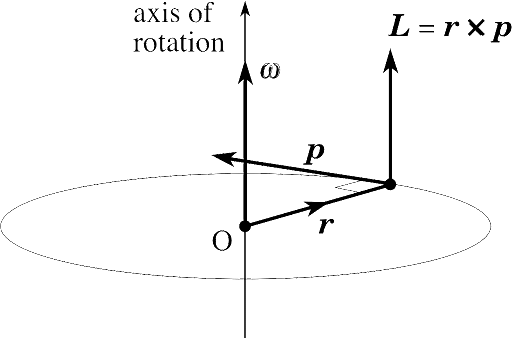
Angular momentum
Furthermore, angular momentum may be expressed as the product of a spinning body's moment of inertia (I) and its angular velocity (ω). In this example, the angular momentum may be calculated using the following formula:
L = I x ω
The angular momentum is denoted by the letter L.
The rotating inertia is denoted by the letter I.
ω is the angle of rotation.
In this scenario, the right-hand thumb rule defines the direction of the angular momentum vector, which is the same as the rotation axis of the given item.
The right-hand thumb rule asserts that if a person arranges his or her hand in such a manner that the fingers point in the direction of r, The thumb of that hand points in the direction of angular velocity, torque & angular momentum (L), while the fingers curl in the direction of rotation.
Read More:
Angular momentum quantum number
It is a quantum number that determines the angular momentum of an atomic orbital and characterises its size and form. The usual value is between 0 and 1.
Relationship between Angular Momentum and Torque
[Click Here for Sample Questions]
Now, \(\frac{dr}{dt}\) is the particle's velocity, but because it's in the same direction as the momentum,
rX\(\frac{dr}{dt}\)=0
As a result, the equation now reads,
Similar to the link between force and momentum, angular momentum and torque have a similar relationship. The change in momentum of a particle is defined as a force. Torque, on the other hand, is the change in the particle's angular momentum. Using the angular momentum formula as a differentiator,
\(\frac{dl}{dt}\)=\(\frac{d}{dt}\)(r x p)
For distinction, use the product rule

\(\frac{dp}{dt}\) represents the force F
\(\frac{dl}{dt}\) = \(\tau \times F\)
As a result, torque determines the rate of change of angular momentum.
In a closed system, angular momentum remains constant in total but can be redistributed within that system as a conservative characteristic. Transient eddies, for example, are the primary way by which the atmosphere transports rotational momentum northward. Vertical angular momentum transit is also possible, with the Hadley and other mean meridional circulations conveying angular momentum.
Angular Momentum: Solved Example
[Click Here for Sample Questions]
Example 1: A 2-kg weight bearing pulley of cylindrical shape with an approximate radius of 0.1 m is observed to rotate at 2 rad/s. How strong is the pulley's angular momentum?
Solution: We know,
Pully’s Mass (m) = 2 kg
pulley’s radius (r) = 0.1 m
Angular speed (ω) = 2 rad/s
To Find: Angular momentum
For a solid cylinder, the moment of inertia formula is:
I = 1/2 m r2
I corresponds to moment of inertia (kg m2), similarly m means mass (kg) and r is depicted as radius (m)
Moment of inertia:
I = 1/2 (2)(0.1)2 = (1)(0.01) = 0.01 kg m2
The angular speed:
L = I ω = (0.01)(2) = 0.02 kg m2/s
Example 2: A horizontal circular platform with a radius of 0.5 m and a mass of 0.45 kg rotates freely around its axis. Two massless spring toy guns, each holding a steel ball weighing 0.05 kg, are affixed to the platform on either side of its diameter at a distance of 0.25 m from the centre. Each cannon fires the balls in different directions, horizontally and perpendicularly to the diameter. The balls' horizontal speed in relation to the ground after departing the platform is 9 m/s. After the balls depart the platform, the platform's spinning speed is measured in rad/s.
Solution: Consider the platform and the balls as a single unit. On the system's centre, there is no external torque. As a result, the system's angular momentum is conserved around its centre. The system's initial and ultimate angular momentum
Li =0, Lf =mvr+mvr+Iω =2mvr+\(\frac{1}{2}\)MR2ω.
The conservation of angular momentum, Li=Lf, gives
ω=\(-\frac{4mve}{MR^2} = - \frac{4(0.05)(9)(0.25)}{0.45(005)^2}\) =-4rad/s
Example 3: With an angular velocity of ω, a thin uniform circular disc of mass M and radius R rotates on a horizontal plane around an axis perpendicular to its plane and passing through its centre. A second disc with the same size but a mass of M/4 is gently put coaxially on the first disc. The system's angular velocity is now 2ω/√5.
Solution: As a system, consider the two discs with masses M and M/4 and a radius R. When one disc is positioned coaxially above the other, there is no external torque about the axis of rotation. As a result, the system's angular momentum is conserved around the rotation axis. The initial and final values of angular momenta about the rotation axis are calculated as follows:
Li =Iiωi =\(\frac{1}{2}\)MR2ω, Lf =Ifωf =(\(\frac{1}{2}\)MR2+\(\frac{1}{2}\)\(\frac{M}{4}\)R2)ωf =\(\frac{5}{8}\)MR2ωf,
where Ii and If are the initial and the final values of the moment of inertia about the axis of rotation. The conservation of angular momentum, Li=Lf, gives f=\(\frac{4}{5}\).
Ques. A smooth sphere A moves with an angular speed and a centre of mass velocity v on a frictionless horizontal surface. It collides with an identical sphere B at rest in an elastic and head-on collision. Their angular speeds after the impact are A and B, respectively. Then,
A. ωA < ωB
B. ωA = ωB
C. ωA = ω
D. ωB = ω
Solution: There is no frictional force between the spheres. Both spheres' collision forces flow via their respective centres of mass. As a result, for each sphere, the torque around the centre of mass is zero. As a result, each sphere's angular momentum around the centre of mass is preserved. The two spheres' initial and final angular momentum are
Li,A =Iω Li,B =0 Lf,A =IωA Lf,B =IωB
Therefore, Li,A=Lf,A gives ωA= ωand Li,B=Lf,B gives ωB=0.
Conservation of Angular Momentum
[Click Here for Sample Questions]
Conservation of angular momentum is a physical situation in which the spin of a spinning system remains constant until it is pressurized by a force of external origin. In other words, the rotational speed remains constant as long as the net torque is zero.
- The velocity of rotation of anything around an axis is known as angular momentum, often known as spin. Gyroscopes are simple devices that employ the principle of angular momentum conservation to guide, stabilize, and measure rotational movement in a variety of systems. The conservation of angular momentum explains why a toy gyroscope or a spinning top stays upright as it rotates rather than succumbing to gravity and falling over.
- When the wheels on a bicycle spin up to speed, they behave like gyroscopes, making it easier for the bicycle to stay upright and making it more difficult for anything to disrupt its motion. The capacity of a figure skater to increase his spin by pushing his arms closer to his body, as well as the rise in the spin of an orbiting planet as it comes closer to the sun, are both examples of angular momentum conservation at the action.
- A person sitting in a rotating chair clutching a spinning bicycle wheel is another popular example of angular momentum conservation. The individual then rotates the bicycle wheel in the opposite direction by turning it over.
The wheel initially possesses an upward angular momentum. The angular momentum of the wheel reverses direction as the person rotates the wheel over. Because the human-wheelchair system is a closed system, total angular momentum must be conserved, hence the person begins to rotate in the opposite direction as the wheel.
Momentum is conserved because the vector sum of angular momentum equals one. This is a surprising example. It seems strange that just turning a bicycle wheel causes it to spin. The phenomenon makes sense, though, when viewed through the lens of momentum conservation.
In quantum mechanics, the orbital angular momentum operator L is defined as the vector cross-product of r and p similar to classical mechanics, except that r and p are quantum mechanical position and momentum operators, respectively. In addition to inherent angular momentum, elementary particles have a quantity called spin. Despite the fact that particles do not rotate about their central axis as the term implies, there is an inherent kind of angular momentum that has been demonstrated to be distinct from orbital angular momentum. In quantum mechanics, the total angular momentum operator, J, is the sum of the orbital (L) and spin (S) angular momentum operators in the equation:
J = L + S
J is preserved as a total angular momentum. Quantization of angular momentum is essential for understanding the structure of matter at the atomic and molecular levels.

Conservation of angular momentum
Things to Remember
- The rotating equivalent of force is torque.
- The idea of angular momentum is significant in physics because it is a conserved quantity: unless an external torque occurs on a system, its angular momentum remains constant.
- The rate at which angular momentum is transmitted into or out of a system is known as torque.
- The moment of inertia of a rigid body is the measure of its resistance to a change in rotational motion.
- The concepts of torque and angular momentum are intertwined.
- Angular momentum (abbreviated as 'l') is the rotating equivalent of linear momentum (abbreviated as 'p'). It's a vector-based item.
- The particle's angular momentum is l = r * p
l = r.p sinθ.
- The principle of angular momentum is used by a gyroscope to maintain its orientation. It makes use of a three-degree-of-freedom spinning wheel. This is useful in space applications where a spacecraft's attitude is a critical parameter to regulate.
Read More:
Sample Questions
Ques: A horizontal flat platform rotates along a vertical axis passing through its center with a uniform angular velocity. A viscous fluid of mass m is put in the center at some point and allowed to spread out and eventually fall. During this time, the angular velocity was: (3 marks)
(a) lowers over time
(b) decreases at first and then drops again
(c)with no change
(d) rises indefinitely
Answer: b) As the liquid spreads out across the platform's circumference, its rotational inertia increases as more and more mass is dislodged from the centre. The conservation of angular momentum is used to minimise the angular velocity. When the fluid eventually falls off the platform, the rotational inertia reduces, causing the angular velocity to rise.
Ques. What is the definition of angular momentum? (3 marks)
Ans. There are two types of angular momentum for an object, similar to angular velocity: spin angular momentum and orbital angular momentum. The angular momentum around a given center of rotation is known as orbital angular momentum, whereas the angular momentum around an object's center of mass is known as spin angular momentum.
A vector that is parallel to the angular velocity is called angular momentum. The angular momentum of a system is conserved if there is no net torque operating on it. The torque multiplied by the time period over which the torque is applied creates a change in angular momentum equal to the torque multiplied by the time interval over which the torque is applied.
Ques. What is the significance of angular momentum? (5 marks)
Answer: The idea of angular momentum is significant in physics because it is a conserved quantity: unless an external torque occurs on a system, its angular momentum remains constant. The rate at which angular momentum is transmitted into or out of a system is known as torque. The moment of inertia of a rigid body is the measure of its resistance to a change in rotational motion.
The conservation of angular momentum explains a wide range of human and natural events. It explains why an ice skater spins quicker when her arms are drawn close to her body and slower when her arms are stretched outward. It also explains why a compact star, such as a white dwarf, spins exceedingly rapidly compared to the big star from which it arose.
Ques. Calculate the angular momentum of a pully of 2 kg, radius 0.1 m, rotating at a constant angular velocity of 4 rad/sec. (3 marks)
Answer: Substitute the supplied values for the following
m = 2 kg and r = 0.1 m in I = 1/2mr²
We obtain (formula for the moment of inertia) as I= 0.01 kg.m2
L=Iω gives us angular momentum, so we can substitute the values we obtain L=0.04 kg.m².s-¹.
Ques. Elucidate why the Torque remains perpendicular to the angular momentum? (2 marks)
Answer: Because torque equals the cross product of the displacement vector and the linear force, and angular momentum equals the cross product of the displacement vector and the linear momentum, The right-hand thumb rule determines the resultant/direction of the cross product, which must always be perpendicular to the plane in which the force vector exists.
Ques. What is Conservation of Angular Momentum? (5 marks)
The change in angular momentum over time is known as torque. It is defined mathematically as the time derivative of angular momentum:
\(\tau = \frac{dl}{dt} = r \times \frac{dp}{dt} = r \times F\)
The mathematical formula for angular momentum is identical to the mathematical equation proving that the external torque operating on the system is zero when the angular momentum is constant (for a closed system). This equivalence may be expressed in the following way:
Lsystem= constant \(\leftrightarrow \sum^{\tau}_{ext}\)=0
where ext is any torque imparted to a particle system.
Planetary orbits' angular momentum
The angular momentum of a planet in orbit is split between the planet's spin and the angular momentum of its orbit:
Ltotal =Lspin +Lorbit
Ques. What is the Significance of Knowing the Concept of Conservation of Angular Momentum? (5 marks)
Answer: The conservation of angular momentum is often employed in the study of what is known as central force motion. If a body's net force is constantly directed toward a fixed point, such as the centre, there is no torque on the body with regard to the centre, and the body's angular momentum around the centre remains constant. When working with the orbits of planets and satellites, constant angular momentum is particularly beneficial. The Bohr model of the atom was also based on this premise.
The conservation of angular momentum explains why an ice skater's arms and legs accelerate as she approaches the vertical axis of rotation (or close to her body). She reduces her body's moment of inertia by moving a portion of her mass closer to the axis. The skater's angular velocity (rotational speed) must rise because angular momentum is constant in the absence of external torques.
When compact stars (such white dwarfs and neutron stars) and black holes are produced from far bigger and slower spinning stars, the same process explains their extraordinarily quick spin.
Ques. What effect does torque have on angular momentum? (3 marks)
Ans. Torque is a twisting force that creates rotation, and it may affect an object's angular momentum by moving it, speeding it up, or slowing it down. The greater the change in angular momentum over time, the more torque you apply to an item.
Read More:



Comments