



Education Journalist | Study Abroad Lead
A non contact force is a force acting on an object without directly coming in contact with it. A force is an interaction such as a push or pull on an object that is caused due to its interaction with another one. After the interaction ends, the objects no longer feel the force. Force can be mainly classified as –
- Contact force – When two interacting items are considered to be physically engaging each other, they experience contact forces. Examples – Frictional forces, normal forces, tensional forces, applied forces, and air resistance forces.
- Non-Contact Force – Non Contact force occurs even when the two interacting objects are not physically in contact with each other but may produce a push or pull despite their physical separation.
Read More: Balanced and Unbalanced Forces
| Table of Contents |
Key Terms:- Force, Acceleration, Gravity, Electrons, Contact, Non-contact force.
Non-Contact Force
[Click Here for Sample Questions]
Non-contact force emerges between two bodies without coming in direct physical contact with one another. Have you ever observed that a ball thrown in the air returns back to the ground after reaching a specific high point? Or how when you jump on the ground, you return to the surface? Non contact force is responsible for all these interactions. The most well-known sort of non-contact force is gravity, which correlates with weight. Non-contact forces basically include the force of gravity, magnetic attraction, electrostatics, and the nuclear force which is of two kinds weak and strong.
- Gravitational forces are an example of action-at-a-distance forces.
- Despite their spatial separation, the sun and planets, for example, have a gravitational pull on each other.
- Electric forces are forces that act at a distance.
- Despite their short spatial separation, protons in an atom's nucleus and electrons outside the nucleus experience an electrical attraction toward each other.
- Magnetic forces are non contact forces. Two magnets, for example, may exert a magnetic force on each other while being separated by only a few millimeters.
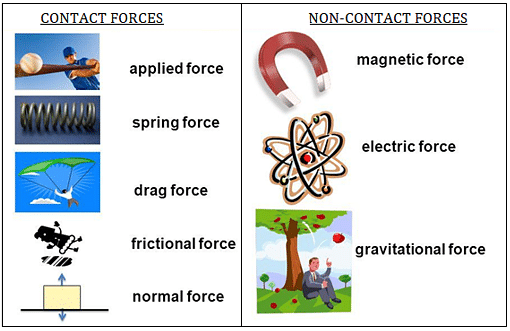
Contact forces vs Non-contact forces
Also Read:
| Related Topics | ||
|---|---|---|
| Inertia and Mass | Inclined plane acceleration | Force of friction |
| Momentum and Inertia | Force and motion | Effects of forces |
Types of Non-Contact Force
[Click Here for Sample Questions]
A non-contact force is one that is applied to an item when the objects do not make physical contact with each other. In other terms, it is a force that acts at a distance. The two interacting bodies are always separated by distance.
Gravitational Force
The gravitational force is a non contact pulling force that exists between any two entities having mass.
- The non-contact gravitational force has several advantages; it is a form of continual force that maintains things in place.
- Gravity keeps our muscles and bones active, as well as allows the planet to maintain its atmosphere.
- Gravity has the ability to retain some energy as potential energy, which allows it to be harnessed. A water dam is an example of this.
- Gravitational Force is felt by any object with mass in the cosmos.

Gravitational Force
Magnetic Force
The non contact force produced by magnetic materials on other magnets or metal objects is known as a magnetic force.
- Magnetic force may be exerted by moving charged particles.
- In nature, the magnetic force may be either a pull or a push force.
- The magnetic force is measured in Teslas.
- As the distance between the magnets grows, the magnetic force of the magnet decreases.

Magnetic Force
Electrostatic Force
Electrostatic force is the non contact force exerted between two charged objects. In nature, it may be both attractive and repulsive.
- Like charges repel each other whereas unlike charges attract each other.
- By rubbing the comb against your clothing and then holding it near little pieces of paper, you may see fragments of paper standing on their ends attracted to the comb.
- Everything is made up of small positive, negative, and neutral particles, and electrostatic forces cause opposing charges to attract and similar charges to repel.

Example of Electrostatic Force
Nuclear Force
Atoms make up all matter, and each atom is made up of electrons and a nucleus. Electrons are negatively charged and move in orbits around the nucleus. The nucleus is made up of protons, which are positively charged particles, and neutrons, which are neutral particles.
- The neutron and the protons are held together by a non contact force called the nuclear force.
- There is also no particle-to-particle interaction.
- Strong Nuclear Force: As the electromagnetic force repels two positive charges, the strong nuclear force overcomes the enormous repulsion between similarly charged particles that dwell in the nucleus of atoms. Extremely high-energy photons are emitted when the strong nuclear force that binds protons and neutrons in an atom is disrupted.
- Weak nuclear force: This force can transform a neutron into a proton through a process known as nuclear decay. Subatomic particles are emitted at a speed near the speed of light when the weak nuclear force changes a neutrally charged neutron into a positively charged proton.
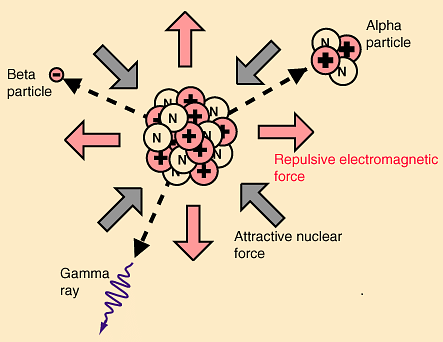
Nuclear Force
Examples of Non-Contact Force
[Click Here for Sample Questions]
The examples of different types of non contact force are –
Gravitational Force Examples
- The Earth and other planets orbit the sun in a stable orbit.
- When a ball or other item is tossed up, it returns to the earth.
- Tides in the ocean are caused by the gravitational pull of the moon.
- When we jump to the earth, we can land safely. This is the most basic illustration of a gravitational pull.
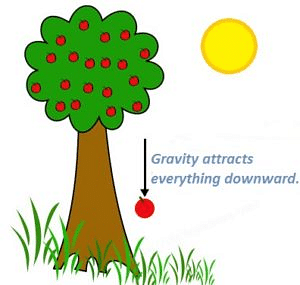
Example of Gravitational Force
Magnetic Force Examples
- A small magnet is included within the compass. The magnet is attracted or repelled by Earth's magnetic poles, indicating the direction.
- The magnetic attraction of iron nails
- Magnetic force is used on contemporary roller coasters to keep the vehicles on the tracks.
- The attraction between the magnet within the gadget and the Earth's south pole causes the compass to point north.
- A motor that rotates as a result of the interaction of magnets on both sides of the center.
- Maglev trains are high-speed trains that use magnetism to maintain train carriages levitated above the rails.
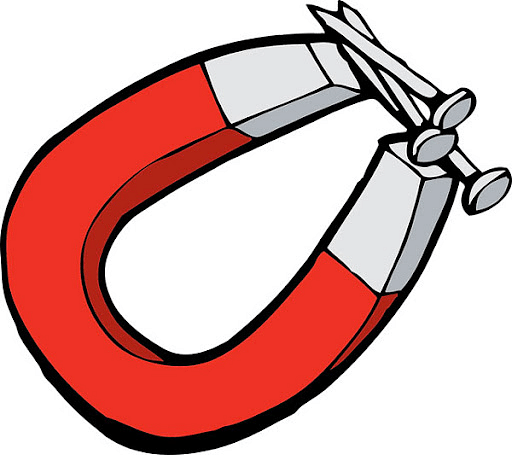
Magnetic force example
Read More: Fundamental Forces in Nature
Electrostatic Forces Examples
- After being rubbed, balloons attract each other due to the non contact force.
- Your hair gets pulled by the static change in front of television screens.
- Items of clothing that adhere to one other are removed from a dryer.
- When sugar is shaken in a plastic container, it is drawn to the sides of the container.
- By swiftly combing your hair and then holding it over the paper pieces, you may attract little bits of paper to a comb.

Electrostatic Force Example
Nuclear Force Examples
- The power of a nuclear explosion has the potential to wreak widespread damage.
- Nuclear fusion and nuclear fusion processes occur continuously on the Sun. As a result, nuclear energy is a source of solar energy.
- Nuclear energy is also utilized to create electricity in power stations.

Nuclear Force
Difference between Contact and Non-Contact Force
[Click Here for Sample Questions]
The difference between contact force and non contact force can be tabulated as below –
| Contact forces | Non – contact force |
|---|---|
| The contact force is created when two separate things come into touch. | Non-contact force happens when two things are attracted or repelled in such a way that they do not come physically into touch. |
| The contact force is not connected to any field. | Non-contact force is always related to a field. |
| For example, frictional force. | For example, gravitational force |
Also Read:
Things to Remember
- A force applied to an item by a body that is not in direct touch with it is known as a non-contact force.
- When objects do not make physical touch with one another or when a force is delivered without interaction, non-contact forces are present.
- Gravitational force, magnetic force, electrostatic force, and nuclear force are examples of non-contact force.
- Any force that necessitates touch is referred to as a contact force.
- The force produced by magnetic materials on other magnets or metal objects is known as a magnetic force.
- The gravitational force is a pulling force that exists between any two entities having mass.
- Contact forces are used in everyday activities such as pushing a car up a hill or kicking a ball across a room.
Sample Questions
Ques. What are the various types of non-contact forces? (5 marks)
Ans. Gravitational force, magnetic force, electrostatic force, and nuclear force are the four categories of non-contact forces:
- The gravitational force is a pulling force that exists between any two entities having mass.
- The force produced by magnetic materials on other magnets or metal objects is known as a magnetic force.
- The force exerted between two charged objects is known as electrostatic force.
- The neutron and the protons in an atom are held together by a force called the nuclear force.
Ques. What is the most powerful non-contact force? (3 marks)
Ans. Out of all four known fundamental interactions of non-contact forces: gravity, the force of attraction that exists between all entities with mass, and friction is the most powerful. We may claim that the strong nuclear force, which is even the strongest force in nature, has a short range, acting only at distances on the order of 10-15 m.
Ques. What are contact forces and what are the different types of contact forces? (2 marks)
Ans. Contact forces are the forces that operate when two bodies come into contact. There are several forms of contact forces, including tensional, spring, normal response friction, air resistance, and weight.
Ques. Which form of force is related with the energy that powers the electronics in our homes and offices? (1 mark)
Ans. Electricity is the passage of electric charges accompanied by electric force, which is a non-contact force.
Ques. A student at school throws a ball into the air, which reaches a particular height before falling back to the ground. What forces work on the ball during this process? (2 marks)
Ans. To toss the ball upwards, the youngster uses muscular power, and the ball is constantly subjected to the forces of gravity and air resistance. The contact forces are muscle force and air resistance, whereas the non-contact force is the gravitational force.
Ques. Is buoyancy a non-contact or contact force? (1 mark)
Ans. When an object is submerged in a fluid, it exerts a contact force on it. As a result, buoyancy acts as a contact force.
Ques. How can you tell the difference between contact and non-contact forces? (3 marks)
Ans. The contact force is created when two separate things come into touch.
Non-contact force happens when two things are attracted or repelled in such a way that they do not come into touch.
The contact force is not connected to any field.
Non-contact force is always related to a field.
Ques. Give some examples of gravitational force. (3 marks)
Ans. Some examples of gravitational force are:
- When a ball or other item is tossed up, it returns to the earth.
- When we jump to the earth, we can land safely. This is the most basic illustration of a gravitational pull.
- When a branch of a tree detaches, the fruit falls to the earth.
Also Read:



Comments