



Content Curator
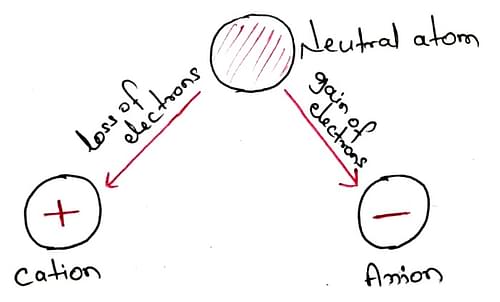
Anions are atoms or groups of atoms that have gained one or more electrons.
- This extra electron gives them a negative electrical charge.
- Common examples of anions include chloride (Cl⁻), bromide (Br⁻), and iodide (I⁻) ions.
- These are called monovalent anions, meaning they gain a single negative charge.
- There are also divalent anions (gain two electrons) and others with varying charges.
- They are attracted to the anode (positive electrode) during electrolysis.
- An ion is an atom or molecule carrying a net electric charge.
- Ions with positive electric charge are known as cation and ions with negative electric charge are referred to as anions.
| Table of Content |
Key Terms: Ions, Anions, Cations, Atom, Molecule, Electrons, Electric charge, Anode, Cathode, Periodic table, Halogens
What are Anions?
[Click Here for Sample Questions]
“Anions are atoms or groups of atoms that have gained one or more electrons, resulting in a negative electrical charge.”
Anions have more electrons (negatively charged particles) than protons (positively charged particles) which gives it a net negative charge.
- Usually, neutral atoms maintain an equal number of protons and electrons, canceling out their charges.
- However, ions, including anions, have an imbalance because of a difference in these particles.
- This electrical difference creates an attraction between anions and positively charged ions called cations.
- This attractive force, due to the opposite charges, plays an important role in the formation of ionic compounds.
Also check:
| Related Concepts | ||
|---|---|---|
| Ionic Bond | Covalent bond | Chemical Bonding and Molecular Structure |
| Valence Electrons | Intermolecular Forces | Schottky defect |
Formation of Anions
[Click Here for Sample Questions]
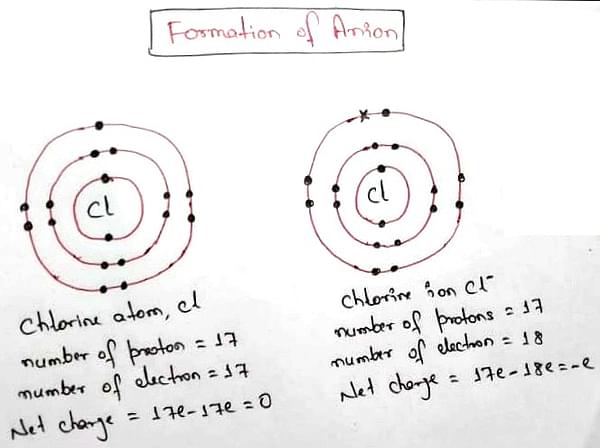
Anions form when an atom, compound, or molecule has a weaker attraction for its outer electrons.
- Another atom or entity with a stronger attraction comes along and pulls away one or more of these outer electrons.
- With the new gianed electron(s), the atom becomes negatively charged.
- The number of electrons gained determines the magnitude of the negative charge.
- For example, oxygen gaining two electrons becomes O²⁻, and chlorine gaining one electron becomes Cl⁻.
Properties of Anions
[Click Here for Sample Questions]
The negative charge of the anions determines the majority of properties of anions in chemistry.
- It is possible to predict whether an atom will be an anion or cation based on its position in the periodic table.
- For example, halogens always form anions whereas alkali and alkaline metals always form cations.
- Some metals form cations e.g. iron, silver, nickel, and non-metals that form anions such as oxygen, carbon, and sulfur.
- Some of the elements can form both anion and cation.
- Hydrogen can lose or gain electrons leading to the formation of hydride compounds such as ZnH2 (Anion) and H2O (Cation).
Difference Between Anions and Cations
[Click Here for Sample Questions]
The differences between anions and cations are given below
| Basis | Anions | Cations |
|---|---|---|
| Definition | A negatively charged atom or molecule is known as an anion. | A positively charged atom or molecule is known as a cation. |
| Charge type | Negative | Positive |
| Type of element | Non-metal | Metal |
| Types of electrodes used | Anode | Cathode |
| Examples | Sulfide, Oxide, Fluoride, Chloride | Iron, Lead, Sodium |
Also Check:
| Chemistry Related Concepts | ||
|---|---|---|
| Intermetallic Compound | Chromium iii Sulfate Formula | Cis Trans Isomerism |
| Examples of Enantiomers | Coordination Compounds MCQ | Coordination Compounds MCQ |
Things to Remember
- Electrically charged atoms or molecules are known as ions.
- Ions are of two types: Anions and Cations
- Anions consist of negative electric charge due to the availability of more electrons in comparison to protons.
- The total number of electrons in an ion is more than the number of protons.
- Cations are positively charged atoms or molecules.
- One can determine whether an atom will be an anion or cation according to its position in the periodic table.
Sample Questions
Ques. What are ions? (1 Mark)
Ans. Ions are positively or negatively charged atoms or molecules, formed by gaining or losing one or more electrons.
Ques. What are cations and anions? (2 Marks)
Ans. Any atom, particle, or molecule that has a net electric charge is known as an ion. This electric charge can either be negative or positive. The atom, particle, or molecule that has a positive electric charge is known as a cation and the ones with a negative electric charge are called anions.
Ques. What are the examples of anions? (2 Marks)
Ans. Anions have a net negative electric charge because of the presence of more negatively charged elements (electrons) in comparison to positively charged elements (protons). Some of the common examples of anions are ions of chlorine, and oxygen represented by Cl- (chlorine anion) and O2- (oxygen anion).
Ques. What is the role of metallic and non-metallic atoms information of anion and cation? (3 Marks)
Ans. Cations are formed by metallic atoms while anions are formed by non-metallic.
- Usually, metallic atoms hold their electrons loosely, consequently leading to loss of electrons and formation of cation (fewer electrons).
- On the other hand, non-metallic atoms have the ability to attract electrons more strongly than metallic atoms.
- This, in turn, leads them to gain electrons to form anions.
Ques. What is meant by zero net electric charge? Give examples. (2 Marks)
Ans. When atoms of metallic and non-metallic elements come together, the non-metallic draws one or more electrons away from the atoms of the metallic element, leading to the creation of ions. Now, the oppositely charged (both positive and negative) ions attract one another to form ionic bonds and further produce ionic compounds that have no net electric charge. Some of the examples of such Ionic compounds with no net charge are magnesium oxide (MgO), calcium chloride (CaCl2), and potassium iodide (KI).
Ques. What occurs to anions in electrolysis? (2 Marks)
Ans. Electrolysis is a process where electrical energy changes into chemical energy. The process happens in the electrolyte, a watery solution. In this process, the cation of the electrolyte moves toward the cathode which is negatively charged. Here, the cation reduces and forms a pure element. Similarly, an anion moves towards a positively charged anode. Here anion oxidizes which means losing an electron to form another pure element.
Ques. What is the difference between anions and cations? (2 Marks)
Ans. An anion can be referred to as a molecule or a group of molecules with one or more negative electric charges. Whereas, cations have one or more positive charges attached to them. One or more negative charges are carried by anions. While metal atoms combine to generate cations. The electrode used by anions is the anode and the cathode is used by cations. Examples of anions include Sulfide, Oxide, Fluoride, and Chloride. Examples of cations are Iron, Lead, and Sodium.
Ques. What are the uses of anion and cation? (1 Mark)
Ans. Using cation-anion ion exchangers demineralized water is produced. It is important that both positively and negatively charged ions are eliminated during this procedure.
Ques. What is meant by anion exchange resin? (2 Marks)
Ans. Anion and cation resins are the two most frequent resins used in the ion exchange process. Negatively charged ions are attracted to anion resins, on the other hand, positively charged ions are attracted to cation resins.
Ques. Is oxygen a cation or anion? (2 Marks)
Ans. Oxygen is neither a cation nor an anion. This is because it has no charge. Oxygen forms around 20% of the air, and it’s a highly reactive gas. Moreover, oxygen comprises various substances out there, in addition to pure oxygen in the air and pure oxygen dissolved in water. A large number of these molecules break down into ions.
For Latest Updates on Upcoming Board Exams, Click Here: https://t.me/class_10_12_board_updates
Also Read:



Comments