



Education Journalist | Study Abroad Lead
Thermodynamics is a branch of science concerning the relationship between heat and various other forms of energy. A variety of topics of engineering and science are dependent on the concept of thermodynamics. There are four laws of thermodynamics that govern the behavior of various quantities associated with it. These laws find their application in a variety of disciplines as we will explore further.
| Table of Content |
Thermodynamics
[Click Here for Sample Questions]
The main objective of thermodynamics is to study the transformation of energy forms. It is basically the branch of science that studies temperature, heat, and their relation to the other forms. It is applicable to various fields of science such as Chemical and Mechanical Engineering. The motive that led to the development of this branch was to improve the steam engine’s efficiency.

Thermodynamic Process
Thermodynamics: Important Terms
[Click Here for Sample Questions]
- System: It is where the observations are made, the rest is constituted as surroundings. The various types of systems are:
- Open System: The systems where the exchange of energy takes place are open systems.
- Closed System: It is a system where energy can be exchanged only with the surroundings and not the matter.
- Isolated Systems: In this system, energy or matter cannot be exchanged with the system and the surroundings.
- Surroundings: Everything excluding the system is termed as surroundings. The universe is made up of both systems and surroundings. Only the system gets affected by the changes that take place within it, the rest remains undisturbed.
- Boundary: It is the wall that separates the system and surroundings.
- Reversible Processes: This type of process is ideal. A Thermodynamic process is regarded as reversible if the system and surroundings can go back to their original state without any change. For instance, water evaporates and can get back to its original form; hence it is a reversible process.
- Irreversible Processes: This type of process is natural and is found in nature. For instance, if you break a glass, you cannot un-break it; hence it is an irreversible process.
CBSE Class 11 Applications of Thermodynamics
History of Applications of Thermodynamics
[Click Here for Sample Questions]
You can find applications of thermodynamics everywhere, be it while taking a soft drink from the refrigerator or sitting in a room with the AC; thermodynamics is applied everywhere. Sadi Carnot is regarded as the father of Thermodynamics as he proposed various concepts and theorems related to thermodynamics that are now utilized in the field of automobiles that are an important part of our present life. The thermodynamic cycles were further refined by Otto, Ericson, and Diesel.
Laws of Thermodynamics
[Click Here for Sample Questions]
In thermodynamics, we have various laws such as:
- Zeroth Law of Thermodynamics: If any two thermodynamic systems exist in thermal equilibrium with any third system, then it can be deduced that they are in thermal equilibrium with each other also.
- First Law of Thermodynamics: ΔU = Q – W (Change in internal energy= heat added- work done by the system)
- Second Law of Thermodynamics: Universe’s total energy always remains constant.
- Third Law of thermodynamics: S=0 when T= 0 Where S is entropy and T is Temperature.
- Charles Law
- Boyle’s Law
The third law of thermodynamics is related to Entropy.

Laws of Thermodynamics
Applications of the Second Law of Thermodynamics
[Click Here for Sample Questions]
- According to the second law of thermodynamics, heat flows from a high-temperature body to a lower-temperature one. It is applied to all the heat engine cycles, such as Diesel, Otto, etc. This law resulted in the enhancement of present-day’s vehicles.

Application of Second Law of Thermodynamics
- This law is also applied in refrigerators and heat pumps as well. For moving the heat from a body at a lower temperature to that of a higher temperature, external work needs to be supplied (via the compressor). It is based on the reversed Carnot cycle.
- A similar kind of law is used in both air conditioners and heat pumps. An air conditioner removes heat from the area and replaces it by throwing that absorbed heat back.
- Similarly, the heat pumps absorb heat from the atmosphere and supply it in the room. In these cases, external work is supplied in the form of electricity. The more the difference in temperature, the more work needs to be supplied.

Thermal Equilibrium in Thermodynamics
Check out the NCERT solutions of Class 11 Chemistry Chapter 6 Thermodynamics. (Thermodynamics Class 11.pdf)
Other Applications of Thermodynamics
[Click Here for Sample Questions]
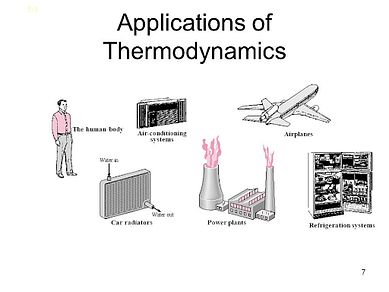
Various Applications of Thermodynamics
Thermodynamics has a vast number of applications as it covers the infinite universe.
- While sweating also, the law of thermodynamics is applicable. The body transfers its heat to the sweat and starts cooling down. The sweat then evaporates from the body and adds heat into the room. Here both first and second laws are applied. In this process, the heat does not get lost; rather it transfers maintaining equilibrium with entropy.
- All types of compressors work on various laws of thermodynamics.
- All types of vehicles like cars and airplanes work as per the second law of thermodynamics and the Carnot cycle.
- Another example where the first and second law is applied is the melting of an ice cube. It makes the drink cooler by absorbing the heat from it, after some time it absorbs heat from the room and attains room temperature.
CBSE Class 11 Thermodynamics and its applications
Applications of Thermodynamics: Things to Remember
[Click Here for Sample Questions]
- The main objective of thermodynamics is to study the transformation of energy forms.
- According to the second law of thermodynamics, heat flows from a higher-temperature body to a lower-temperature one.
- For moving the heat from a body at a lower temperature to that of a higher temperature, external work needs to be supplied (via the compressor).
- The heat pumps absorb heat from the atmosphere and supply it in the room. In these cases, external work is supplied in the form of electricity.
- All types of vehicles like cars and airplanes work as per the second law of thermodynamics and the Carnot cycle.
Sample Questions
Ques. What is the application of thermodynamics in a biological system? (1 mark)
Click Here To View Answer
Ans. In a biological system, thermodynamics is basically used for the generation of ATP. The synthesis of glucose-6-phosphate is driven by the energy that is stored in the bonds of ATP.
Ques. State a daily life application of thermodynamics. (1 mark)
Click Here To View Answer
Ans. Both the first and second law of thermodynamics is applicable to sweating as the body transfers its heat to the sweat and starts cooling down. The sweat then evaporates from the body and adds heat into the room
Ques. Who is regarded as the father of thermodynamics? (1 mark)
Click Here To View Answer
Ans. Sadi Carnot is regarded as the father of Thermodynamics as he proposed various concepts and theorems related to thermodynamics that are now utilized in the field of automobiles
Ques. What do you understand by entropy? (1 mark)
Click Here To View Answer
Ans. Entropy is basically the energy that is unavailable. It is the part that cannot be used to do work. The randomness in a system is referred to as entropy. The unit is JK-1mol-1.
Ques. What is the purpose of thermodynamics? (1 mark)
Click Here To View Answer
Ans. Thermodynamics is concerned with the interactions between heat and other sources of energy. It was mainly developed to work towards the improvement of the efficiency of a steam engine.
Ques. Out of these cases, in which one does entropy decrease? Why? (2 marks)
- Preparing an aqueous solution of common salt
- Change of water into ice
- Melting of ice
- Dry ice placed in an open vessel
Click Here To View Answer
Ans. The answer is b) change of water into ice because the matter in solid ice is more organized. Therefore, entropy decreases as the randomness are decreasing here.
Ques. Explain the working of a heat pump. (2 marks)
Click Here To View Answer
Ans. The heat pumps absorb heat from the atmosphere and supply it in the room. In these cases, external work is supplied in the form of electricity. The more the difference in temperature, the more work needs to be supplied.
Ques. What is the second law of thermodynamics? State its application. (2 marks)
Click Here To View Answer
Ans. According to the second law of thermodynamics, heat flows from a high-temperature body to a lower-temperature one. The heat engines and modern-day automobiles work on this law.
When we put an ice cube in a cup full of water at room temperature, the ice cubes absorb the heat released, and thereby the entropy of the water rises.



Comments