



Content Curator
Quadrant is defined as the region formed by the two axes (X axis and Y axis) of the coordinate system within the circle. A quadrant is said to be the one-fourth part occupied in the circle. The circle has four quadrants and they are produced when the circle is partitioned equally into four segments. The area of a quadrant can be obtained by dividing the one-fourth area of a circle. The sum of areas of the four quadrants is equal to the whole area of the circle.
| Table of Content |
Key Takeaways: Quadrant, Circle, Coordinate axes, x-axis, y-axis
What is a Quadrant?
[Click Here for Sample Questions]
Quadrant can be defined as the region formed by two different coordinate axes (x and y axis) within a circle at a right angle. The regions may include positive and negative values of both coordinate axes.
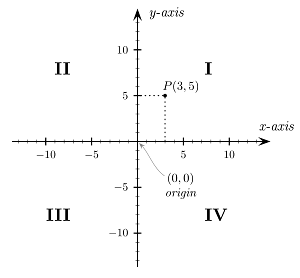
Quadrant
In other words, the quadrant is defined as the one-fourth region/part occupied in a circle. When two straight lines intersect with each other at right angle or 90° a quadrant is formed. When those four quadrants are joined together, then the figure formed is a complete circle.
Area of Quadrant
[Click Here for Sample Questions]
The area of a quadrant is defined as the space that is occupied by one fourth part of the circle in a two-dimensional space. The total area of all four quadrants will be equal to the area of a circle. There are mainly two methods for the calculation of the area of a quadrant. The steps are given below.
Method 1 - Since the area of one quadrant is one-fourth area of a complete circle, then we can divide the area of the circle by 4.
So,
Area of circle = πr2
One-fourth part of circle = ¼
Hence, Area of Quadrant = ¼ π r2
Method 2: By using the area of the sector of a circle, the area of a quadrant can be obtained.
Area of a sector of a circle = θ/360º × π× r2
For a quadrant of a circle, θ = 90°
Area of a quadrant = (90°/360°).π.r2
Area of a quadrant = ¼ × π× r2
Unit of Measurement for Area of Quadrant
[Click Here for Sample Questions]
Similar to other units of measurement for areas, square units are used to determine the area of a quadrant. The most commonly used square units are square meters and square centimeters. Measurements with greater precision use square millimeters.
Things To Remember
[Click Here for Sample Questions]
- Quadrant of a circle is formed when the coordinate axes cut each other at right angles at the origin or centre of the circle.
- The quadrant is one - fourth part of a circle.
- The area of a quadrant is one-fourth the area of a circle.
- Area of a quadrant is determined by the formula A = ¼ πr2
- There are four equal quadrants to a circle.
Sample Questions
Ques. The radius of a circle given is 4 m. Find out the perimeter of the circle and the area of a quadrant of the circle. [3 marks]
Ans. Given,
Here, the radius of a circle = 2m
So, Area of circle = πr2
Circumference = 2πr
Area of a Quadrant = πr2/4
Circumference of the Circle=2πr
Circumference = 2 * 3.14 * 4
Circumference = 8 * 3.14
Circumference = 25.12 m.
Now,
Area of a Quadrant = πr2/4
Area of a Quadrant = π42/4
Area of a Quadrant = π×4×4/4
Area of a Quadrant = 3.14×16/4
Area of a Quadrant = 3.14 *4 m2
Area of a Quadrant = 12.56 m2
Ques.The radius of a circle is 6 cm. Find out the area of the circle. [2 marks]
Ans. Given,
The radius = 4 cm
So, Area of circle = πr2
Then,
Area of Circle = πr2
Area of Circle = 3.14 * 42 (value of π = 3.14)
Area of Circle = 3.14 * 4 * 4
Area of Circle = 3.14 * 16
Area of Circle = 50.24cm2
Ques.The two circles are given as having diameters 10 cm and 24 cm and the area of a circle is equal to the sum of the areas of two circles of diameters. Then find out the diameter of the larger circle (in cm). [2 marks]
Ans. Diameter1 = 10 cm and Diameter2 = 24cm (Given)
Then, find the radius by dividing the diameters by 2.
Given, [ Diameter1 = 10/2 = 4 cm and Diameter2 = 24/2 = 6 cm ]
∴ R1 = 5 & R2 = 12
Here is the formula to find the radius of the large circle.
πR2 = πr21 + πr22
πR2 = π(r21 + πr22) [ π is common on both sides ]
R2 = 52 + 122 = 24 + 144
R2 = 169 cm
R = 13 cm
∴ Diameter = 2 *(13) = 26 cm ( As diameter is twice of the radius )
Hence, the diameter of the large circle is 26 cm.
Ques. What is known as quadrant? [2 marks]
Ans. The quadrant is defined as the part of a cartesian plane which is formed when the two axes intersect each other. Because of the intersection, four equal parts are produced. These are known as quadrants of the circle.
Ques. What is an area of a quadrant? [2 marks]
Ans. The area of a quadrant is the space occupied by one-fourth region of a circle. The quadrant is equal to one-fourth of the area of a circle. The formula given for the area of a quadrant is πr2/4.
Ques. What are perpendicular lines? [2 marks]
Ans. Perpendicular lines are those lines that meet or intersect each other at right angles i.e. (90°). The two lines intersect with each other and form regions or parts in a particular figure. If two straight lines are intersected with each other in the circle. Then, the four quadrants will be produced.
Ques. Find out the radius of the circle whose circumference is given 18 cm. [2 marks]
Ans. Circumference of a circle = 2πr
2πr = 18
2* 22/7 *r = 18
r = 18 * 7 / 22 * 2
r = 126 / 44
r = 63 / 22
Therefore, r = 63 / 22
Ques. Define the circle? What is the segment of a circle? [2 marks]
Ans. A circle is round in shape. It does not have edges, vertices, and corners. It only has a central point through which a line can be made. The whole line segment is known as a segment. The half segment is known as the radius of the circle. The segment is the line in a circle that can be formed by breaking apart from the rest of the circle through a secant or a chord. The segment can break the circle into many parts.
Ques. Write the formula for the circumference of the circle and the area of the quadrant. [2 marks]
Ans. The formula of the circumference of the circle is given below.
Circumference of the circle = 2 π r
Given , Value of π = 22/7 or 3.14
r = radius of the circle
Now, Area of the Quadrant = π r2 / 4
Here, Value of π = 22/7 or 3.14
r = radius of the circle
Also Read:



Comments