



Content Curator
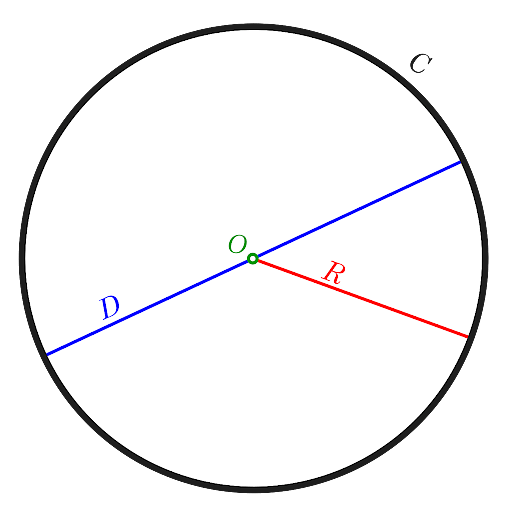
Circle is a two-dimensional geometry with a round structure in which all points on the circle's surface are equal from the centre point. The radius of the circle is the distance between the centre point and any point in the circumference. A circle doesn't have any sides or edges. Consequently, a quarter circle is made by slicing a circle into 4 equal sections, and a semicircle is half of a circle.
| Table of Content |
Definition of Circle
A circle is a two-dimensional figure, it has two parts: area and perimeter or circumference. The formula for the area and the circumference of a circle is discussed below.
Area of a Circle
The space occupied by the circle is known as the circle's area. Area of Circle A is given by the formula,
A = πr2 Sq. Units
Circumference of a Circle
The outline or perimeter of a circle is called the circumference of a circle. The circumference of a circle can be calculated by using the following formula.
Circumference of Circle = 2πr units
Read More:
Parameters of a Circle
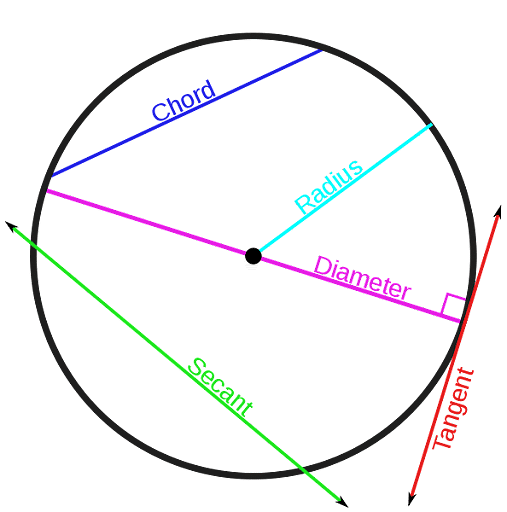
Radius: The radius of a circle is defined as the distance between the circle's centre and a point in the circle’s circumference.
Chord: The chord of the circle is a straight line of any length that connects any two points of the circle’s circumference. The diameter of the circle is the largest chord of the circle.
Secant: Secant is a line segment that intersects the circumference of the circle and divides it into two parts namely the minor and major segments of the circle.
Tangent: Tangent is a line segment that touches the circle at only one point in its circumference.
Incircle
The Incircle is created when a circle is embedded in one of the polygons, with the sides of the polygon being the tangent of the circle.

The intersection of the centre point of the circle and all the vertex of the triangle forms the incentre. The distance between the incentre and any point on the circumference of the circle is called the inradius.
Read More:
Special Case of the Inradius of the Incircle
If the triangle is right-angled, then the inradius of the incircle is given by:
R = P+B - H/2

Where,
P → Perpendicular of the right-angled triangle.
B → Base of the right-angled triangle.
H → Hypotenuse of the right-angled triangle.
Things to Remember
- Circle is a two-dimensional geometry with a round structure in which all points on the circle's surface are equal from the centre point.
- The radius of the circle is the distance between the centre point and any point in the circumference.
- The space occupied by the circle is known as the circle's area. Area of Circle A is given by the formula, A = πr2 Sq. Units
- The outline or perimeter of a circle is called the circumference of a circle. The circumference of a circle can be calculated by using the following formula. Circumference of Circle = 2πr units.
- The Incircle is created when a circle is embedded in one of the polygons, with the sides of the polygon being the tangent of the circle.
- If the triangle is right-angled, then the inradius of the incircle is given by R = P+B - H/2
Read More:
Sample Questions
Ques. A chord of a circle of radius 10 cm subtends a right angle at its centre. Calculate the length of the chord (in cm). (CBSE 2014) (2 marks)
Ans.

AB² = OA² + OB² …(Pythagoras’ theorem)
AB² = 10² + 10²
AB² = 2(10)²
AB = 10 2 cm
Ques. In the given figure, PQ R is a tangent at a point C to a circle with centre O. If AB is diameter and ∠CAB = 30°. Find ∠PCA. (CBSE 2016) (2 marks)
Ans.

∠ACB = 90° …[Angle in the semi-circle
In ?ABC,
∠CAB + ∠ACB + ∠CBA = 180°
30 + 90° + ∠CBA = 180°
∠CBA = 180° – 30° – 90° = 60°
∠PCA = ∠CBA …[Angle in the alternate segment]
∴ ∠PCA = 60°
Ques. In the given figure, AB and AC are tangents to the circle with centre o such that ∠BAC = 40°. Then calculate ∠BOC. (CBSE 2011) (2 marks)

Ans.

AB and AC are tangents
∴ ∠ABO = ∠ACO = 90°
In ABOC,
∠ABO + ∠ACO + ∠BAC + ∠BOC = 360°
90° + 90° + 40° + ∠BOC = 360°
∠BOC = 360 – 220° = 140°
Read More: Circle formulas
Ques. In the given figure, AP, AQ and BC are tangents to the circle. If AB = 5 cm, AC = 6 cm and BC = 4 cm, then calculate the length of AP (in cm). (CBSE 2012) (2 marks)

Ans.
2AP = Perimeter of ?
2AP = 5 + 6 + 4 = 15 cm
AP = 15/2
AP = 7.5 cm
Ques. In the given figure, PQ and PR are two tangents to a circle with centre O. If ∠QPR = 46°, then calculate ∠QOR. (CBSE 2014) (2 marks)

Ans.
∠OQP = 900
∠ORP = 90°
∠OQP + ∠QPR + ∠ORP + ∠QOR = 360° …[Angle sum property of a quad.
90° + 46° + 90° + ∠QOR = 360°
∠QOR = 360° – 90° – 46° – 90° = 134°
Ques. From an external point P, tangents PA and PB are drawn to a circle with centre 0. If ∠PAB = 50°, then find ∠AOB. (CBSE 2016) (2 marks)
Ans.
PA = PB …[? Tangents drawn from an external point are equal]

∠PBA = ∠PAB = 50° …[Angles equal to opposite sides]
In ?ABP, ∠PBA + ∠PAB + ∠APB = 180° …[Angle-sum-property of a ?]
50° + 50° + ∠APB = 180°
∠APB = 180° – 50° – 50° = 80°
In cyclic quadrilateral OAPB
∠AOB + ∠APB = 180° ……[Sum of opposite angles of a cyclic (quadrilateral is 180°]
∠AOB + 80o = 180°
∠AOB = 180° – 80° = 100°
Read more:
Ques. In the given figure, the sides AB, BC and CA of a triangle ABC touch a circle at P, Q and R respectively. If PA = 4 cm, BP = 3 cm and AC = 11 cm, find the length of BC (in cm). (CBSE 2012) (2 marks)

Ans.

AP = AR = 4 cm
RC = 11 – 4 = 7 cm
RC = QC = 7 cm
BQ = BP = 3 cm
BC = BQ + QC
= 3 + 7 = 10 cm
Ques. Find the perimeter (in cm) of a square circumscribing a circle of radius a cm. (CBSE 2011) (2 marks)

Ans.
Radius = R
AB = a + a = 2a
∴ Perimeter = 4(AB)
= 4(2a)
= 8a cm
Read more:
Ques. In the given figure, a circle is inscribed in a quadrilateral ABCD touching its sides AB, BC, CD and AD at P, Q, R and S respectively. If the radius DA of the circle is 10 cm, BC = 38 cm, PB = 27 cm and AD ⊥ CD, then calculate the length of CD. (CBSE 2013) (2 marks)

Ans.
Const. Join OR
Proof. ∠1 = ∠2 = 90° … [Tangent is ⊥ to the radius through the point of contact]
∠3 = 90° …[Given]

∴ ORDS is a square.
DR = OS = 10 cm …(i)
BP = BQ = 27 cm …[Tangents drawn from an external point]
∴ CQ = 38 – 27 = 11 cm
RC = CO = 11 cm …[Tangents drawn from an external point]
DC = DR + RC = 10 + 11 = 21 cm …[From (i) & (ii)]
Ques. In the figure, AB is the diameter of a circle with centre O and AT is a tangent. If ∠AOQ = 58°, find ∠ATQ. (CBSE 2015) (2 marks)

Ans.
∠ABQ = 1/2
∠AOQ = 58º / 2
= 29°
∠BAT = 90° ….[Tangent is ⊥ to the radius through the point of contact]
∠ATQ = 180° – (∠ABQ + ∠BAT)
= 180 – (29 + 90) = 180° – 119° = 61°
Ques. If the diameter of the circle is 20 cm, then find the circumference of the circle. (2 marks)
Ans. Given, the diameter of the circle as 20 cm,
Then the radius of the circle will be
Radius = 20/2
Circumference of the circle:
Circumference = 2πr
Circumference = 2*22/7*20/2
Circumference = 62.8 cm
Read more:
Ques. What is the area of the circular park, if the radius of the park is 5 m? (2 marks)
Ans. The radius of the circular park is 5 m
The area of the park is:
Area = πr2
Area= 22/7*5*5
Area= 78.5 cm2
The area of the park is 78.5 cm2
Ques. In the given figure, O is the centre of a circle, AB is a chord and AT is the tangent at A. If ∠AOB = 100°, then calculate ∠BAT. (2 marks)
Ans.

∠1 = ∠2
∠1 + ∠2 + 100° =180°
∠1 + ∠1 = 80°
2∠1 = 80°
∠1 = 40°
∠1 + ∠BAT =90°
∠BAT = 90° – 40° =50°
Read more:
Ques. In the given figure, PA and PB are tangents to the circle with centre O. If ∠APB = 60°, then calculate ∠OAB. (2 marks)

Ans. ∠1 = ∠2
∠1 + ∠2 + ∠APB = 180°
∠1 + ∠1 + 60° = 180°
2∠1 = 180° – 60° = 120°
∠1 = 120?/2 = 60°
∠1 + ∠OAB = 90°
60° +∠OAB = 90°
∠OAB = 90° – 60° = 30°
Ques. In the given figure, O is the centre of a circle, PQ is a chord and PT is the tangent at P. If ∠POQ = 70°, then calculate ∠TP. (2 marks)

Ans.
∠1 = ∠2
∠1 + ∠2 + 70° = 180°
∠1 + ∠1 = 180° – 70°
2∠1 = 110° ⇒ ∠1 = 55°
∠1 + ∠TPQ = 90°
55° + ∠TPQ = 90°
∠TPQ = 90° – 55° = 35°
Read more:



Comments