



Content Curator
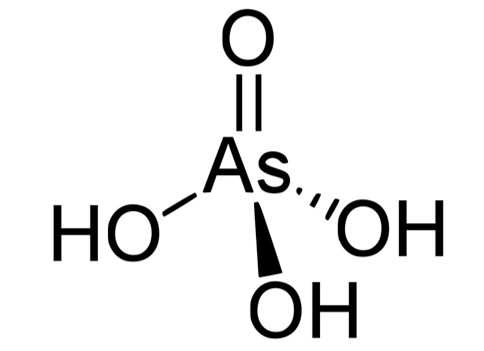
Arsenic acid formula is also known as Ortho Arsenic acid formula or Arsenic acid formula. There are three hydroxyl groups and one oxo group in this arsenic oxoacid. They're connected to the arsenic atom in the middle. The chemical compound arsenic acid has the formula H3AsO4. AsO(OH)3 is how we write it descriptively. It is a colourless solution in its aqueous form. H3AsO41/2H2O, its hemihydrate form, does form stable crystals. It is white and translucent in its crystalline form. The crystalline samples dehydrate at 100 oC due to condensation.
| Table of Content |
Key Terms: Arsenic acid, Formula, Acid, Arsenic, Preparation of Arsenic Acid, Uses, Applications
Arsenic Acid Formula and Structure
[Click Here for Sample Questions]
H3AsO4 is the chemical formula, and AsO(OH)3 is the molecular formula of Arsenic acid. Arsenic has 5 electrons that it shares with four oxygen atoms. Furthermore, these three oxygen atoms share one electron with three hydrogen atoms to complete their valence shell electron. This yields arsenic, four oxygen atoms, and three hydrogen atoms. The component is canonicalized, which means it consists of a collection of representations of a molecule's resonance structure, each of which puts up the real structure.

Arsenic Acid (H3AsO4)
Preparation of arsenic acid
[Click Here for Sample Questions]
Arsenic acid can be made by combining arsenic trioxide with concentrated nitric acid. It creates dinitrogen trioxide as a byproduct.
As2O3+ 2 HNO3+ 2 H2O → 2 H3AsO4+ N2O3
The resultant solution is then cooled to produce colourless hemihydrate H3AsO4·1⁄2H2O crystals. When crystallisation occurs at lower temperatures, however, the dihydrate H3AsO4·2H2O is formed.
Properties of Arsenic Acid
[Click Here for Sample Questions]
| Particulars | Details |
|---|---|
| Chemical formula | H3AsO4 |
| Molecular weight | 141.94 g/mol |
| Monoisotopic mass | 141.924728 g/mol |
| Density | 2.5 g/cm3 |
| Boiling point | 120 °C |
| Melting point | 35.5 °C |
Application of Arsenic acid
[Click Here for Sample Questions]
Because of its toxicity, its commercial applications are restricted. It's also a precursor of a number of insecticides. It's used as a broad-spectrum antimicrobial, a wood preservative, a glass and metal polishing agent, and a reagent in the manufacture of certain dyestuffs and organic arsenic compounds on occasion.
Arsenic Acid Hazards
[Click Here for Sample Questions]
It is extremely carcinogenic, poisonous, and corrosive, just like all arsenic compounds. It causes irritation, itching, redness, and burning when it comes into contact with the skin. It causes discomfort, redness, and watery eyes when it comes into contact with the eyes. It irritates the throat and nose when inhaled. It can also induce a loss of appetite, nausea, headaches, diarrhoea, stomach cramps, and puking.
Uses of Arsenic acid
[Click Here for Sample Questions]
Arsenic acid has long been used in agriculture as pesticides, insecticides, herbicides, cotton desiccants, soil sterilants, and defoliants, among other things. We also utilise it as an antimicrobial in clothing. They're also used in the manufacturing of automobiles. It is used as a raw material in a wide range of sectors and goods, including cosmetics, chemical manufacture, metal production, and so on. It is grown as an agrochemical crop. It's also used in the production of glass.
Things to Remember
[Click Here for Sample Questions]
- The arsenic acid formula is also known as Ortho Arsenic acid formula or Arsenic acid formula. The chemical compound arsenic acid has the formula H3AsO4. AsO(OH)3 is how we write it descriptively.
- Arsenic has 5 electrons that it shares with four oxygen atoms. Furthermore, these three oxygen atoms share one electron with three hydrogen atoms to complete their valence shell electron. This yields arsenic, four oxygen atoms, and three hydrogen atoms.
- Arsenic acid can be made by combining arsenic trioxide with concentrated nitric acid. It creates dinitrogen trioxide as a byproduct.
As2O3+ 2 HNO3+ 2 H2O → 2 H3AsO4+ N2O3
- It is extremely carcinogenic, poisonous, and corrosive, just like all arsenic compounds. It causes irritation, itching, redness, and burning when it comes into contact with the skin, eyes, throat or nose. It can also induce a loss of appetite, nausea, headaches, diarrhoea, stomach cramps, and puking.
- Arsenic acid has long been used in agriculture as pesticides, insecticides, herbicides, cotton desiccants, soil sterilants, and defoliants, among other things. We also utilize it as an antimicrobial in clothing. They're also used in the manufacturing of automobiles. It is grown as an agrochemical crop.
Sample Questions
Ques. Mention a method to prepare arsenic acid directly from Arsenic? (2 Marks)
Ans. Arsenic acid can be made directly from elemental arsenic by moistening it and treating it with ozone (O3) and water (3 H2O):
2 As + 3 H2O + 5 O3 → 2 H3AsO4 + 5 O2
Ques. What is the chemical formula and structure of Arsenic acid? (3 Marks)
Ans. H3AsO4 is the chemical formula of Arsenic acid. Arsenic has 5 electrons that it shares with 4 oxygen atoms. Furthermore, these 3 oxygen atoms share one electron with three hydrogen atoms to complete their valence shell electron. This yields arsenic, four oxygen atoms, and three hydrogen atoms. The component is canonicalized, which means it consists of several representations of a molecule's resonance structure, each of which assembles the genuine structure.
Ques. What are the physical properties of Arsenic acid? (2 Marks)
Ans. AsO(OH)3 is the molecular formula of Arsenic acid. Its Molecular weight is 141.94 g/mol and its monoisotopic mass is 141.924728 g/mol. This acid has a density of 2.5 g/cm3 .It has a higher boiling point than water i.e. 120 °C and a melting point of 35.5 °C.
Ques. What are the daily based applications of Arsenic acid? (2 Marks)
Ans. Its commercial applications are limited due to its toxicity. It's also a starting point for a variety of pesticides. It's utilised as a broad-spectrum antibacterial, a wood preservative, a glass and metal polishing agent, and occasionally as a reagent in the production of certain dyestuffs and organic arsenic compounds.
Ques. What are the Arsenic acid hazards on human beings? (2 Marks)
Ans. Arsenic acid, like all arsenic compounds, is exceedingly carcinogenic, toxic, and corrosive. When it comes into touch with the skin, it produces irritation, itching, redness, and burning. When it comes into contact with the eyes, it produces irritation, redness, and watery eyes. When inhaled, it irritates the throat and nose. It can also cause vomiting, nausea, headaches, diarrhoea, stomach cramps, and a loss of appetite.
Ques. How can Arsenic acid be prepared from concentrated nitric acid? (2 Marks)
Ans. Combining arsenic trioxide with concentrated nitric acid yields arsenic acid along with dinitrogen trioxide as a byproduct.
As2O3+ 2 HNO3+ 2 H2O → 2 H3AsO4+ N2O3
Ques. What are the uses of Arsenic acid? (2 Marks)
Ans. Pesticides, insecticides, herbicides, cotton desiccants, soil sterilants, and defoliants have all been employed in agriculture for a long time. It's also used in garments as an antibacterial. They're also used in vehicle production. It's utilised as a raw material in a variety of industries and products, including cosmetics, chemical manufacturing, and metal fabrication. It's a type of agrochemical crop. It's also used in the glassmaking process.
Read More:



Comments