



Content Writer-SME
Ascending Order is the method of arranging numbers in increasing order that is from smallest to the largest value. Ideally, the order is represented in the left to the right form. The Less than (<) symbol is used to represent numbers in ascending orders. On the contrary, in descending order, numbers are arranged from largest to smallest and are represented by greater than (>) symbol.
A set of natural numbers can be represented in ascending order as follows:
| 10<20<30<40<50<60<70<80<90<100 with 10 being the smallest and 100 the largest number. |
In this article, we will learn about one of the important topics of number system in Maths and that is Ascending Order. Along with this, we will also discuss symbols, examples and their major differences between ascending and descending order in detail.
Read Also: Decimal Numbers Standard Forms
Definition of Ascending Order
[Click Here for Sample Questions]
When numbers are arranged in a pattern of smallest to the largest value in a way such that the smallest lies to the left and largest to the right-hand side, it is known as ascending order. The numbers at the extreme left are the smallest and the number at the extreme right is the largest.
Ascending order is also known as numbers arranged in increasing order. Using ascending order is common in:
- Arranging information in tables or lists.
- Putting numbers in order.
- Arranging data in a systematic manner for ease of analysis or comparison.
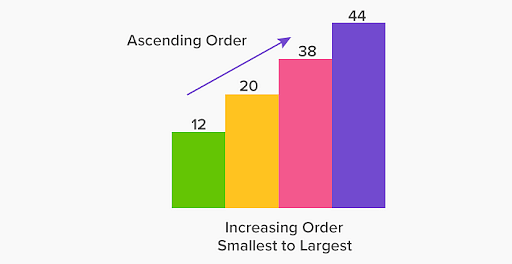
Ascending Order
From the above graph, we can say that ascending order can also be represented as a pattern of numbers going up in increasing order. In addition, there are patterns shown in the picture:
- Lowest to highest value, and
- Bottom to top value.
Check Important Difference Between Whole Number and Natural Number
Symbol of Ascending Order
[Click Here for Sample Questions]
The less-than sign (<) is used as a symbol to represent numbers in ascending order. For example, if we have to arrange 10,30,50,20 and 35 in ascending order then it can be written as:
10<20<30<35<50
The above numbers are from 10 to 50 are arranged in ascending order from left to right with 10 being the smallest and 50 is the largest number.
Thus, the sign(<) denotes that the succeeding number is greater than the preceding number.
Examples of Ascending Order
[Click Here for Sample Questions]
Some examples of numbers arranged in ascending numbers are as follows:
- 1<2<3
- 111<1111<11111
- -4<-3<-2<-1
- 22<453<855<998<1910<3270
- -22<-21<-20<-19
Read More: Difference Between Fraction and Rational Number
Ascending Order on Number Line
[Click Here for Sample Questions]
To understand the concept of ascending numbers, let us look up at number line. Here the numbers keep increasing as we move towards the right, for example, -4 is the leftmost and 4 is the rightmost, which means -4 is the smallest and 4 is the largest.

Ascending Order on Number Line
Difference between Ascending and Descending Order
[Click Here for Sample Questions]
Here are the key differences between ascending order and descending order:
| Degree of Comparison | Ascending Order | Descending Order |
|---|---|---|
| Definition | When numbers are arranged in increasing order of their value they are called ascending numbers. | When numbers are arranged in decreasing order of the value they are called a descending number |
| Representation on Number Line | The smallest number is at the extreme left and the largest is at the extreme right. | The largest number is at the extreme left and the smallest number is at the extreme right. |
| Symbol | Denoted by smaller than sign (<). | Denoted by greater than sign (>) |
| Example | Example: 1<2<3<4. | Example: 4>3>2>1. |
Check Also: Number System
Integers in Ascending Order
[Click Here for Sample Questions]
Integers are the numbers that can either be negative, positive, but are never in form of a fraction. Let us learn how to arrange integers in ascending order.
- Compare the number of digits in each number.
- The number with the least number of digits is the smallest and the number with the most number of the digits is the largest.
- If, numbers have the same number of digits look for the left-most digit of the number, and so on.
- Negative numbers are always smaller than positive numbers. The greater a negative number is, the smaller value it holds.
| Solved Example: 1 Arrange 24, 54, -34, 56, 8 in ascending order. Solution: We can see that -34 being negative is the smallest digit followed by 8, 24, 54 and 56. Thus, the given numbers can be arranged in ascending order as: -34< 8 < 24 < 54 < 56 |
Check More: Integers as Exponents
Fractions in Ascending Order
[Click Here for Sample Questions]
Fractions are used to represent a part of a whole. Numerator and denominator are used to represent a number In the fractional form. Let us learn how to represent fractions in ascending order.
There are two ways to represent fractions in ascending order:
By converting fractions to decimals
First, convert the fraction in decimal form by dividing the numerator by the denominator. After this arrange the number in increasing order of the decimal value. After this, replace the decimals with the actual fraction.
For example, to arrange 1/2, 2/5, 5/6, 3/5 in ascending order, we first need to convert these fractions into their decimal equivalents one by one,
1/2 = 0.5
2/5 = 0.4
5/6 = 0.83
3/5 = 0.6
We can now clearly see that,
0.4 < 0.5 < 0.6 < 0.83
∴ 2/5 < 1/2 < 3/5 < 5/6.
By converting given fractions into like fractions
In this method, we will convert the denominators of all the fractions the same by taking the LCM of the denominators and multiplying the same number to numerator and denominator. After that, we can compare the values in the numerator of the fractions and arrange them in increasing order.
For example, Arrange 1/2, 2/5, 5/6, 3/5 in ascending order.
LCM of 2, 5, 6 is 30
1/2 × 15/15 = 15/30
2/5 × 6/6 = 12/30
5/6 × 5/5 = 25/30
3/5 × 6/6 = 18/30
Thus, we can now easily compare the numerators of the obtained fractions, i.e
12 < 15 < 18 < 25
12/30 < 15/30 < 18/30 < 25/30
∴ 2/5 < 1/2 < 3/5 < 5/6.
Check Important Relation Between HCF and LCM
Negative Numbers in Ascending Order
[Click Here for Sample Questions]
Negative numbers lie on the left-hand side of the number line, if a bigger number has a negative sign then it becomes smaller than the positive number. The highest number with the negative sign has the least value. The smaller the negative number, the greater the value.
| Solved Example 1: Arrange -34, -56, -4 into ascending order. Solution: -56 is the smallest number followed by -34 and -4. Thus, the given numbers can be arranged in ascending order as: -56 < -34 < -4 |
Decimals in Ascending Order
[Click Here for Sample Questions]
Decimals are numbers with two parts- a whole number part and a fractional or decimal part connected through a decimal point (.).

Decimal
In order to arrange decimals in ascending order, we have to first look at the whole number part. If the whole number part of a decimal is greater than the other number, it means the number is greater than the other number.
For instance, 45.65 < 56.78 < 78.98.
If the numbers have the same whole number part, then we look at the tenths place digit in the given numbers and so on.
For instance, 10.25 < 10.45 < 10.98
Read Further: Decimal To Fraction Formula
Things to Remember
[Click Here for Sample Questions]
- Ascending Order refers to the method of arranging numbers in increasing order from smallest to the largest value.
- Ascending order is always represented with less than the (<) sign.
- In order to arrange numbers in ascending order, first count the digits, the number with more digits will be larger and the number with fewer digits will be smaller.
- For numbers with the same number of digits, start comparing from the leftmost digit.
- In the case of fractions, remember to convert them into decimals or like fractions, then compare them and arrange them in ascending order.
- In the case of negative numbers, the greater the negative number is the smaller it will be and vice versa.
- In decimals, first, compare the whole number part and if the whole number part is the same, compare the digits at the tenths place, or the hundredths place and so on.
Sample Questions on Ascending Order
Ques. Arrange the following numbers in ascending order. (3 Marks)
a) 23, 87, 90, 76, 65
b) 22, -22 ,97, -98, 190
Ans. (a) The ascending form of numbers will be
23 < 65 < 76 < 87 < 90
(b) Here, -98 is the smallest number and 190 is the largest number. The ascending order will be as follows:
-98 < -22 < 22 < 97 < 190
Ques. Arrange the following fractions in ascending form: 3/4, 7/6, 9/8, 18/9 (3 Marks)
Ans. The first step is to convert fractions into the decimal form:
3/4= 0.75
7/6= 1.6667
9/8=1.125
18/9= 2
Now, arrange the decimal in increasing order;
0.75 < 1.125 < 1.667 < 2
Now replace the decimals by fractions;
3/4 < 9/8 < 7/6 < 18/9
Ques. Arrange the following sets of decimals according to their ascending order. (3 Marks)
1) 0.6, 0.4, 5.4, 3.2, 1.5
2) 0.7, 1.8, 1.09, 2.1, 2.02
3) 1.5, 2.1, 0.21, 2.03, 1.35
Ans. In decimals, to arrange the numbers in ascending form, we first look at the whole number. If the whole number is the same we will move on to the tenths place digits or hundredths place digits and so on.
- i) 0.4 < 0.6 < 1.5 < 3.2 < 5.4
- ii) 0.7 < 1.09 < 1.8 < 2.02 < 2.1
iii) 0.21 < 1.35 < 1.5 < 2.03 < 2.1
Ques. Arrange the following decimals in increasing order of their values: (3 Marks)
a) 0.5673,0.4682,0.9863,0.8763
b) 1.24, 5.67, 7.89, 4.56
Ans. (a)Since the whole number part is the same, so we will look at the tenths place digits, thus,
0.4682 < 0.5673< 0.8763 < 0.9863
(b) We can clearly arrange these decimals in ascending order by looking at the whole number,
1.24 < 4.56 < 5.67 < 7.89
Ques. Arrange the following in increasing order of their values: 83, 77, 85, 95, 54 (3 Marks)
Ans. First, convert the power form of the given numbers to simplified digits.
83 = 517
77 = 823542
85 = 32768
95 = 59049
54 = 625
Now arrange the numbers in increasing order of their values
517< 625 < 32768 < 59049 < 823542
Now replace the value with the original form of the numbers, i.e,
83 < 54 < 85 < 95 < 77
Ques. Arrange the following in ascending order of their values: (3 Marks)
a) 3/8, 4/8, 7/8, 6/8
b) 7/9, 5/9, 8/9, 6/9
Ans. Now since the denominators are equal we can go on with checking the numerator.
(a) Comparing the numerator, we get 3<4<6<7
Hence the ascending order is
3/8 < 4/8 < 6/8 < 7/8
(b) Comparing the numerator, we get 5 < 6 < 7< 8
Hence the ascending order is
5/9 < 6/9 < 7/9 < 8/9
Ques. What is the ascending order and the descending order? (3 Marks)
Ans. Ascending order or increasing order of the number is the method of arranging numbers from smallest to largest value. The method of arranging numbers from the highest to the lowest value is known as Descending order.
Ascending numbers are denoted by less-than sign (<), whereas descending numbers are denoted by greater than sign (>).
Ascending order is also known as increasing order and descending order is also known as decreasing order.



Comments