



Content Curator
Decimal expansion of rational numbers is the conversion of a rational number to a decimal number.
- Rational numbers are any numbers that can be represented in the form p/q, where p and q are integers and q is not equal to 0.
- As a result, when these numbers are simplified further, they become decimals.
- 4, -3.1, 3/5, etc. are all examples of rational numbers.
| Table of Content |
Key Terms: Rational number, Decimal number, Integers, Terminating decimal numbers, Non-terminating decimal numbers, Prime factors
Rational Numbers in Decimal Representation
[Click Here for Sample Questions]
Converting a rational number to a decimal number with the same mathematical value as the rational number is known as decimal representation.
- The long division method can be used to convert a rational number to a decimal number.
- We divide the given rational number in long division form, and the quotient we get is the rational number's decimal representation.

Also check:
| Related Concepts | ||
|---|---|---|
| Arithmetic Progression | Geometric Progression | Polynomial Formula |
| Polynomial Equation | Geometric Mean | Polynomial Important questions |
Types of Decimal Representation
[Click Here for Sample Questions]
There are two types of decimal representations (expansions) for a rational number:
- Terminating
- Non- Terminating
Note: Any non-terminating and non-recurring decimal representation is an irrational number.

Types of Decimal Representation
Terminating Decimal Numbers
[Click Here for Sample Questions]
The terminating decimal numbers are decimal numbers with a finite number of digits after the decimal point.
- The number of decimal places available to them is limited.
- The term "exact decimal numbers" refers to these decimal numbers.
- These decimal numbers can be represented in p/q form, where q is not equal to 0.
Example: If p = 23 and q = 10, it can be represented as 23/10.
After solving, we get 2.3 with one decimal place.
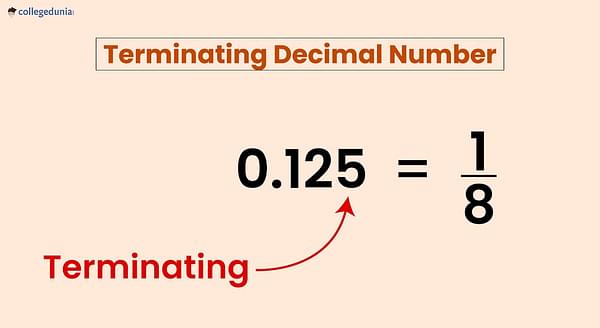
Terminating Decimal Number
How to Decimalize Rational Numbers
[Click Here for Sample Questions]
By definition, rational numbers are those that are recurring or terminating in nature. Let's look at an example to understand.
- Take the number 33.3333.......
- This number is a rational number because it can be expressed as 100 / 3.
- The decimal part that never ends is the recurring part.
- 38.34, 23.015, 22.553, and so on are examples of terminating decimals.
- These figures meet the criteria for being rational numbers.
Consider a decimal number. For example, 0.567.
- It can be expressed as 567/1000 or 567/103.
- Similarly, the fractional representations of the numbers 0.6689, 0.032, and.45 are 6689/104, 32/103, and 45/102.
- Thus, any decimal number can be expressed as a fraction with a denominator in powers of ten.
- We know that the prime factors of 10 are 2 and 5.
- Therefore, every decimal rational number can be simply expressed in the form of p/q, where p and q are integers and the prime factorization of q is 2x5y, where x and y are non-negative integers.
This statement gives rise to a very significant theorem.
Theorems
The theorems are given below
Theorem 1
If m is a natural rational number with a terminating decimal expansion, it can be written as j/k, where j and k are co-primes and k's prime factorization is 2x 5y, where x and y are non-negative integers.
The converse of this theorem holds true, and it is as follows:
Theorem 2
If m is a rational number that can be written in j/k form, and k's prime factorization is 2x 5y, where x and y are non-negative integers, then x has a terminating decimal expansion.
Theorem 3
If n is a rational number that can be expressed as the ratio of two integers j / k, and k's prime factorization does not take the form 2x 5y, where x and y are non-negative integers, x has a repeating decimal expansion.
Non-Terminating Decimal Numbers
[Click Here for Sample Questions]
Non-terminating decimal numbers are decimal numbers that have an infinite number of digits after the decimal point.
Example: 0.3333..., 4.43333..., and 5.34672310...,
Non-terminating decimal numbers are divided into two categories:
- Recurring decimals
- Non-Recurring decimals
Recurring Decimals
Recurring decimal numbers are decimal numbers that have an infinite number of digits after the decimal point and the digits are repeated at equal intervals after the decimal point.
Example: 0.111...,4.44444...,5.232323...,21.123123...., and so on.

Recurring Decimals
We can represent recurring decimal numbers in pq form, where q is not equal to 0 zero, or we can represent them as rational numbers.
Non-Recurring Decimals
Non-recurring decimal numbers are decimal numbers with an infinite number of digits after the decimal point and digits that are not repeated at equal intervals after the decimal point.
Example: 0.1223589..., 4.4782451...., 5.67245...., and so on.

Non-recurring decimal
Non-recurring decimals can't be represented in pq form. Irrational numbers are those that cannot be represented in pq form, where q is not equal to 0 zero. As a result, non-terminating non-recurring decimals can be classified as irrational numbers.
Also check:
| Relavant Topics | ||
|---|---|---|
| Trigonometric Functions | Complex numbers and Quadratic Equations | Straight Lines |
| Real-Valued Function | Horizontal and Vertical Lines | Angle Between Two Lines |
Things to Remember
- Decimal expansion of rational numbers is the conversion of a rational number to a decimal number.
- Rational numbers are any numbers that can be represented in the form p/q, where p and q are integers and q is not equal to 0.
- The long division method can be used to convert a rational number to a decimal number.
- There are two types of decimal representations (expansions) for a rational number: Terminating and repeating but non-terminating.
- Any non-terminating and non-recurring decimal representation is an irrational number.
Sample Questions
Ques. What is a decimal number? (2 Marks)
Ans. A decimal is a number consisting of two parts: whole and fractional. Decimal numbers are between integers and indicate numerical value for a whole plus some fraction of a whole.
Ques. What are the two options for a rational number's decimal expansion? (2 Marks)
Ans. If and only if the only primes that divide b are 2 or 5, a rational number a/b in lowest terms has two decimal expansions. When a rational number has two decimal expansions, as 1/5 does, one of them will repeat 0 from a certain point, while the other will repeat 9.
Ques. Is a rational number's decimal expansion always terminating? (2 Marks)
Ans. A rational number's decimal expansion always ends after a finite number of digits or begins to repeat the same sequence of digits over and over. Furthermore, any decimal that repeats or terminates is a rational number.
Ques. 0 is a rational number or not? (2 Marks)
Ans. What Makes a Number 0 a Rational Number? Because any number can be divided by 0 and equal to 0, this rational expression proves that 0 is a rational number. When 0 is divided by a whole number, the result is infinity, as shown by the fraction r/s. Because it cannot be expressed in fraction form, infinity is not an integer.
Ques. Give 5 examples of Rational numbers. (2 Marks)
Ans. 1/2, 1/5, 3/4, and so on are some examples of rational numbers. The number "0" is also a rational number because it can be represented in a variety of ways, including 0/1, 0/2, 0/3, and so on. However, 1/0, 2/0, 3/0, and so on are irrational because they give us infinite values.
Ques. Simplify: 21.5 ÷ 5 – 1/5 of (20.5 – 5.5) + 0.5 × 8.5. (2 Marks)
Ans. Using the BODMAS rule, we have
21.5 ÷ 5 – 1/5 of (20.5 – 5.5) + 0.5 × 8.5
= 21.5 ÷ 5 – 1/5 of 15 + 0.5 × 8.5
= 21.5 × 1/5 – 1/5 × 15 + 0.5 × 8.5
= 4.3 – 3 + 4.25
= 4.3 + 4.25 – 3
= 8.55 – 3
= 5.55
Ques. Simplify: \(2.3 -[1.89 - {3.6 - (2.7 - \overline{0.8 - 0.03})}]\) (3 Marks)
Ans. Using the BODMAS rule, we have
2.3 – [1.89 – {3.6 – (2.7 – 0.77)}]
= 2.3 – [1.89 – {3.6 – 1.93}]
= 2.3 – [1.89 – 1.67]
= 2.3 – 0.22
= 2.08
Ques. During a festival sale, the cost of an object is Rs. 870 on which 20% is off. The same object is available at other shops for Rs. 975 with a discount of 6 2/3 %. Which is a better deal and by how much? (3 Marks)
Ans. The cost of the object = Rs. 870
Discount = 20% of Rs. 870 = 20/100 × 870 = Rs. 174
Selling price = Rs. 870 – Rs. 174 = Rs. 696
The same object is available at other shops = Rs. 975

Selling price = Rs. 975 – Rs. 65 = Rs. 910
Since Rs. 910 > Rs.696
Hence, the deal at the first shop is better, and by Rs. 910 – Rs. 696 = Rs. 214
Ques. Show how √5 can be represented on the number line. (3 Marks)
Ans. Draw a number line and take points O and A on it such that OA = 1 unit. Draw BA ⊥ OA as BA = 1 unit. Join OB = √2 units.
Now draw BB1 ⊥ OB such that BB1 =1 unit. Join OB1 = √3 units.
Next, draw B1B2⊥ OB1such that B1B2 = 1 unit.
Join OB2 = √4 units.
Again draw B2B3 ⊥OB2 such that B2B3 = 1 unit.
Join OB3 = √5 units.

Take O as center and OB3 as radius, and draw an arc that cuts the number line at D.
Point D
represents √5 on the number line.
Ques. Express \(\overline {0.6}\) in the form pq where p and q are integers and q ≠ 0. (2 Marks)
Ans. Let x = \(\overline {0.6}\) = 0.6666… … (1)
As there is only one repeating digit,
multiplying (1) by 10 on both sides, we get
10x = 6.6666… … (2)
Subtracting (1) from (2), we get
10x – x = 6.6666… -0.6666…
⇒ 9x = 6 ⇒ x = 6/9 = 2/3
Thus, \(\overline {0.6}\) = 2/3
For Latest Updates on Upcoming Board Exams, Click Here: https://t.me/class_10_12_board_updates
Also Read:



Comments