



Exams Prep Master
An Asymptote is defined as a straight line that approaches a curve. But, the condition here with a straight line is that it shouldn't meet the curve at any distance. In other words, it will approach the curve to infinity and is in use to convey the behavior and tendencies of curves. When the graph comes close to the vertical asymptote, it curves either upward or downward very steeply. This is how even the steep curve almost looks like a straight line. This is the way in which the asymptotes of a function can be determined and is an essential step in sketching its graph. If this condition is fulfilled then that straight line is an Asymptote. Let us learn about the Asymptotes along with their formula and solved examples.
| Table of Content |
Key takeaways: Asymptotes, Asymptote formula, Hyperbola, horizontal Asymptote, vertical Asymptote, oblique Asymptote.
Also read: Isosceles Triangle Theorems
What is Asymptote?
[Click Here for Sample Questions]
A straight line that approaches the curve on a graph but never meets the curve. That straight line is called Asymptote. This can take place when either the x-axis i.e., the horizontal axis, or the y-axis i.e., the vertical axis tends to infinity.

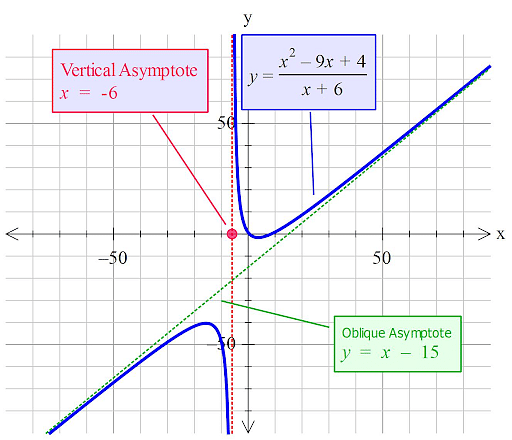
From the above figure, we can see that an asymptote of a curve is a line to which the curve converges. There is a very unique relationship between the curve and its asymptote, where they run parallel to each other, but never meet each other, at any point in infinity. Also, they run very close to each other but are still apart. There are different types of asymptotes such as Horizontal asymptotes, vertical asymptotes, and oblique asymptotes. Asymptote equation is usually for a hyperbola.
Horizontal Asymptote
If the curve approaches a constant value b when x moves towards infinity (either in positive or negative value). Then, the horizontal Asymptotes are found there.

Vertical Asymptote
If the curve moves towards the direction of infinity, when x approaches a constant value c from either right or left. Then, it is a symptom of Vertical Asymptote.

Oblique Asymptote
If the curve moves towards the direction of the line y = mx + b, when x is also moving towards infinity in any direction. Then, it is Oblique Asymptote.
Discover about the Chapter video:
Conic Sections Detailed Video Explanation:
Read more:
The Equation of Asymptote
[Click Here for Sample Questions]
An asymptote of the curve y = f(x).
In the function form: f(x,y) = 0 is a straight line distance where the curve and the straight line don't meet each other.

Asymptote of a Hyperbola
The asymptote of a hyperbola that has an equation as x2/a2 - y2/b2 = 0 is denoted by the following formula:
The Equation of Asymptotes=
b/a.x, and y = – b/a.x
Equation of Pair of Asymptotes= x2/a2 - y2/b2 = 0

Read more:
Things to Remember
- The Standard Equation of hyperbola is… x2/a2 - y2/b2 = 1
- The curve approaches and x moves towards infinty in horizontal asymptote.
- The curve approaches and x moves towards C in vertical asymptote.
- If a hyperbola has an equation of x2/a2 - y2/b2 = 1 then, the equation of asymptotes is bx/a and – bx/
- If the degree of the given numerator is greater than the degree of the denominator, then a horizontal asymptote cannot be contained by the function.
Also read: Difference between Sequence and Series
Solved Questions
Ques: Find the equations of the asymptotes of the hyperbola x2/49 - y2/36 = 1. [4 marks]
Ans: The equation of the hyperbola is already provided to us.
Equation: x2/49 - y2/36 = 1
Firstly, we would modify the equation according to the standard equation of a hyperbola…
Standard equation of hyperbola:
x2/a2 - y2/b2 = 1
Hence, x2/72 - y2/62 = 1
Then, Comparing the equation with the standard equation of hyperbola, we will find that a= 7, and b= 6.
Now, we already know that the equation of the asymptotes are
y = -b/a.x and y = b/a.x
Thus,
y = 6x/7 and y = -6x/7
7y = 6x and 7y = -6x
7y- 6x = 0 and 6x + 7y = 0
Therefore, the equations of the asymptotes are...
7y- 6x = 0 and 6x + 7y = 0
Ques: Find the Asymptotes parallel to the y-axis for curve a2x2 − b2y2 = 1. [3 marks]
Ans: The curve given to us is a2/x2 − b2/y2 = 1
After cross multiplication, we will get...
a2y2 - b2x2 = x2y2
a2y2 - x2y2 = b2x2
y2(a2 - x2 ) = b2x2
y2 = b2x2/a2 −x2
y = ±bx (a2−x2)
There y = ±b because an asymptote is known as a horizontal asymptote when it is parallel to the x-axis.
Ques: Find the equation of a pair of asymptotes of a hyperbola x2/16 - y2/25 = 1. [3 marks]
Ans: Equation of the hyperbola is given:
x2/16 - y2/25 = 1
Therefore, b = 5 and a = 4
Already known…
- If a hyperbola has an equation of x2/a2 - y2/b2 = 1 then, the equation of asymptotes is bx/a and -bx/a
Thus, y =-4x/5 and y = 4x/5 for the equation of the pair of asymptotes.
Hence, the Equation of the pair of asymptotes would be 5y-4x = 0 and 5y +4x =0
Ques: Given the function g(x) = x/x2 + 2, determine its horizontal asymptotes. [2 marks]
Ans: In this given function, we can observe that the numerator is x’s degree less in comparison to the degree of x in the denominator.
This means that the horizontal asymptote is determined at y = 0.
Ques: Given the function f(x) = x2 + 2/x + 1, find its horizontal asymptotes. [3 marks]
Ans: As we already know, If the degree of the given numerator is greater than the degree of the denominator, then a horizontal asymptote cannot be contained by the function.
Now, we need to compare the given equation according to this statement.
Equation: f(x) = x2 + 2/x + 1
While comparing, we can see that the equation’s numerator has a degree of 2 while the denominator only has a degree of one.
Hence, it can be said that the function does not contain a horizontal asymptote.
Ques: Find the horizontal asymptote of the function f(x) = 2x + 1/ 3x - 5. [3 marks]
Ans: Provided Function is
f(x)= 2x + 1/ 3x - 5
We can see that the degree of x in the numerator is the same as the degree of x in the denominator.
Hence, we need to divide the leading coefficients of both the given numerator and the denominator.
Therefore, we will find that the line y = âÂÂ...ÂÂ’’ is the horizontal asymptote there.
Ques: Find the vertical Asymptote of f(x)= 3x2 + 6x + 5/x2 - 3x + 2. [4 marks]
Ans: Need to find: Vertical asymptote
Equation: f(x)= 3x2 + 6x + 5/x2 - 3x + 2
Before proceeding further, we will make the denominator equal to 0 and then solve,
Making the denominator zero…
x2 - 3x + 2 = 0
Then we can factor the trinomial and set the factors to be equal to 0 in order to solve the equation.
(x - 2)(x - 1) = 0
x - 2 = 0 and x - 1 = 0
x = 2 and x = 1.
Thus, The vertical asymptotes are at x = 2 and x = 1.
Ques: What is the method to identify a vertical graph? [4 marks]
Ans: The method to identify a vertical graph is as follows in steps:
Step 1: We will need to Factorize the denominator and numerator.
Step 2: Then, we will find out any restrictions in the domain of the function.
Step 3: Now, we will cancel the common factors between the numerator and the denominator to reduce the expression.
Step 4: Make sure to note the values that make the denominator zero after canceling out the factor.
This is the method to identify the vertical asymptotes.
Note: Asymptotes are not there in the restrictions of the domain. These are identified as removable discontinuities.
Ques: Find the Equation of a hyperbola whose vertices are (± 5, 0) and its asymptotes are 3x ± 5y = 0. [4 marks]
Ans. As already known, The equation of the hyperbola is x2/a2 − y2/b2 = 1.
The vertices are (± a, 0).
The asymptotes need to be shown as straight lines.
Equation: y = -(b/a)x and y = (b/a)x.
Hence, the given Asymptotes are:
3x ± 5y = 0 and Vertices are (± 5, 0).
So, 5y = -3x and 5y = 3x
y=−(3/5)x and y=(3/5)x
As, b = 3 and a = 5
So, the Equation of hyperbola would be…
x2/25 − y2/9 = 1
Hence, 9x2 – 25y2 = 225
Ques: What are the asymptotes of the hyperbola 9x2 - 16y2 = 144? [3 marks]
Ans: The given equation of the hyperbola is
9x2 - 16y2 = 144
The above-provided equation can be described as x2/16 − y2/9 = 1
Standard equation of hyperbola:
x2/a2 − y2/b2 =1
Now, if we compare the above equation with the standard equation of Hyperbola.
we will get b = 3 and a = 4.
Thus, the asymptotes here are y = ±3/4x
Ques: Find the horizontal asymptotes for f(x) = x + 1 / 2x. (2 marks)
Ans: Given a function, f(x) = (x+1)/2x
We will consider here the coefficient of x because the highest degree here in both numerator and denominator is 1.
Thus, the horizontal asymptote is located at y = ½ for f(x) = x+1/2x.
Ques: Find the horizontal asymptotes for f(x) = x/x2 + 3. (2 marks)
Ans: Given function, f(x) = x/x2 + 3
Statement:
If the degree of the given numerator is greater than the degree of the denominator, then a horizontal asymptote cannot be contained by the function.
As we can observe that the degree of the numerator is less than the denominator here, hence, the horizontal asymptote for f(x) = x/x2 + 3 is at y = 0.
Ques: Find the horizontal asymptotes for f(x) = (x2 + 3) / x + 1. (2 marks)
Ans: Given a function,
f(x) =(x2+3)/x+1
Statement:
If the degree of the given numerator is greater than the degree of the denominator, then a horizontal asymptote cannot be contained by the function.
As we can observe, the degree of the numerator is greater than that of the denominator here. Hence, there is no horizontal asymptote for
f(x) =(x2+3)/x+1
Mathematics Related Links:



Comments