



Content Curator
When you inflate a balloon, the gas molecules are added to it. The result is that the volume of the balloon increases and the number of molecules in your lungs decreases accordingly. This gas phenomenon is based on Avogadro's law.
What is Avogadro’s Law?
Avogadro’s law is a gas law. It states that the total number of molecules/atoms of a gas is directly proportional to the volume occupied by the gas at constant temperature and pressure.
Avogadro’s Law is also known as Avogadro’s Hypothesis or as Avogadro’s Principle. This law is also associated with the ideal equation of the gas due to the reason that it links pressure, volume, temperature along with the amount of the substance of a gas.
The Avogadro’s law is named after an Italian Scientist; Amedeo Carlo Avogadro who discovered the fact that the two different types of gases occupy the same quantity of volume at a constant temperature, as well as pressure, must contain an equal number of molecules or atoms.
Formula and Graphical Representation of Avogadro’s Law
At any constant pressure and temperature, Avogadro’s Law can be expressed as:
V ∝ n
So, the formula of Avagadro’s Law can be given as-
V/n = k
Here,
V denotes the volume of gas,
n indicates the amount of gas (in moles) and
k is the constant.
Accordingly, if there is an increase in the amount of gaseous substance, there will be an increase in volume which is occupied by the gas and it can be calculated with the formula given below:
V1 /n1 = V2/n2 (=K, according to Avogadro’s Law)
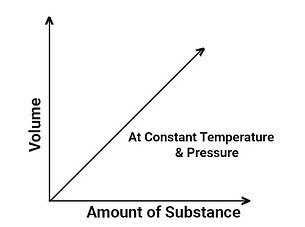
The following graphical representation can be used to understand Avogadro’s Law Formula:
The straight line in the graph indicates that zero moles of gas will occupy zero volume. Hence, both volume and amount of substance are directly proportional
Derivation of Avogadro’s Law
Avogadro’s Law can be expressed can be derived from the ideal gas equation. The Ideal gas equation can be expressed as:
PV = nRT
Here,
P indicates the pressure exerted on the wall of the container by the gas.
V indicates the volume that has been occupied by gas.
n indicates the total amount or total number of moles of the gaseous substance
R indicates to the Universal gas constant
T indicates the absolute temperature of the gas
The equation of ideal gas can be rearranged and the following equation can be stated:
V/n = (RT)/P
Here, (RT)/P is a constant as no change of temperature and pressure takes place & the product of two or more constants always remains a constant.
Hence,
V/n = K
So it can be stated that the definition of Avogadro’s Law and proportionality of the amount of gaseous substance and the Volume occupied is verified.
Avogadro’s Law: Molar Volume of a Gas
According to Avogadro’s Law, the ratio of the amount of gaseous substance and volume of gas at constant temperature and pressure is denoted by K. So,
K = (RT)/P
Under standard conditions, T= 273.15K and P=101.325 kilopascals
Therefore, the volume of one mole of gas at STP= 8.314 J.mol -1.K-1273.15 K(101.325 k Pa)= 22.4 Litres
So, the volume occupied by one mole of a gas at STP is 22.4 liters
Read Also: Charles Law Important Notes
Example of Avogadro’s Law
The respiration process is one of the great examples of Avogadro’s law. When we inhale, there is an increase in the molar quantity of the air in our lungs. This leads to an increase in lungs volume and our lungs expand.

A balloon filled with helium weighs much less than an identical balloon filled with air. Both balloons contain the same number of molecules. Helium atoms have a lower mass than either oxygen molecules or nitrogen molecules in the air, so the helium balloon is lighter.
Limitations of Avogadro’s Law?
- The Avogadro’s Law is perfectly applicable only on the ideal gases
- In case of the real gases, at very low pressure or at very high volume, the law provides an approximate relationship between the total number of molecules/atoms of the gas and the volume of gas.
- The ratio of volume to mole is a little bit more for real gases in comparison to ideal gases at High Pressure and Low temperature.
- Gases such as Hydrogen & Helium have relatively low molecular masses to follow Avogadro’s law in comparison to the other gases.
Check Important Notes for Avogadro’s Law (Volume-Amount Relationship)
Important Questions Based on Avogadro’s Law
Ques. 1: 5L of a certain gas contains 0.965mol. If the amount of the gas increases to 1.80mol, what new volume will be obtained? (2 Marks)
Answer: Given that:
V1 = 5 L
n1 = 0.965mol
n2 = 1.80mol
We have to find the new volume obtained i.e. V2
By the equation of Avogadro’s Law-
V1n2 = V2n1
(5.00L) (1.80mol) = (x) (0.965 mol)
9.00 = (x) (0.965 mol)
x= 9/0.965 mol
x = 9.3264 or 9.33 L
So, the new volume obtained is 9.33 L
Ques.2: If a balloon is filled with a volume of 1.90L with the amount of 0.0920 mol of helium gas. If some additional quantity of 0.0210mol of helium gas is added to the same balloon with constant temperature & pressure. What will be the new volume of the balloon? (2 Marks)
Answer: Given that:
V1 = 1.90L; n1=0.0920 mol; n2 = 0.0210 + 0.0920 = 0.1130 mol
Rearranging the Avogadro’s equation,
V2 = (V1 X n2)/n1
Putting the values to the equation
V2 = (1.90 L X 0.1130 mol) /0.0920 mol
V2= 2.33 L
Hence, a slight amount of helium has been additionally added, so the volume of the balloon will slightly increase.
Ques.3: State Avogadro’s Hypothesis? (2 Marks)
Answer: Avogadro’s hypothesis can be explained by taking two different gas having equal volume and the same amount of gaseous molecules at some constant pressure and temperature. According to his experiment, he stated that the Volume of the gas does not depend on the number or size of the molecules of the gaseous substance. So, the formula derived was V=kn. The hypothesis was developed by Avogadro in the year 1811. Only the behavior of ideal gases can be seen with Avogadro’s hypothesis.
Ques.4: A cylinder with a movable piston contains 2 g of helium, He, at room temperature. More helium was added to the cylinder and the volume was adjusted so that the gas pressure remained the same. How many grams of helium was added to the cylinder if the volume was changed from 2 L to 2.7 L? (2 Marks)
Answer: Given that:
V1 = 2 L
V2 = 2.7 L
n1= 2.00 g / 4.00 g/mol = 0.500 mol
n2 = ?
By Avogadro's Law:
V1 / n1 = V2 / n2
2.00 L / 0.500 mol = 2.70 L / n2
n2= 0.675 mol
The amount of He added in grams:
0.675 mol − 0.500 mol = 0.175 mol
(0.175 mol) (4.00 g/mol) = 0.7 grams of He added
Ques.5: If 0.00810 mol neon gas at a particular temperature and pressure occupies a volume of 214 mL, what volume would 0.00684 mol neon gas occupy under the same conditions? (2 Marks)
Answer: Given that:
V1 = 214 mL
V2 = ?
n1= 0.00810 mol
n2 = 0.00684 mol
By Avogadro's Law:
V1 / n1 = V2 / n2
214 mL / 0.00810 mol = V2 / 0.00684 mol
V2 = 181 mL
Alternatively-
According to ideal gas equation-
PV = nRT
Dividing PV1 = n1RT by PV2 = n2RT, we get
V1/V2 = n1/n2
V2 = V1n2/n1
V2 = [(214 mL) (0.00684 mol)] / 0.00810 mol
V2 = 181 mL



Comments