



Content Curator
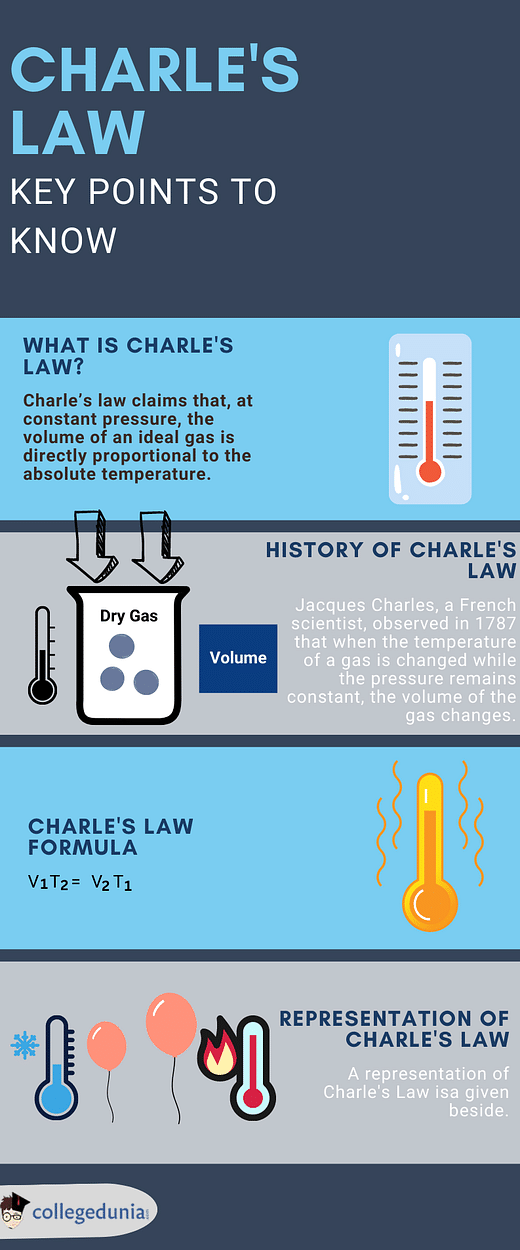
Charle’s law claims that, at constant pressure, the volume of an ideal gas is directly proportional to the absolute temperature.
- Charle’s law also states that Kelvin temperature and volume are directly proportional when the pressure exerted on a sample of a dry gas is kept constant.
- Jacques Charles, a French scientist, observed in 1787 that when the temperature of a gas is changed while the pressure remains constant, the volume of the gas changes.
- Later, in 1802, Joseph Gay-Lussac refined Charles' concept and popularised it as Charles' law.
- At very high temperatures and low pressures, gases follow Charle's law.
For example, hot air can be seen to rise, which is why hot-air balloons soar higher in the atmosphere. It's also why warm air tends to condense towards the ceilings while cold air condenses on the ground. As a result of this behaviour, heating registers should only be placed near the floors, while air-conditioning vents should be located near the ceilings.
The explanation for this behaviour is that when gases are heated, they tend to expand. Hot air is less dense than colder air because the same amount of substance tends to occupy a larger volume. The substances with a lower density, such as hot air, tend to rise through the substance with a higher density, which in this example is cooler air.
Also Read: Avogadro’s Law
| Table of Content |
Key Terms: Charle’s Law, Volume of Gas, Temperature, Kelvin Scale, Gas, Atmosphere, Gay-Lussac Law
What is Charle’s Law?
[Click Here for Sample Questions]
Charle’s Law, also known as the Law of Volumes, explains how gas expands when temperature increases. However, the volume decreases when there is a decrease in temperature.
During the comparison of a substance under two different conditions from the above statement, the following can be written:
| V2/V1 = T2/T1 Or, V1T2 = V2T1 |
The equation shows that as the absolute temperature is increased, the volume of the gas also rises in proportion.
- Charle’s law is considered a special case of the ideal gas law.
- It is applicable to the ideal gases which are held at constant pressure with a changing temperature and volume.
- Charle’s law is an experimental gas law.
- It shows how gases expand when heated.
Examples of Charles Law
Some examples of Charle’s law are:
Shrinking of Inflated Object Due to Charle’s law
The shrinking of objects is a good example of Charle’s Law.
- During winters, when the temperature decreases, a ball outside the ground tends to shrink.
- This is why the pressure in the car tyres is checked when outside in winter.
- It is also the case for any given inflated object.
Bursting Tube Due to Charle’s law
In case a tube is overfilled and then placed in a pool on a hot day.
- if a tube has been overfilled, it can swell and burst when put under the sun.
- The same is when a turkey is cooked, the gas inside the thermometer tends to expand until it can “pop” the plunger.
- Pop-up turkey thermometers are based on the principle of Charles’ law.
Another common application of Charle’s Law can be seen in the working of a car engine.
Charle’s Law Formula
[Click Here for Previous Year Questions]
Charle’s Law formula can be expressed as:
| VI /TI=VF /TF |
Here,
- VI = Initial volume
- VF = Final volume
- TI = Initial absolute temperature
- TF = Final absolute temperature
Note: The temperatures, here, are absolute temperatures measured in Kelvin, not in ⁰F or ⁰C.
Charles Law Application
This law has a wide application in daily life. Some
- In a cool environment, helium balloons are seen to shrink.
- In the winters, the capacity of the human lung decreases.
Experiment Verification of Charle’s lawCharle’s Law can be experimentally determined as well. Thus,
Hence, by knowing the temperature and volume of both conditions, we can verify Charle’s law. |
Derivation of Charle’s Law
[Click Here for Sample Questions]
At constant pressure, the volume of a fixed amount of dry gas is directly proportional to absolute temperature. This can be said as per Charle’s law. Thus, it can be shown as:
⇒ V∝T
Now, as V and T are varying directly, they can be equated by having a constant k. Thus,
V/T = constant = k
Here, the value of k depends on the gas pressure, its amount and the unit of the volume.
Thus, V*T=k … (1)
Assuming that V1 and T1 are the initial volume and the temperature respectively of an ideal gas.
Then, we can say:
V1/T1 = k … (2)
Now, after changing the temperature of the gas to T2, its volume changes to V2, therefore:
V2/T2 = k … (3)
From equation 2 and 3,
V1/T1 = V2/T2
Or, V1T2 = V2T1
As per Charles’ Law, the volume (V) of the gas is directly proportional to its temperature (T). The temperature, in this case, is measured in terms of Kelvin.
In case the temperature changes one unit of the Kelvin scale, it is then equivalent to a change in one Celsius degree. Also, 0 on the Kelvin scale indicates -273 or “Absolute Zero”.
Charle’s Law Infograph
Charles’ Law Temperature-Volume Relationship
[Click Here for Previous Year Questions]
According to Charles Law, when a gas with a fixed mass is cooled, its volume decreases and increases as the temperature rises. The volume of the gas tends to rise by 1/273 of its actual volume at 0°C for every degree increase in temperature.
As the temperature rises, the volume rises, and as the temperature falls, the volume falls. In the figure below, volume-temperature data for a 1-mole sample of methane gas at 1 atm are listed and graphed.

Let Vo and Vt be the volume of the gas at 0 and t degrees Celsius, respectively.
Then,
Vt = Vo + t/273.15 Vo …..(i)
Vt = Vo ( 1 + t/273.15 ) ….(ii)
Vt = V0 ( 273.15+t / 273.15) …. (iii)
We'll now establish a new temperature scale, with t = T -273.15 for temperature in Celsius and To = 273.15 for temperature in Fahrenheit. The Kelvin temperature scale, often known as the Absolute temperature scale, is a new temperature scale (T). When writing a temperature in Kelvin scale, the degree sign is omitted.
It's also known as the thermodynamic temperature scale, and it's widely used in all fields of science. As a result, while writing temperature in Kelvin scale, we add the temperature in Celsius to 273 to get the temperature in Kelvin scale.
So,
Tt = 273.15 + t
To = 273.15
Now, we can write equation (iii) as :
Vt = Vo ( Tt/ To )
=> Vt / Vo = Tt / To
=> Vt / Tt = Vo / To
In general,
V1 / T1 = V2 / T2
We can see in this equation that V/T is constant which is equal to ‘k’ (proportionality constant). The value of the constant 'k' is proportional to the volume V, the amount of gas, and the pressure.
Read Also:
Charles’ Law Graphical Representation
[Click Here for Sample Questions]
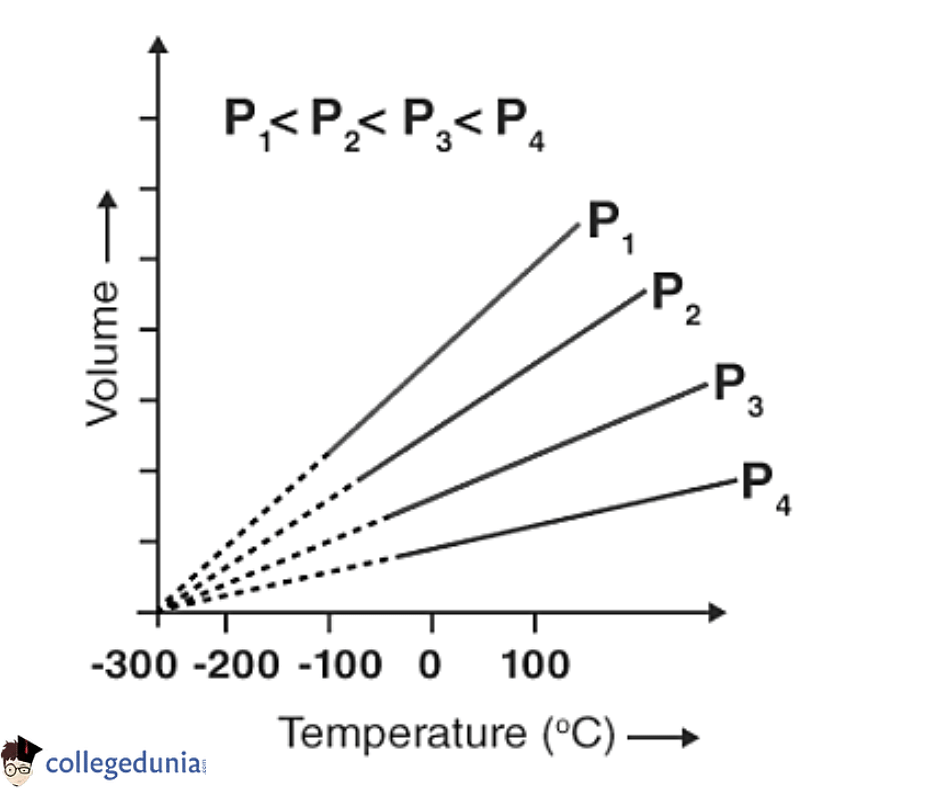
When the volume is altered at constant pressure, the volume-temperature connection follows a straight line on the graph, and when the volume is reduced to zero, all lines cross at -273.15 C on the temperature axis.
- The lines in the graph of volume vs temperature are isobars (since pressure is constant).
- Absolute zero refers to the lowest imaginary temperature of -273°C at which gas has no volume.
Limitations of Charles lawSome limitations of Charle’s Law include:
|
Things to Remember
- Charles’ Law states that “The volume of a fixed mass of gas decreases when cooled, and increases when the temperature is increased.”
- The value of the constant 'k' is proportional to the volume V, the amount of gas, and the pressure.
- One of the major Charles’s law limitation is that it is applicable only to ideal gases.
- The equation for Charles’ Law can be written as : V1 / T1 = V2 / T2
Read More:
Previous Year Questions
- According to Boyle's law, the product of pressure and volume…(KCET 2010)
- What volume of oxygen gas …(NEET 2008)
- Boyle's law is applicable for an…
- Above the Boyle temperature, the compressibility factor… (AMUEEE 2013)
- At Boyle temperature, compressibility factor Z for a real gas…
- Name the process in which Boyle's law is applicable…(JEE Advanced 2019)
- Densities of two gases are in the ratio of 1 : 2 and their…
- With increase in temperature, which one of these changes...?
Sample Questions
Ques. Define Charle’s law. (1 mark)
Ans. Charle’s law states that, at constant pressure, an ideal gas’ volume is directly proportional to the absolute temperature. Charle’s law also claims that Kelvin temperature and volume are in direct proportion when the pressure exerted on a sample of a dry gas is kept constant.
Ques. Determine the initial volume of a gas at 300 K, considering that the ultimate volume is 6 L at 200 K. (2 marks)
Ans. As per the given equation,
V2 = 6 L
T1 = 300 K
T2 = 200 K
Thus, to determine V1:
Using Charle's Law,
(V1)(T1) = (V2)(T2)
(V1)(300) = (6)(200)
V1 = 3 L
Hence, the initial volume of a gas at 300 K is 3 litres.
Ques. A gas thermometer is used to measure temperature by watching the volume of the gas change as the temperature changes at constant pressure. When immersed in a mixture of ice and water (0.00 °C = 273.15K), the hydrogen in a specific hydrogen gas thermometer has a volume of 150.0 cm3. The volume of hydrogen is 131.7 cm3 when immersed in boiling liquid ammonia at the same pressure. On the Kelvin scale, calculate the temperature of boiling ammonia. (2 marks)
Ans. When there is a volume change due to a temperature change at constant pressure, we should apply Charles' law. Using V1 and T1 as the initial values, T2 as the unknown volume's temperature, and V2 as the unknown volume, and converting °C to K, we get:
V1 / T1 = V2 / T2 (Charles’ Law)
=> 150.0 cm3 / 273.15K = 131.7 cm3 / T2
On rearranging and solving, we get,
T2 = 239.8 K
Ques. At 10 °C and 750 torr, a sample of carbon dioxide, CO2, takes up 0.300 L space. At 30°C and 750 torr, how much volume will the gas have? (2 marks)
Ans. This is a job for Charles' law because we're seeking for the volume change produced by a temperature change at constant pressure.
Using V1 and T1 as the initial values, T2 as the unknown volume's temperature, and V2 as the unknown volume, and converting °C to K, we get:
V1 / T1 = V2 / T2 (Charles’ Law)
=> 0.300L / 283K = V2 / 303K
On solving we get,
V2 = 0.321 L
This confirms the explanation of Charles' law, according to which increasing the temperature of a gas (from 283 K to 303 K) at a fixed pressure will result in an increase in its volume (from 0.300 L to 0.321 L).
Ques. What is the connection between temperature and pressure? (3 marks)
Ans. A graph depicts the link between pressure and temperature. This graph is explained in the following manner. When the volume and amount of air are kept constant, the temperature and pressure of the gas are directly proportional on the Kelvin scale.
However, because of the gases' tendency to condense at lower temperatures, we are unable to quantify these. When the line on the graph is extended to lower pressures, it tends to achieve zero pressure at -273.15 degrees Celsius. According to the Kelvin scale, this is 0 degrees Celsius and the lowest temperature imaginable, often known as absolute zero.

Ques. What is the connection between Pressure, Volume and Temperature? (3 marks)
Ans. Pressure, volume, and temperature have the following relationship:
- Depending on the experimental findings of the characteristics they exhibit, the behaviour of the gases is defined by numerous different laws. Amonton's Law explains when the volume is held constant, the pressure for a given amount of gas is precisely proportional to the absolute temperature.
- Charles' Law explains when the pressure remains constant, the volume of a particular gas is directly proportional to the absolute temperature.
- Boyle's Law expresses when the temperature is held constant, the volume of the gas is inversely proportional to the pressure it contains.
- Equal volumes of gases have the same molecules under the same pressure and temperature circumstances. This is according to Avogadro's Law.
Ques. At a temperature of 0°C and a pressure of 760 mm Hg, a gas fills 221cm3. What will the volume be at 100 degrees Celsius if the mass of the gas remains the same? (3 marks)
Ans. Since the mass of the gas is constant, pressure also remains constant. So, we can use Charles’ Law here. Let V1 and T1 be the initial values of volume and temperature respectively and V2 and T2 be the final values. Because the temperature in the question is given in Celcius, it must be converted to the absolute temperature, which is Kelvin, using the following formula:
V1 = 221cm3 ; T1 = (0 + 273) = 273 ; T2 = (100 + 273) = 373K
Now,
V1 / T1 = V2 / T2 (Charles’ Law)
=> 221 / 273 = V2 / 373
On rearranging and solving, we get,
V2 = 302cm3
Ques. A gas sample has an initial volume of 30.8L, with an initial temperature of -67°C. Determine the temperature of the gas if the volume is 21.0L? (5 marks)
Ans. As per the given equation,
V1 = 30.8L
T1 = – 67°C = 206K
Thus, we have to determine the value of T2
V2 = 21.0L
As per Charle’s law
V1/T1=V2/T2
Thus, by replacing the values, we get,
30.8/67 = 21/T2
T2 = 21*67/30.8
= 46.9⁰C
Assuming that V1 is the 3.60L, T1 = 255K,
T2=102K
According to the question, we have to find V2.
Thus,
With the help of Charle’s law, we can say:
V1/T1 = V2/T2
3.60/255 = V2/102
V2 = 1.44L
Also Read:



Comments