



Content Curator
Beat is an interesting phenomenon arising from the interference of waves. The difference in frequency of two superimposed waves is called beat frequency. Interference occurs when two or more waves moving in the same medium and the same direction come in contact with each other. The beat is the best example of Inference. It's due to both constructive and destructive interference. In sound, we perceive the beat frequency as the rate at which the loudness of the sound fluctuates, whereas the regular frequency of the waves is heard as the pitch of the sound.
| Table of Content |
Key Terms: Beat Frequency, Frequency, Derivation, Waxing and Waning, Uses, Applications
Beat Frequency
[Click Here for Sample Questions]
Beats are produced when two waves of nearly identical frequencies moving in the same medium and the same direction meet at a point. When two superimposed sound waves of different frequencies approach our ear, the alternating constructive and destructive interference is produced which causes the sound to be alternately loud and soft; this phenomenon is known as beating.
The formula for beat frequency is fb = f2 - f1, where
fb is the difference between the frequency of two waves. And f1 and f2 are two waves.
The frequency difference between the two waves is equal to the beat frequency.
Beat frequency is defined as the number of beats per second that is equivalent to the difference in frequencies of two waves.
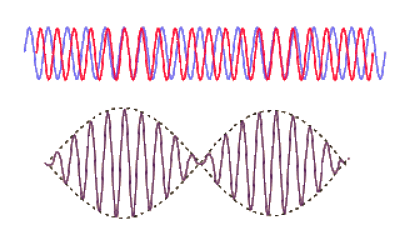
Different Types of Sound Waves
| Beat frequency formula: fb = f2 - f1 Where fb indicates Beat Frequency. And f1 and f2 indicate two different frequency waves |
Read Also: Waves
Derivation of Beat Frequency Formula
[Click Here for Sample Questions]
We know that the number of beats in a second is the beat frequency.
Considering two distinct sounds from different origins meet at a point p in the same medium air. Suppose one source has a shorter time (TS) and a high frequency (f2), on the other hand, the other source has time, and frequencies are TL and f1.
As we discussed above when a crest from each source is at point p. After an amount of time TS passes, the next crest from the shorter-period source arrives, the equivalent crest from the longer-period source won’t arrive for an amount of time.
T= TL-TS
With each subsequent short-period crest, the equivalent long-period crest is additional T behind. The long-period crest will eventually reach a full long period TL after the analogous short period crest arrives after some number n of short periods.
n T = TL ……(1)
This signifies when the short-period crest arrives, the long-period crest is preceding the equivalent arriving long-period crest. As a result, constructive interference occurs (loud sound). The beat period is the time it takes, when the interference is maximum constructive, for the interference to become maximally constructive.
TBEAT = n TS ……(2)
From equation 1 & 2, we get
TBEAT = TLTTS
Here, T = TL- TS
So, TBEAT = TLTL - TS Ts
TBEAT = TLTSTL - TS
Dividing top and bottom by the product TLTS gives,
TBEAT = 11TS - 1TL
Taking reciprocal both sides we get,
1TBEAT = 1Ts - 1TL
Now, by using the relation between f = 1T we get,
fBEAT = f2 - f1
Waxing and Waning of the Sound
[Click Here for Sample Questions]
Assume that two waves in any given medium with identical amplitudes and slightly differing frequencies move in the same direction and meet at a particular spot. The resulting intensity of the sound, the highest sound, is referred to as 'waxing,' while the minimum sound is referred to as 'waning.' Beats are described as simultaneous waxing and waning.
Uses of beat frequency
[Click Here for Sample Questions]
- Musicians used beats to determine the tone of musical instruments.
- The beat frequency is used in RADAR. RADAR speed detectors used the reflected waves of microwave radiation bounced off by moving vehicles. The Doppler effect shifts the frequency of these waves, and the beat frequency between the directed and reflected waves provides an estimate of the vehicle speed.
- Beats are used in finding the unknown frequency.
- Doppler ultrasonography and echocardiography are based on the phenomena of the beats.
- This technique is also used by piano and organ tuners to count beats to generate a precise number of specific intervals.
Read Also: Electromagnetic Spectrum
Things to Remember
[Click Here for Sample Questions]
- Beats: sound waves travel in the same direction and the same medium, varying wavelength and amplitude, and f1 and f2 are not similar to each other.
- The difference between two superimposed sound waves is called beat frequency. The negative value of beat frequency is not possible. Commonly used in RADAR and musicians take the help of this method to tune their instruments.
- Humans can hear sounds with frequencies ranging from 20 Hz to 20 kHz.
- Infrasound wave frequency is less than 20hz, which is inaudible to the human ear. Ultrasound wave frequency is above 20hz which is inaudible to the human ear.
- Sounds are soft and pleasant to hear, originated from a source having periodic vibrations, whereas, noises are just opposite of the sound. Noises are unpleasant and irritating, originated from irregular vibrations, and have no quality.
Read Also: Unit of Sound
Sample Questions
Ques. Compute the beat frequency if the two frequencies of waves are 750 Hz and 380 Hz respectively? (2 marks)
Ans. Given parameters are, f2 = 800Hz and f1= 400Hz
The beat frequency is given by, fb = f2 - f1
fb = |800−400|= 400Hz
Ques. Compute the beat frequency if the wave frequencies are 550 Hz and 1000Hz respectively? (2 marks)
Ans. Given data are, f1= 550 Hz and f2= 1000 Hz
Thus, the beat frequency is given by, fb = f2 - f1
fb = |1000−550|= 450Hz
Ques. Write the primary differences between Standing waves & Beats. (2 marks)
Ans.
| Standing Waves | Beats |
|---|---|
| Sound waves travel in the opposite direction in the same medium. | Superimposed sound waves travel in the same direction in the same medium. |
| Wavelength and amplitude are equivalent. | The wavelength and amplitude are not equivalent |
| Frequency of the two waves is the same. | The frequency of the two waves is not the same. |
Ques. How to obtain the frequency of unknown tuning forks? (2 marks)
Ans. The phenomenon of beats can be used to determine the unknown frequency of the tuning fork.
Assume tuning fork A has a known frequency of f1 and generates m beats per second with another tuning fork B which has an unknown frequency of f2. We may calculate f2 using the following formula: f2 = f1 m. The sign here signifies that m can be either positive or negative.
Ques. Sound of maximum intensity is heard successively at an interval of 0.2 seconds on sounding two tuning forks to gather. What is the difference in frequencies of two tuning forks? (2 marks)
Ans. The beat period is 0.2 seconds so the beat frequency is fb= 1/0.5= 5HZ. As a result, the difference of frequencies of the two tuning forks is 5HZ.
Ques. Write the real-life applications of Beats. (1 mark)
Ans. Beats are used by musicians for tuning instruments, determining the presence of hazardous gases in mines, and building low-frequency oscillators.
Ques. The two closed organ pipes of length 100 cm and 101 cm, respectively, give 16 beats in 20 seconds when each is sounded in its basic node, then the velocity of sound is? (3 marks)
Ans. Given L1 = 100 cm = 1.0 m and L2 = 101 cm = 1.01 m
Number of beats, m = f1-f2
16/20 = v/(4/1) - v/(4/2)
= v/4
1/1.0−1/1.01
1/1.0−1/1.01
⇒ 16/20 = v x 0.01 / 4 x 1.01
On solving, we get: v = 332 m/s
Ques. Calculate the Beat Frequency if the Two Frequencies of Waves are 720Hz and 280 Hz Respectively? (2 marks)
Ans. From the given data, f2 = 700Hz and f1= 300Hz
The formula for beat frequency is fb = f2 - f1
fb = |700−300|= 400Hz
Therefore, the beat frequency of the above given two waves is 400Hz.
Ques. Derive the Beat Frequency of the Wave, with Frequencies, are 650 Hz and 800 Hz Respectively? (2 marks)
Ans. From the given data, f1 = 650Hz and f2 = 800Hz
The beat frequency derivation fb = f2 - f1
fb = |800−650|= 150Hz
Therefore, the beat frequency of the above given two waves is 150Hz.
Ques. Explain beat frequencies are audible or not? (3 marks)
Ans. If the difference between two superimposed sound waves is less than 10Hz, the waves are quite near in frequency and we may hear the sound as one pinch. The pinch here signifies the average of two waves' frequencies.
Similarly, the loudness of the beat frequency is entirely determined by the frequency range. The beat frequency between the two waves can range from 10Hz to 60Hz.
Ques. Two sitar strings A and B playing the note "Ga" are slightly out of tune and produce beats of frequency 6 Hz. The tension in string A is slightly reduced and the beat frequency is found to reduce to 3 Hz. If the original frequency of A is 324 Hz, what is the frequency of B? (NCERT) (3 marks)
Ans. Let f1and f2be the frequencies of strings A and B respectively.
Then, f1= 324 Hz, f2= ?
The number of beats, fb= 6
f2= f1± fb= 324 ± 6
i.e., f2= 330 Hz or 318 Hz
Since the frequency is directly proportional to the square root of tension, on decreasing the tension in the string A, its frequency f1 will be reduced i.e., the number of beats will increase if f2= 330 Hz. This is not so because the number of beats becomes 3.
Therefore, it is concluded that the frequency f2= 318 Hz. Because of reducing the tension in string A, its frequency may be reduced to 321 Hz, thereby giving 3 beats with f2= 318 Hz.
Ques. Explain following conditions and how do they happen: (3 mark)
(a) bats can travel distances, directions, nature, and sizes of the obstacles without any “eyes”.
(b) a violin note and a sitar note may have the same frequency, yet we can distinguish between the two notes.
Ans.
- While flying bats produce high-frequency ultrasonic sounds. When these ultrasonic waves reflect from the barriers along their route, it is observed by bats. These waves provide them with information on the distance, direction, nature, and size of the barriers.
- The note quality of both instruments is different. Hence, both the instruments release different harmonics which can be observed by the human ear and easily used to differentiate.
Also check:



Comments