



Content Curator
Standing waves are a spectrum of vibrating patterns that get filled inside a medium when light or sound waves passes.Standing waves help us understand the reason behind the sounds produced by various musical instruments like guitar, violin, piano, flute, saxophone, etc. Standing waves are produced every time you ring a bell. Waves are disturbances that transfer energy from particle to particle.
Mechanical Waves
[Click Here for Sample Questions]
The mechanical waves always require a medium to propagate or travel. When a mechanical wave travels in a medium, the energy gets transferred from one particle to the consecutive one and so on, resulting in a successive disturbance propagation.
When two similar mechanical waves from different sources overlap, the displacement of a particle at a given point in a medium disturbed by these waves is the sum of the individual displacements caused by the overlapping waves. This cumulative displacement is called Superposition.
When two identical waves having the same frequency and amplitude overlap, then the superposition caused by these waves is termed as Interference. For superposition the waves can have any frequency and amplitude but the same does not hold true for the interference of waves. So, we can say that interference is a special case of superposition in which the overlapping waves must be identical.
Read more: Important terms related to wave motion
Standing Waves
[Click Here for Sample Questions]
Standing waves are formed by the interference of two identical waves generated from different sources and opposite directions. In case of a string fixed at both ends, the disturbance caused on one end propagates in positive x direction in the form of an incident wave.
This incident wave gets reflected back when it reaches the far end. The reflected wave then overlaps the incident wave and their interference turns into a wave called the standing wave. So, a standing wave is nothing but the interference of two identical waves travelling in opposite directions.

Incident Waves
In a stretched string fixed at both ends, the equation for a standing wave travelling in positive x direction at any point x and time t is given by
| y(x, t) = (2a sin kx) coswt |
Nodes and AntiNodes
[Click Here for Sample Questions]
Standing waves consist of a pattern formed by nodes and antinodes. In a standing wave, the point of minimum or zero displacement is called node and the point of maximum amplitude or displacement is called antinode. Every two consecutive nodes or antinodes are set apart by a distance of λ/2.
The nodes and antinodes are always located at the same point along the path of the standing wave in a medium. They appear to be stationary or standing still. Hence, these waves are also called “Stationary Waves”.
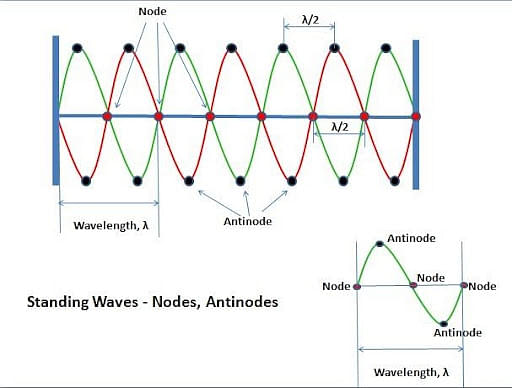
Standing Wave- Nodes, Antinodes
Normal Mode of Oscillation
[Click Here for Sample Questions]
Resonance occurs when a standing wave is formed by two identical waves which interfere in such a manner that their amplitudes add or subtract in repetitive ways.
The standing waves are formed by forced resonance vibrations which create a pattern at specific frequencies of vibration called harmonic frequencies of harmonics. In case of the fixed end string of length L, the trip along the string and back to the oscillating end is equal to n number of wavelengths.
Trip to and fro along the string length = 2L = n.λ
Therefore,
Wavelength is:
λ= 2L/n, for n = 1, 2, 3…..
Also, frequency corresponding to this wavelength is obtained by dividing the velocity or speed of the wave with the wavelength.
f = v / λ = n. v/ λ , for n = 1, 2, 3…..
Therefore, f = n. v/2L
Where,
- f = harmonic frequency
- v = velocity of the wave travelling along the string
- n = no. of wavelength segments = harmonic number
- λ = wavelength
The special modes of vibration of a stretched string obtained by the above equation are called the Normal Modes.

Standing Wave- Resonance
First Harmonic Pattern
[Click Here for Sample Questions]
The fundamental frequency or the first harmonic pattern consists of a single antinode in the middle of the stretched string. This antinode vibrates up and down from a maximum upward displacement to a maximum downward displacement, thus, creating a loop within the string. As we know, a standing wave pattern consists of two loops, which means one loop is equal to half of the wavelength. As we observe the first harmonic pattern in the image above, we can see that there is only half of the wave stretching across the length of the string.
So, for first harmonic, L = λ /2
Second Harmonic Pattern
[Click Here for Sample Questions]
The second harmonic pattern is characterised by two antinodes as seen in the image above. So in this pattern, there are 2 loops of length λ /2.
For the equation for 2nd Harmonic is –
L = 2 λ /2 = λ
Similarly, for 3rd harmonic, L = 3 λ /2
Hence, the general equation representing the length-wavelength relationship of a harmonic is given by –
L = n λ /2
Read more: Transverse and Longitudinal Waves
Things to remember
- Standing wave is actually a pattern that occurs from the interference of two or more waves travelling in opposite directions.
- Nodes are located at the points of zero displacement where destructive interference occurs. They are formed at points of intersection of the crest of one wave and the trough of the other wave.
- Antinodes are located at the points of maximum displacement/amplitude, i.e. where constructive interference occurs.
- The points of disturbance that travel from one location to other in a medium are represented by crests and troughs.
- The point of large positive displacement is called crest and the point of large negative displacement is called trough.
Also check:
Sample Questions
Ques.Why are standing waves also called stationary waves? (2 Marks)
Ans. Standing waves are characterised by a pattern formed by nodes and antinodes. These nodes and antinodes are always located at the same point along the path of the standing wave in a medium. They appear to be stationary or standing still. Hence, these waves are also called “Stationary Waves”.
Ques.In a stretched string of length 10m, standing waves are produced. Find the frequency, if the string vibrates in 5 segments and the velocity of the wave is 20 m/s. (2 Marks)
Ans. Length of the stretched string = L =10 m
Number of segments of vibration = n = 5
Wavelength of the vibration = λ
L= n λ /2 therefore, λ = 2L/n
Wavelength = λ = 10x2/5 = 4m
Velocity of the wave = v =20m/s , v = f. Λ
Frequency = f =v/ λ = 20/4 = 5Hz
Ques.What do you mean by Superposition and Interference? (3 Marks)
Ans. When two similar mechanical waves from different sources overlap, the displacement of a particle at a given point in a medium disturbed by these waves is the sum of the individual displacements caused by the overlapping waves. This cumulative displacement is called Superposition.
When two identical waves having the same frequency and amplitude overlap, then the superposition caused by these waves is termed as Interference. For superposition the waves can have any frequency and amplitude but the same does not hold true for the interference of waves. So, we can say that interference is a special case of superposition in which the overlapping waves must be identical.
Ques.What are nodes? (2 Marks)
Ans. Standing waves are formed by patterns produced by interference of two identical waves with same frequencies characterised by points along the medium which always appear to be standing still. These points of zero displacement are called Nodes.
Ques. What are standing waves? Explain how standing waves may be formed in a stretched string. (3 Marks)
Ans. When two identical progressive waves, travelling in opposite directions in a medium along the same straight line, are superimposed then the resultant wave obtained is called standing wave.
The standing waves are formed in a stretched string in the following manner:
In case of a string of length L fixed at both ends, the disturbance caused on one end propagates in positive x direction in the form of the incident wave.
When the wave reaches the other fixed end, it is reflected back to the oscillating end.
The reflected wave then overlaps the incident wave and their interference turns into a wave called the standing wave.
Ques.The velocity of waves in a string fixed at both ends is 2 m/s. The string forms standing waves with nodes 5.0 cm apart. Find the frequency of vibration of the string in Hz. (2 Marks)
Ans. Velocity of wave = v = 2 m/s
Distance between two consecutive nodes = λ/2 = 5 cm
Therefore, wavelength, λ = (5x2) = 10 cm = 0.1 m
Now, frequency f = v/ λ = 2/0.1 = 20 Hz
Ques. How does the speed of sound respond with change in (i) amplitude and (ii) wavelength of sound wave? (2 Marks)
Ans. The speed of sound is affected in the below given ways:
- Amplitude: The speed of the sound doesn't change with any change in amplitude.
- Wavelength of sound wave: The speed of sound does not change with change in wavelength of sound wave.
Ques. A cylindrical tube, open at both ends, has a fundamental frequency f in the air. The tube is dipped vertically in water so that half of its length is in water. The new fundamental frequency of the air column in the tube is? (3 Marks)
Ans. The initial fundamental frequency is,
The relation of fundamental frequency for open tube is given by, f:
f = v/2L
Here, v is the speed of sound and L is the length of the tube.
When the cylindrical tube is dipped into the water vertically, it will become a closed tube, and also, the length of the tube is halved.
The relation of fundamental frequency for closed tube is given by,
fc = v/4(L/2)
fc= v/2L
fc= f
Thus, the new fundamental frequency will be f.
Also read:



Comments