



Content Curator
Biodiversity of plants and animals refers to the diversity of different species of the living organisms living on our planet Earth. Biodiversity is a measure of variation at the genetic, species, and ecosystem level. The meaning of the term 'Biodiversity' is biological diversity and its study involves the counting of the total number of species living in a certain area.
| Table of Content |
Read Also: Biodiversity and Conservation
On our planet, every single living species is very important for the smooth workflow of our ecosystem and plays an important role in keeping our planet a better place to live. Biodiversity is also referred to the genes of a species by some biologists and also their involvement and role in the ecosystem. In the tropical region, biodiversity is considered to be very rich and greater near the equator due to the warm climate of these areas and high primary productivity.

Plant Biodiversity
Plant Biodiversity is one of the most important characteristics of our environment because the complete balance of the ecosystem depends on the biodiversity of plants. It plays the role of moderating our climate, to mitigate the soil from erosion, providing shelter to animals, and is also a major source for food and medicine. But due to the rise of human population and increased set up of factories and industry, the plant biodiversity is being endangered. It is causing a threat to various plant species as many of them are getting extinct with every passing day.

And not only plants, many animal species are also being endangered because they are losing their homes to us humans for building various factories and industries.
The plants provide us oxygen through the process of oxygen which we breathe and without which we wouldn't be able to survive. Maintaining and improving the number of plants on our planet is very important as it serves us with both food and oxygen and will also help us to control global warming and climate change.
Read Also: Definition of Biodiversity
In the tropical countries where there is a lot of economic development going on and the rise of human population is also on a larger scale, the encroachment in the forest land and areas is also increasing rapidly. More humans need more space to reside and work and thus it is leading to deforestation and is affecting our plant biodiversity.
All the plants, trees, shrubs, grasses, herbaceous plants and gymnosperms which include conifers are some of the examples of plant biodiversity.

Animal Biodiversity
The Animal biodiversity present in our planet is very vast and there is a name for animal biodiversity of amphibians and reptiles, which is called Herpetology, which is included in the part of zoology. Animal Biodiversity is very important for our ecosystem and it plays an important role in contributing to food production as livestock and also helps in rural development.
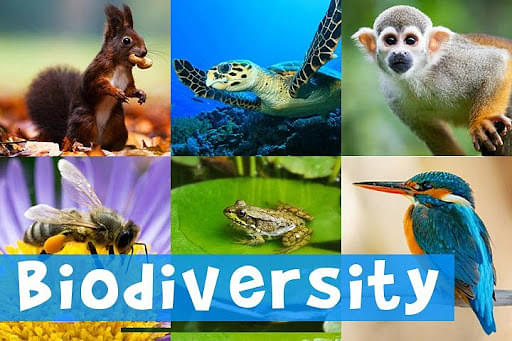
But now many animal species are on the verge of extinction while some of them are already extinct because of increase in human exploitation in forests due to which they have lost their homes and also lack of awareness among the people about their role and importance in our ecosystem. And this time is very crucial for all of us to understand their importance and start taking steps to save them and make our planet a better place to live. Animals such as blue whales, white-tailed deer, white pine trees, sunflowers, microscopic bacteria and all other species of this planet are all examples of animal biodiversity.

Things To Remember
- Biodiversity refers to the variability of plants and animals
- The evolutionary history decides the phylogenetic classification.
- The scientific naming of plants and animals is called binomial nomenclature.
- Plants provide us with food and oxygen without which life is impossible
- Taxonomic hierarchy is the framework of classification which helps in appropriate placing of organisms.
- The five kingdom system of classification was proposed by H. Whittaker.
- Herpetology is the name of animal biodiversity for amphibians and reptiles.
Also Read:
Sample Questions
Ques: What is the reason behind the vast diversity in Indian ecology?
Ans: The geographical diversity of India in terms of different topography such as rain, forests, coral reefs, desserts etc are one of the major reasons behind the vast diversity of our India.
Ques: What is a biodiversity hotspot?
Ans: The biogeographic region where a large amount of biodiversity is found and is threatened by human habitation is called biodiversity hotspot.
Ques: What is The Role of Animals in The Ecosystem?
Ans: Animals are of the most critical level of the food pyramid and without animals, the cycle of producers and consumers would be ruined. The biodiversity of animals and their abundance in the environment is no more than a blessing for human beings.
Ques: How can the loss of one species lead to the extinction of another?
Ans: The reason behind the extinction of one species because of another species can be explained via co-extinction. Co-extinction is that situation where extinction of two mutually related species happens. For example, the extinction of host fish also causes the extinction of all the parasites located in it.
Ques: What are the factors that determine a species as threatened?
Ans: There are several factors which determine a species of animal or plant biodiversity as threatened or endangered. Some of them are,
- Faster declination of the population of a particular species compared to their birth rate.
- The destruction and modification of their natural habitat which causes loss of many plant and animal species.
- The increasing activities of poachers is also one of the major reasons behind the destruction of many species.
Ques: What are the ways through which humans are benefitted from biodiversity?
Ans: We humans are very much benefitted from biodiversity and here are a few examples.
- We get the food, fibre and firewood from the plants around us.
- We get fresh oxygen from plants without which we wouldn't be able to survive.
- Many industrial products and construction materials are also being taken from the forests.
Ques: In comparison to other animal groups, why are amphibians more vulnerable to extinction?
Ans: Amphibians are more vulnerable to extinction when compared to other animal groups because of the fragmentation and destruction of their natural habitat and also due to large scale climate change.
Ques: Is more solar energy available in the tropics? Justify your answer.
Ans: Yes, there is more solar energy available at the tropics and here are a few reasons to justify the answer.
- Less energy is being lost in reflection and absorption by the atmosphere because the rays of the sun possess less atmosphere to reach the tropics.
- The presence of dense vegetation causes more absorption of radiation in the tropical rainforests and the rays of the sun are also more concentrated.
Also Read:



Comments