



Content Curator
In general, a bisector divides something into two equal parts. In geometry a bisector is a line that divides a line or an angle into congruent or equal parts. It extends all the way to the segment’s bisectors and angle bisectors. The line segment bisector is a straight line that travels through the midway of a line section, whereas the angle bisector is a straight line that runs through the apex of an angle.
Also read: Isosceles Triangle Theorems
| Table of Contents |
Key Terms: Line Bisector, Angle Bisector, Perpendicular, Triangle, Equidistant, Sides, Angle, Vertex
What is a Bisector?
[Click Here for Sample Questions]
A bisector is a straight line that breaks an angle or a line into two equal parts. A segment's bisector always passes through the sections halfway. Basically, the bisectors are classified into two types based on the geometrical shape that it bisects.
- Line Segment Bisector (Perpendicular Bisector theorem)
- Angle Bisector (Triangle Bisector Theorem)
Read more: Angle Formula
Line Segment Bisector
[Click Here for Sample Questions]
A line segment bisector breaks a line segment into two halves that are equal of length. It passes the line segment through its midpoint. Here the red line bisects the blue line segment.
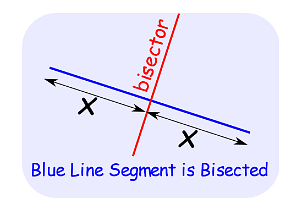
Line Segment Bisector
-
Example for Line segment Bisector
In the below given picture the line segment in the upper section of the image is approximately 10 inches long and the bottom section of the image shows what exactly happens how a line segment bisector breaks this line segment.

Example for Line segment Bisector
As a result, the line segment which 10 inches long. It is split into two pieces, each 5 inches long, after being split by a line segment bisector. When the two 5-inch pieces are added together, the result is 5 inches + 5 inches = 10 inches.
Read more: Line Segment
Perpendicular Bisector
[Click Here for Sample Questions]
A perpendicular bisector is a line segment or a line that separates a given line segment into two equal-sized parts. The term 'bisect' is used to represent dividing evenly. Perpendicular bisectors contact the line segment they bisect on both sides and produce four 90° angles. A perpendicular line segment or a line is one that forms a 90° angle with another line segment or a line.
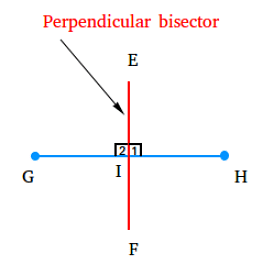
Perpendicular bisector
Properties of Perpendicular Bisector
- The important properties of a perpendicular bisector are mentioned below.
- Creates two congruent segments from a line segment or a line.
- Divides a triangle's sides into congruent sections.
- They form a 90-degree angle with the line being bisected.
- They cross the line segment exactly in the middle.
- The circumcentre of a triangle is the place where the perpendicular bisectors intersect.
- They meet inside a triangle in an acute triangle, outside the triangle in an obtuse triangle, and at the hypotenuse in right triangles.
Read more: Vertex
Perpendicular Bisector Theorem
[Click Here for Sample Questions]
The perpendicular bisector theorem states that “Any point that lies on the perpendicular bisector is equidistant from both the edges of the line segment on which it is drawn”.

Perpendicular Bisector Theorem
In the Above Figure: MQ = NQ, MR = NR, MS = NS, MT = NT
-
Proof of Perpendicular Bisector Theorem
Draw the diagram where the point C is considered as an arbitrary point on AB's perpendicular bisector which intersects AB at the point D:

Triangles for proving perpendicular bisector
Comparing ΔACD and ΔBCD
- AD=DB //Given, CD is a bisector
- ∠ADC≅ ∠BDC //Side-Angle-Side postulate
- CD=CD //Common side
- ∠ADC =∠BDC = 90° //Given, CD is perpendicular to AB
- CA=CB //corresponding sides of congruent triangles
Hence proved the Perpendicular Bisector Theorem.
-
Perpendicular Bisector Equation
The General equation of Perpendicular Bisector is represented by:
\(y = (y_1 + y_2) /2 = \frac{x_2 - x_1}{y_2 - y_1}(x - (x_1 + x_2)/2)\)Read more: Introduction to Constructions
-
Converse of Perpendicular Bisector Theorem
The converse of the perpendicular bisector theorem states that “A point is on the perpendicular bisector of a line segment if it is equidistant from both endpoints of the line segment in the same plane”.
-
Steps to Construct a Perpendicular Bisector
The steps involved in constructing a perpendicular bisector is mentioned below:
Step 1: Firstly, draw the line segment

Step 2: At one end of the line segment, place the compass.
Step 3: Set the compass to a length that is slightly longer than half the length of the line segment. Arcs should be drawn above and below the line.

Step 4: Draw arcs from the other end of the line, keeping the compass width the same.

Step 5: Draw the line segment with the ruler where the arcs cross.

Angle Bisector
[Click Here for Sample Questions]
A line that divides an angle into two sections of equal size. The ∠LKJ is bisected by the red line KM originating from the point K as shown in the diagram below. The bisector is the red line.

Angle Bisector
In the figure, the KM bisects the angle ∠JKL.
The angles ∠JKM and ∠LKM are congruent.
So, ∠JKM = ∠LKM.
-
Example for Angle Bisector

Example for Angle Bisector
In the diagram BD is an angle bisector. Determine the value of ABC.
Due to the fact that BD is an angle bisector,
∠CBD = ∠ABD
Therefore, ∠CBD = 65°
The Angle Addition Postulate states that
∠ABC = ∠ABD + ∠CBD
Substitute.
∠ABC = 65° + 65° = 130°
-
Angle Bisector Theorem
Angle Bisector Theorem states that "An angle bisector of a triangle divides the opposing side into two segments that are proportional to the other two sides of the triangle".
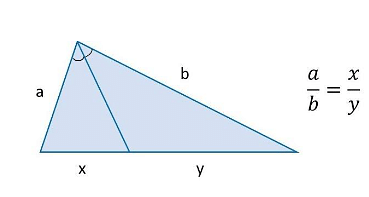
Angle Bisector Theorem
-
Properties of Angle Bisector
- The important properties of an angle bisector are mentioned below.
- An angle bisector is a tool that divides a given angle into two equal halves.
- Any point on an angle's bisector is equidistant from the angle's sides or arms.
- It divides the opposite side of a triangle into the ratio of the other two sides measures.
Read more: Difference between Sequence and Series
-
Angle Bisector of a Triangle
One angle bisector is a straight line that divides an angle into two congruent or equal angles in a triangle. Every triangle can have three angle bisectors, one for each vertex. The incentre of a triangle is the place where these three angle bisectors meet. The distance between the incentre and all of a triangle's vertices is the same. Take a look at the graphic below, which depicts a triangle's angle bisector. The angle bisectors of BAC, ACB, and ABC, respectively, are AG, CE, and BD. The point F is the incentre, or point of intersection, of all three bisectors, and it is located at an equal distance from each vertex.

Angle Bisector of a Triangle
-
Steps to Construct an Angle Bisector
The steps involved in constructing an Angle Bisector is mentioned below:

Steps to Construct an Angle Bisector
Step 1: Draw any angle, for an instance take ∠ABC.
Step 2: Taking the point B as the centre and any appropriate radius, draw an arc to intersect the rays BA and BC at, say, E and D respectively.
Step 3: Now, taking the points D and E as centres and with the same radius as taken in the previous step, draw two arcs to intersect each other at the point F.
Step 4: Join the points B to F and extend it as a ray. This ray BF is the required angle bisector of ∠ABC.

Steps to Construct an Angle Bisector
Things to Remember
- A line, segment, or ray that runs perpendicular to a segment and passes through its midway
- Two-line segments, rays, lines, or any combination of those that meet at right angles are perpendicular.
- Bisector is a term used to describe an object (a line, a ray, or a line segment) that divides another object (an angle or a line segment) into two equal pieces.
- A line, ray, or line segment that bisects an angle or line segment at a right angle.
- Any point within the angle bisector is equidistant from the angle's sides.
- The perpendicular bisector's points are equidistant from both ends of the segment they bisect.
Read more: First Order Differential Equation
Sample Questions
Ques. What Is a Perpendicular Bisector and What Does It Mean? (2 marks)
Ans. A perpendicular bisector is a line segment that cuts another line segment at a 90-degree angle. A perpendicular bisector, in other words, meets another line segment at 90? and separates it into two equal parts.
Ques. If we know how long a circle's radius is, can we sketch a perpendicular bisector? (2 marks)
Ans. If we know the radius of the circle then we can sketch the perpendicular bisector. Because the radius of a circle is equivalent to twice its diameter. As a result, using the identical techniques, we may sketch a perpendicular bisector to the diameter of the circle.
Ques. If you draw a perpendicular bisector to a line segment with a length of 8cm. What is the length of each line segment? (2 marks)
Ans. A perpendicular bisector joins a line segment at a right angle and separates it into two equal portions, as we know from the definition. As a result, each section of the line segment (8 cm) bisected by a perpendicular is 4 cm in length.
Ques. Is it possible for a Perpendicular Bisector to be the Median of a Triangle? (3 marks)
Ans. A perpendicular bisector can, in fact, be a triangle's median. A median is a line segment that connects a triangle's vertex to the midway of the opposing side. The perpendicular bisector of a side is formed when the median joins the opposing side at 90 degrees. In an equilateral triangle, for example, the medians are always perpendicular bisectors.
Ques. What is the measurement of each angle if an angle bisector splits an angle of 80°? (3 marks)
Ans. An angle measure of 80° is given.
The angle bisector, as we all know, divides an angle into two equal pieces.
As a result, 80° is divided into two equal portions, x and y.
Hence,
x + x = 80°
2x = 80°
x = 80°/2
x = 40°
Ques. An angle ABC is divided into two equal pieces by a ray BX. What is the value of x if one portion is equal to 4x – 5 and the other part is equal to 20? (3 marks)
Ans. BX divides angle ABC into two equal pieces when given. As a result, BX denotes the angle bisector.
Now, each portion should be the same size.
Thus,
4x – 8 = 20
4x = 20 + 8 = 28
x = 28/4 = 7
Hence, the value of x is 7.
Ques. What exactly is the Sine Rule? What role does it play in proving the Angle Bisector Theorem? (3 marks)
Ans. The sine rule, often known as the law of sines, is a trigonometric law that creates a link between a triangle's sides and angles. According to the rule, the ratio of the angle's sine to its opposite side is the same for all three angles and sides. In other words, for all sides and angles of a triangle, the ratio of a side to the sine of the opposite angle remains unchanged. The sine rule asserts that if ABC is a triangle with side 'a' opposite angle A, side 'b' opposite angle B, and side 'c' opposite angle C, then
\(\frac{a}{SinA} =\frac{b}{SinB} = \frac{c}{SinC}\)
This sine rule is used to calculate the ratios of angles and sides in the two triangles generated by the angular bisector in a triangle in order to prove the angle bisector theorem.
Ques. The angle bisector of BON is the ray traced from point O in the diagram. Look for x. (3 marks)
Ans. We will use the property to find x: Any point on an angle's bisector is equidistant from the angle's sides.
As a result, the bisector drawn from O will be equidistant from OB and ON sides.
3x − 2 = 10
3x = 2 + 10
3x = 12
x = \(\frac{12}{3}\) = 4
∴ The value of x is 4.
Ques. Determine where a perpendicular bisector bisects a 10-unit-long line segment. (3 marks)
Ans. A perpendicular bisector is a line that, at its midpoint, divides a given line segment into two congruent line segments. It is assumed that the line segment is 10 units long. As a result, the perpendicular bisector bisects the line segment exactly at 5 units, dividing the 10-unit line segment into two 5-unit line segments.
Ques. Imagine a triangle in which AE is the bisector of the exterior ∠CAD that meets CB at the point E. If the value of AB = 10 cm, AC = 6 cm and CB = 12 cm, find the value of EC. (5 marks)
Ans. Given, AC = 6 cm, AB = 10 cm and CB = 12 cm
Let EC will be equal to x.
By the concept of exterior angle bisector theorem, we know that,
BE / CE = AB / AC
(12 + x) / x = 10 / 6
6(12 + x) = 10 x [ by cross multiplication]
72 + 6x = 10x
72 = 10x – 6x
72 = 4x
x = 72/4
x = 18
EC = 18 cm
Ques. Using the angle bisector theorem, find the value of x for the given triangle. (5 marks)
Ans.
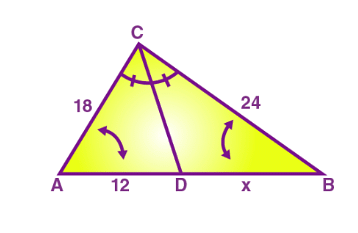
Given,
DA = 12, CA = 18, CB=24, BD = x
According to the angle bisector theorem,
DA / CA = BD / CB
Now substitute the values, we get
12 / 18 = x / 24
X = (2/3)24
x = 2(8)
x = 16
Hence, the value of x is 16.
Also Read:



Comments