



Content Curator
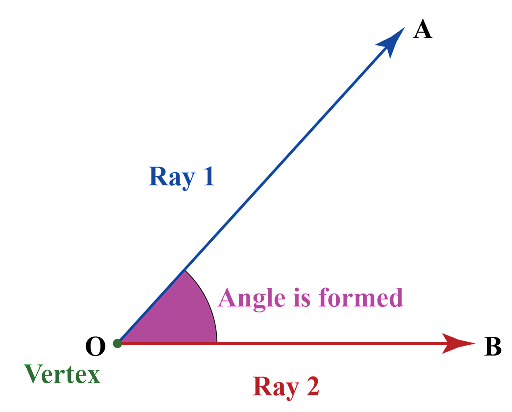
Vertex refers to the point where two or more lines/rays/edges intersect to form angles. Vertex is always denoted by uppercase letters such as O, A, P, etc. Vertex in plural form is known as Vertices. Vertices can be found in three-dimensional geometry, where shapes such as cubes, cuboids, etc, consist of multiple vertices.
Read Also: Properties of Parallel Lines
| Table of Content |
Vertex in Shapes and Angles
[Click Here for Sample Questions]
Vertex is the point where two lines/ edges meet. Vertex also refers to the angular corners in shapes where two or more lines/edges meet between faces.

Read More: Corresponding Angles Axiom
Vertex of an angle is the point where two lines or rays intersect. The corner of the angle forms the vertex.
Vertices of 3D Shapes
[Click Here for Sample Questions]
Three Dimensional shapes in solid Geometry also have vertices. Vertex in 3D shapes is created where the edges of the solid shape meet. Different shapes have different vertices based on the number of edges. For example, a cube or cuboid would have 8 vertices, whereas a tetrahedron would have 4 vertices.

Check Important Notes for Angle Between Two Lines
List of Shapes with Number of Vertices
| 3D Shape | Number of Vertices (V) |
|---|---|
| Cube | 8 vertices |
| Cone | 1 vertex |
| Sphere | 0 vertex |
| Cylinder | 0 vertex |
| Rectangular prism | 8 vertices |
| Triangular prism | 6 vertices |
| Hexagonal prism | 12 vertices |
| Pentagonal prism | 10 vertices |
| Square pyramid | 5 vertices |
| Octagonal prism | 16 vertices |
| Triangular pyramid | 4 vertices |
| Rectangular pyramid | 5 vertices |
| Pentagonal pyramid | 4 vertices |
| Hexagonal pyramid | 7 vertices |
| Octagonal pyramid | 9 vertices |
Read Further: Frequency Polygon
What is Polyhedron?
[Click Here for Sample Questions]
A polyhedron is a three-dimensional solid which has multiple faces, edges and vertices. Polyhedrons can be said to be a group of polygons connected at the edges. All polyhedrons consist of three parts: Faces, Edges and Vertices.
Face: Faces are the polygons (flat surfaces) that constitute the polyhedron.
Edge: Edge is the line segment formed when two faces (flat surface) meet in a polyhedron.
Vertex: Vertex is the point of intersection of two or more edges. All corners of a polyhedron are its vertices.

Difference between Edges and Vertices
[Click Here for Sample Questions]
Edge is the part where two faces of a shape meet. For a two-dimensional figure, all its lines are its edges.
Vertex is the point where two or more lines/edges meet.

Euler’s Formula
[Click Here for Sample Questions]
According to Euler’s Formula, any Convex Polyhedron with number of Faces (F) and number of Vertices (V) add up to a value that is exactly two more than its number of Edges (E).
Therefore, the formula is:
F + V = 2 + E
Things to Remember
[Click Here for Sample Questions]
- Vertex is the point where two or more lines/ edges/ rays join to form an angle.
- The plural of vertex is vertices.
- Vertices in 3D shapes are when two or more edges of the polyhedron meet at a point. Different shapes have different vertices based on the number of edges.
- Polyhedron is a three-dimensional solid shape. It is made up of three parts: faces, edges and vertices. Polyhedron is a group of polygons connected at the edges.
- The part where two faces of a shape meet is called the edge. Vertex is the point where two or more lines/edges meet.
Also Check Further:
Sample Questions
Ques: How many vertices does a triangular prism have? (1 mark)
Ans. A triangular prism is made up of 6 vertices in total. It also has 5 faces and 9 edges.
Ques: What is the formula that connects all the properties of a 3D shape? (2 marks)
Ans. Euler’s Formula is important because it connects the three primary properties in a 3D Shape- face, edge, and vertex. Through this formula, if one information is given, the value of the other properties can be easily calculated.
Ques: Do 2D figures also have vertices? (2 marks)
Ans. Yes, both 3D and 2D figures have their own vertices. Any point of intersection of two edges in a 2D or 3D shape forms vertices.
Ques: With regards to Vertices, which of the following statements is true? (1 mark)
- Some 2D shapes do not contain any vertices
- A triangle also has two vertices
- Vertices refer to point on a shape where two or more lines, edges, or curves meet
- The corners of polyhedral and polygons are also vertices
Ans. The correct statement is b. A triangle also has two vertices. This is because a triangle technically has 3 vertices instead of 2.
Ques: How can we prove Euler’s Formula in a Cube? (2 marks)
Ans. As we know, a cube has 6 faces, 12 edges, and 8 vertices. According to the Euler’s formula, the expression will be-
F + V – E = 2
Taking L.H.S.,
6 + 8 – 12
= 14 – 12
= 2 (R.H.S)
Thus, proved.
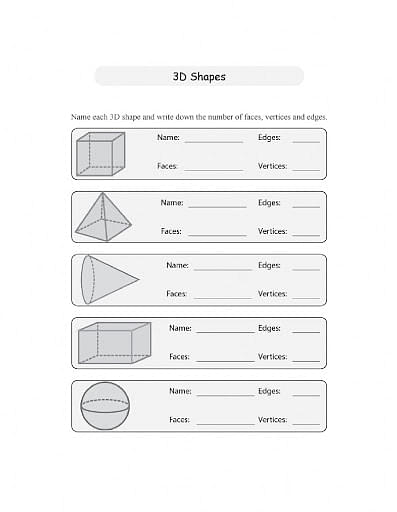
Ques: Fill out the given worksheet (10 marks)
Ques: What shape has 6 vertices, 5 faces, and 9 edges? (1 mark)
Ans. Triangular Prism is the shape that has 6 vertices, 5 faces and 9 edges.
Ques: How many vertices does a circle have? (1 mark)
Ans. A circle has zero (0) vertices as it has no corners. There are no straight lines intersecting at a point, which is necessary to create a vertex.
Mathematics Related Links:



Comments