




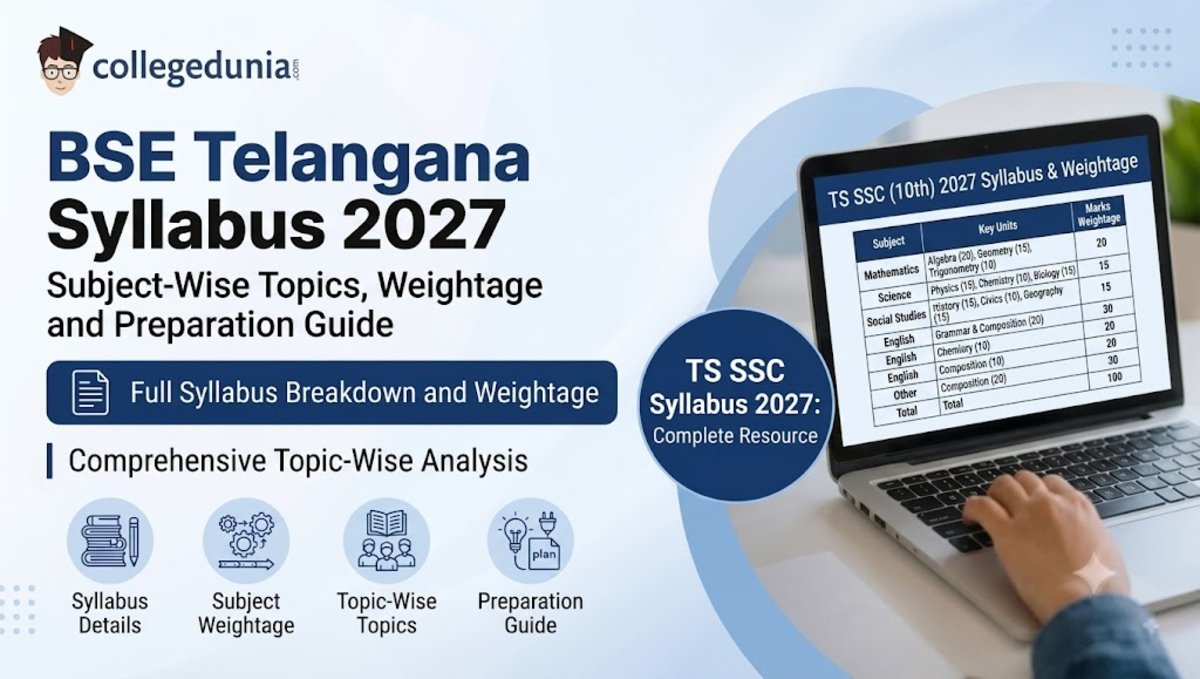
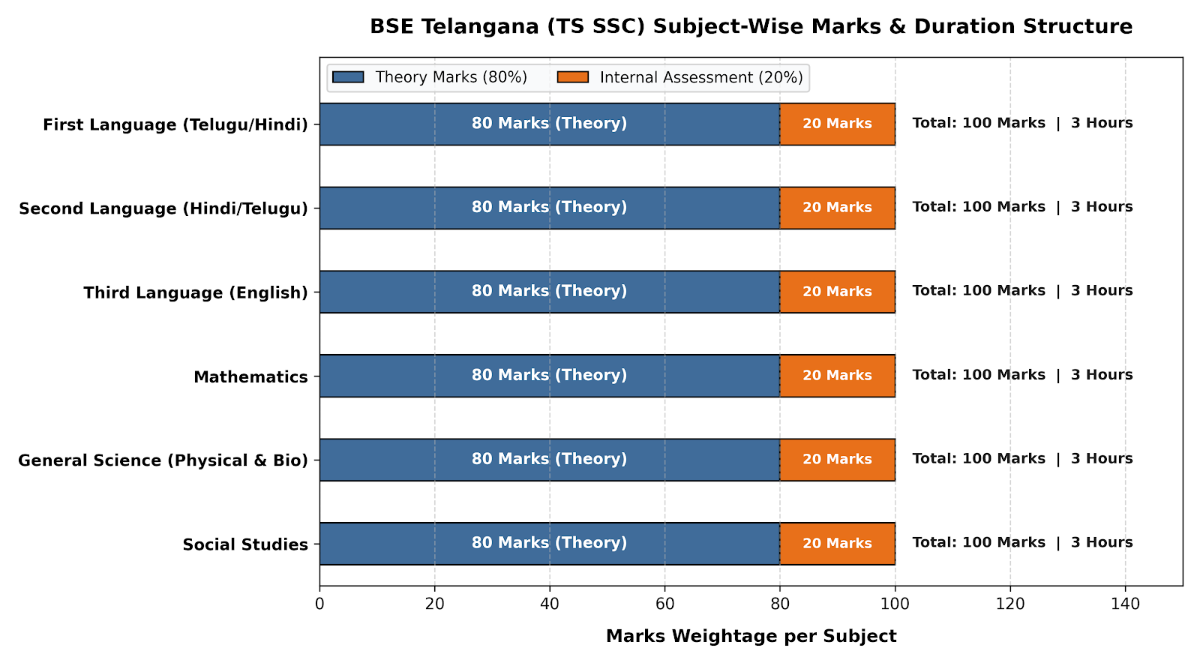
The Board of Secondary Education, Telangana (BSE Telangana) prescribes the BSE Telangana Syllabus 2027 for secondary education up to Class 10 (SSC). The BSE Telangana SSC curriculum runs on a 6-subject, 600-mark system. Each subject is split into an 80-mark written theory board exam and a 20-mark school-level internal (Formative) assessment.
The TS SSC syllabus covers First Language, Second Language, English, Mathematics, General Science, and Social Studies. The syllabus follows Telangana SCERT/state-prescribed textbooks, rather than the CBSE/NCERT curriculum.
| Check Out: Official BSE Telangana Syllabus 2027 |
- General Science is divided into Physical Science and Biological Science in the BSE Telangana exams, with 40 theory marks each and separate 1.5-hour papers.
- Mathematics is algebra-heavy: Algebra carries the highest weight, while Geometry and Trigonometry together also contribute substantially to the theory paper.
- Physics focuses on optics and electricity. Electric Current, Electromagnetism, Refraction, Reflection, and the Human Eye form the major Physics areas. Important areas in Chemistry include Chemical Bonding, Carbon and its Compounds, Acids, Bases and Salts, and Principles of Metallurgy.
- Social Studies has two broad parts. Geography & Economics and History & Civics together cover 21 chapters and carry broadly equal weightage. Social Studies preparation should include India and World map work, tables, graphs, and data interpretation.
- English and Hindi assess areas such as reading comprehension, literature, grammar, vocabulary, and creative writing, making format-based practice important.
Related Links:
- BSE Telangana Exam Pattern 2027: Marking Scheme, Syllabus, Passing Marks and Difficulty Level
- TS SSC Question Paper 2026: Download Subject-wise Question Paper with Solution PDF
Key Summary
- BSE Telangana Syllabus 2027 covers 6 subjects worth 600 marks total — 3 languages, Mathematics, General Science, and Social Studies.
- TS SSC board marking stays at 80 theory + 20 internal marks per subject, same as previous cycles.
- SSC Telangana board exams require a minimum of 35% overall, with at least 28 marks in the written theory component — higher than CBSE's 33% pass threshold.
- BSE Telangana SSC has not deleted any chapters for 2027, unlike CBSE's post-pandemic ~30% syllabus rationalization.
- General Science under the BSE Telangana Syllabus 2027 is a dual-textbook subject: Physical Science and Biological Science, each worth 40 theory marks.
BSE Telangana Syllabus 2027: Overview
The TS SSC Syllabus 2027 covers six major subjects, combining state-specific SCERT content with separate Physical Science, Biological Science, Social Studies, and language curricula.
- The Telangana State Board of Secondary Education runs the SSC exam once a year (March/April), with Supplementary exams in June for students who fail.
- Every subject under the BSE Telangana Syllabus 2027 carries the same 100-mark split (80 theory + 20 internal), so the marking structure is uniform regardless of subject difficulty.
- Three of the six subjects are languages (First, Second, Third), meaning language papers collectively account for exactly half of the 600-mark aggregate.
| Parameter | Details |
|---|---|
| Conducting Body | Board of Secondary Education, Telangana (BSE Telangana) |
| Exam Name | Secondary School Certificate (SSC) Public Examinations / TS Class 10 Board Exams |
| Courses Covered | Secondary Education (Class 10 curriculum) |
| Total Marks | 600 Marks (100 per subject: 80 Theory + 20 Internals) |
| Total Questions | Varies by subject; typically 30–40 across Essay, Short and Objective types |
| Language | English, Telugu, Hindi, Urdu, and other recognized regional mediums |
| Subjects | 3 Languages (First, Second, Third), Mathematics, General Science, and Social Studies |
| Syllabus Level | Matriculation / 10th Standard State Board level |
| Eligibility | Cleared Class 9 with required school attendance |
| Exam Frequency | Once a year (March/April), Supplementary in June |
Also Check:
BSE Telangana Syllabus: What’s New?
The Board of Secondary Education, Telangana (BSE Telangana) curriculum has stabilized following structural changes over the last few years.
There are no major content deletions or revisions added to the syllabus for the upcoming exam cycle. However, the board continues to enforce a streamlined exam pattern implemented to ease the academic burden on students.
Based on previous-year trends, below is how the content has been structured over the years:
- The exam prioritizes real-world problem-solving, word problems, and diagram/lab questions over rote memorization.
- You need 35% overall per subject, including minimum written scores of 28/80 on core theory papers and 14/40 on each science sub-paper.
- Language exams strictly stick to predictable patterns like unseen passages, letter writing, grammar, and textbook long answers.
BSE Telangana Exam Pattern 2027
The BSE Telangana exam pattern has remained stable over the years, with no major changes to the syllabus or pattern.
- General Science is the only subject split into two separately timed sub-papers, each lasting 1.5 hours:
- Physical Science (Physics and Chemistry)
- Biological Science (Biology)
- All non-Science subjects follow an identical 80+20 split and 3-hour duration, so the exam pattern itself doesn't distinguish Mathematics from Social Studies or a language paper.
- Because internal assessment is a flat 20 marks across every subject, it contributes exactly 20% of the total 600-mark aggregate.
| Subject | Theory Marks | Internal Assessment | Total Marks | Exam Duration |
|---|---|---|---|---|
| First Language (Telugu/Hindi) | 80 | 20 | 100 | 3 Hours |
| Second Language (Hindi/Telugu) | 80 | 20 | 100 | 3 Hours |
| Third Language (English) | 80 | 20 | 100 | 3 Hours |
| Mathematics | 80 | 20 | 100 | 3 Hours |
| General Science (Physical & Bio) | 80 (40+40) | 20 (10+10) | 100 | 3 Hours (1.5 hrs each) |
| Social Studies | 80 | 20 | 100 | 3 Hours |
TS SSC Question Paper 2026 with Solution PDF
| Subject | Question Paper PDF | Solution PDF |
|---|---|---|
| Mathematics | Download PDF | View Solution |
| First Language - (Group-A) | Download PDF | View Solution |
| First Language Part-I (Composite Course) | Download PDF | View Solution |
| First Language Part-II (Composite Course) | Download PDF | View Solution |
This video discusses the syllabus for BSE Telangana in 2027, any changes made in the syllabus, and previous-year trends about how the syllabus has been structured across the years.
TS SSC Class 10 Maths Syllabus 2027
Mathematics syllabus includes a total of 6 units, out of which Algebra is the highest-weighted unit, with repeated questions seen over the years:
- Algebra alone carries approximately 20 marks; it constitutes five separate chapters.
- The BSE Telangana Syllabus 2027 for Mathematics includes Sets as a standalone chapter. This topic has been removed by CBSE from its own Class 10 curriculum years ago.
- Geometry and Trigonometry together add roughly 22 marks. It shows that Algebra, Geometry, and Trigonometry together account for over half of the 80-mark theory paper.
| Unit / Branch | Chapter Name & Key Topics | Approx. Weightage |
|---|---|---|
| Number Systems | 1. Real Numbers: Euclid’s Division Lemma, Fundamental Theorem of Arithmetic, Logarithms, Rational & Irrational proofs. | ~6 Marks |
| Algebra | 2. Sets: Roster/Set-builder form, Venn diagrams, Operations (Union, Intersection, Difference).3. Polynomials: Degree/Zeros of polynomials, Graphing quadratics, Relationship between coefficients.4. Pair of Linear Equations in Two Variables: Substitution, elimination, and graphical solutions.5. Quadratic Equations: Factorization, completing the square, quadratic formula, nature of roots.11. Progressions: Arithmetic Progressions, Intro to Geometric Progressions. | ~20 Marks |
| Coordinate Geometry | 7. Coordinate Geometry: Distance formula, Section formula, Midpoint, Centroid, Area of a Triangle, Slope of a line. | ~6 Marks |
| Geometry | 8. Similar Triangles: Thales Theorem (BPT), Pythagoras Theorem proofs, construction of similar triangles.9. Tangents and Secants to a Circle: Tangents from external points, lengths, area of a segment. | ~12 Marks |
| Trigonometry | 11. Introduction to Trigonometry: Trigonometric Ratios (0° to 90°), Trigonometric Identities.12. Applications of Trigonometry: Heights and distances, angles of elevation and depression. | ~10 Marks |
| Mensuration | 10. Mensuration: Surface areas and volumes of combinations of solids (Cylinders, Cones, Spheres, Hemispheres). | ~10 Marks |
| Data Handling | 13. Statistics: Mean, Median, and Mode for grouped data, Ogive curves.14. Probability: Classical probability, mutually exclusive and complementary events. | ~10 Marks |
Also Check:
TS SSC Class 10 Science Syllabus 2027
The BSE Telangana Class 10 Science syllabus is divided into two separate papers, Physical Science and Biological Science, with equal weightage.
- Physical Science and Biological Science each have 40 theory marks, giving both subjects equal importance in the written exam.
- Physical Science includes Physics and Chemistry, while Biological Science focuses on Biology.
- The two papers are conducted separately, with 1.5 hours allotted to each, so students are assessed independently in Physical Science and Biological Science.
TS SSC Class 10 Physics Syllabus 2027
The Physics section of BSE Telangana Class 10 Physical Science focuses on five key chapters, with emphasis on electricity, electromagnetism, and optics.
- Electric Current and Electromagnetism are among the most important Physics chapters. Students should practise clear, correctly labelled circuit and field diagrams to score well.
- Reflection, Refraction, and Human Eye together form an optics-focused unit. Learning the basic ray-diagram techniques can help students prepare for three of the five Physics chapters efficiently.
| Chapter | Chapter Name | Key Topics |
|---|---|---|
| 1 | Reflection of Light at Curved Surfaces | Spherical mirrors; ray diagrams; sign conventions; mirror formula; magnification; solar cooker |
| 4 | Refraction of Light at Curved Surfaces | Refractive index; Snell's law; total internal reflection; lenses; lens formula; lens maker's formula |
| 5 | Human Eye and Colorful World | Eye structure and accommodation; myopia, hypermetropia, presbyopia; prism; dispersion; scattering |
| 9 | Electric Current | Current, potential difference, EMF, Ohm's Law, resistance, series/parallel circuits, electric power, Joule heating |
| 10 | Electromagnetism | Oersted's experiment; magnetic field due to current; Faraday's and Lenz's Laws; electric motor and generator |
TS SSC Class 10 Chemistry Syllabus 2027
The Chemistry section of BSE Telangana Class 10 Physical Science covers key concepts such as chemical reactions, acids and bases, metals, and carbon compounds.
- Structure of Atom, Classification of Elements, and Chemical Bonding are closely connected, so studying these chapters in sequence can make the concepts easier to understand.
- Carbon and its Compounds is one of the most detailed Chemistry chapters, covering topics such as catenation, hydrocarbons, functional groups, IUPAC nomenclature, and cleansing agents.
- Principles of Metallurgy focuses more on understanding the steps involved in processes such as ore concentration, smelting, and refining, making process-based questions particularly important.
| Chapter | Chapter Name | Key Topics |
|---|---|---|
| 2 | Chemical Equations | Writing/balancing equations; types of reactions; oxidation; corrosion; rancidity |
| 3 | Acids, Bases and Salts | Properties; reactions with metals/carbonates; pH scale; neutralization; baking soda, washing soda, bleaching powder, Plaster of Paris |
| 6 | Structure of Atom | Bohr's model and limitations; quantum mechanical model; electronic configuration; Aufbau, Pauli, Hund's rule |
| 7 | Classification of Elements – The Periodic Table | Dobereiner's Triads; Newlands' Octaves; Mendeleev's table; Modern Periodic Law; periodic trends |
| 8 | Chemical Bonding | Lewis structures; octet rule; ionic and covalent bonding; VSEPR theory; molecular shapes |
| 11 | Principles of Metallurgy | Ore concentration; froth flotation; smelting; roasting; calcination; electrolytic refining |
| 12 | Carbon and its Compounds | Catenation; tetravalency; hydrocarbons; functional groups; IUPAC nomenclature; soaps and detergents |
TS SSC Class 10 Biology Syllabus 2027
The BSE Telangana Class 10 Biological Science syllabus covers human physiology, life processes, heredity, and environmental science.
- Nutrition, Respiration, Transportation, and Excretion form a connected human physiology unit and carry the highest weightage, with many questions based on diagrams and biological processes.
- Control and Coordination, Reproduction, and Heredity & Evolution focus on how organisms function, reproduce, and pass on traits. These chapters are generally tested through conceptual and explanatory questions.
- Our Environment and Natural Resources have comparatively lower weightage, making them suitable for quick revision while preparing for the exam.
| Chapter | Chapter Name | Key Topics |
|---|---|---|
| 1 | Nutrition | Photosynthesis; human digestion; enzymes; malnutrition |
| 2 | Respiration | Human respiratory system; cellular respiration; respiration vs combustion |
| 3 | Transportation | Heart structure; cardiac cycle; blood circulation and clotting; xylem and phloem |
| 4 | Excretion | Excretory system; nephron structure; urine formation; dialysis |
| 5 | Control and Coordination | Nervous system; neurons; reflex action; plant hormones |
| 6 | Reproduction | Mitosis and meiosis; asexual reproduction; plant fertilization; reproductive health |
| 7 | Coordination in Life Processes | Hunger sensations; mastication; peristalsis; digestive pH |
| 8 | Heredity and Evolution | Mendel's experiments; sex determination; theories of evolution |
| 9 | Our Environment | Ecosystems; food chains and webs; biological pest management |
| 10 | Natural Resources | Biodiversity; conservation; renewable resources; sustainability |
TS SSC Class 10 Science unit-wise weightage
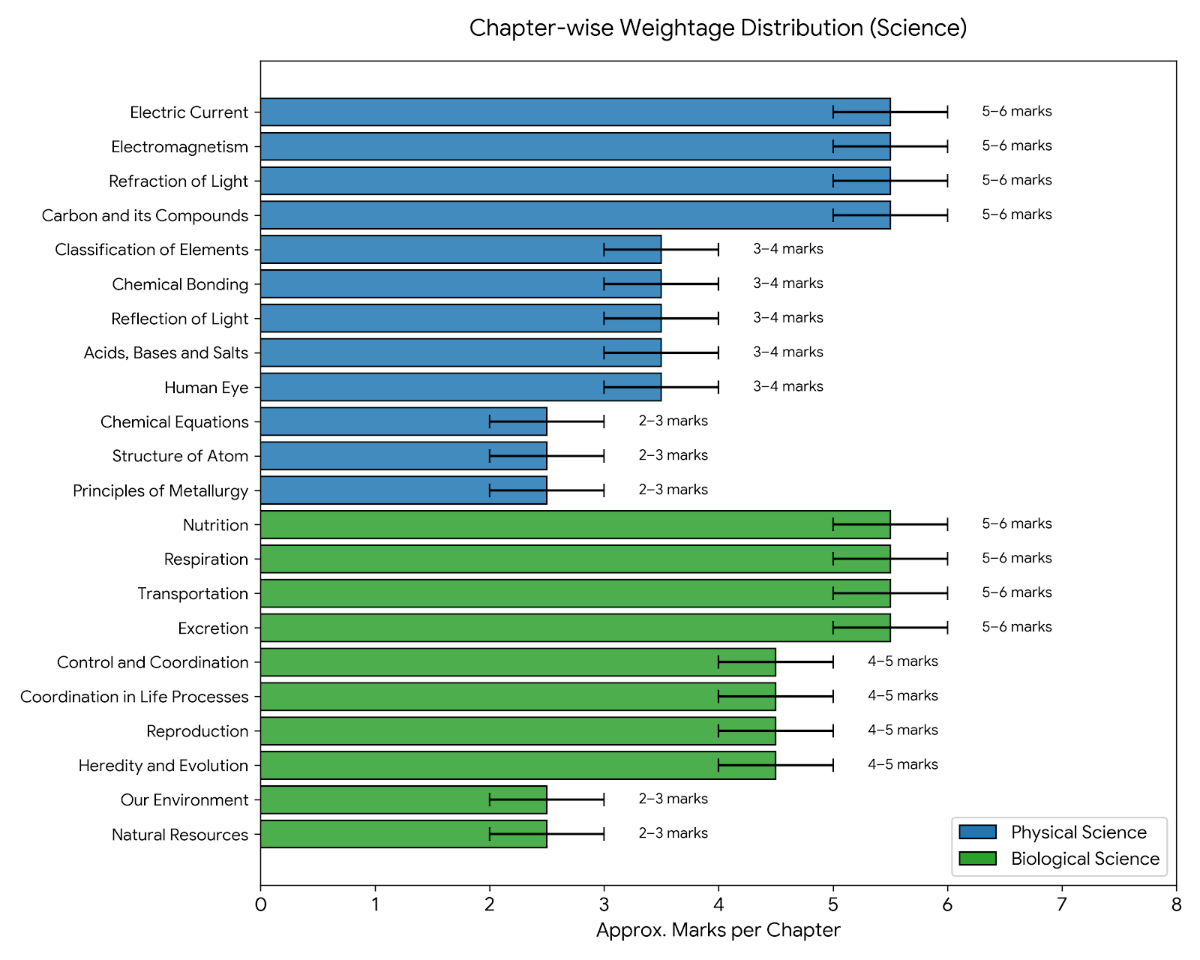
The BSE Telangana Class 10 General Science syllabus gives important chapters across Physical Science and Biological Science similar weightage, helping students plan their revision effectively.
- Nutrition, Respiration, Transportation, Excretion, Electric Current, Electromagnetism, Refraction, and Carbon Compounds carry around 5–6 marks each, making them priority chapters for preparation.
| Subject | Chapters Covered | Approx. Marks per Chapter |
|---|---|---|
| Physical Science | Electric Current; Electromagnetism; Refraction of Light; Carbon and its Compounds | 5–6 marks |
| Classification of Elements; Chemical Bonding; Reflection of Light; Acids, Bases and Salts; Human Eye | 3–4 marks | |
| Chemical Equations; Structure of Atom; Principles of Metallurgy | 2–3 marks | |
| Biological Science | Nutrition; Respiration; Transportation; Excretion | 5–6 marks |
| Control and Coordination; Coordination in Life Processes; Reproduction; Heredity and Evolution | 4–5 marks | |
| Our Environment; Natural Resources | 2–3 marks |
Also Check: Telangana Board 2026 Class 10 Science Part-I Physical Science Question Paper with Solutions
BSE Telangana Class 10 Social Science Syllabus 2027
The BSE Telangana Class 10 Social Studies syllabus covers Geography, Economics, History, and Civics, with both major sections carrying nearly equal importance.
- The syllabus is divided into Geography & Economics (Chapters 1–11) and History & Civics (Chapters 12–21), with each part carrying 40 marks. So, students should prepare both sections equally.
- Part 1 combines geography with economic concepts, while Part 2 covers World Wars, post-Independence India, and Telangana’s formation, including state-specific topics not found in the CBSE curriculum.
Part 1: Geography & Economics (Chapters 1–11)
- Memorize the Himalayan divisions (Himadri, Himachal, Shivaliks) and the Thar Desert characteristics.
- Understand the mechanism of the South-West Monsoon and the difference between Western Disturbances and October Heat.
- Understand the role of PDS (Public Distribution System), FCI (Food Corporation of India), and minimum support prices.
- For globalization, focus on the impact of MNCs on local markets and the need for fair globalization.
| Chapter | Chapter Name | Key Topics |
|---|---|---|
| 1 | India: Relief Features | Himalayas; Indo-Gangetic Plains; Peninsular Plateau; Thar Desert; Coastal Plains; Islands |
| 2 | Ideas of Development | Development indicators; income; HDI; public facilities |
| 3 | Production and Employment | Primary/secondary/tertiary sectors; GDP; organized and unorganized employment |
| 4 | Climate in Indian Context | Climatic controls; monsoons; seasons; global warming |
| 5 | Indian Rivers and Water Resources | Himalayan and Peninsular rivers; groundwater management |
| 6 | The Population | Census; growth rates; literacy; sex ratio |
| 7 | Settlement and Migration | Settlement patterns; urbanization; migration effects |
| 8 | Rampur: A Village Economy | Agriculture; infrastructure; land distribution; non-farm activities |
| 9 | Globalisation | MNCs; foreign trade; WTO; effects of globalization |
| 10 | Food Security | Availability and accessibility; PDS; buffer stocks |
| 11 | Sustainable Development with Equity | Environmental impact; resource depletion; ecological equity |
Part 2: History & Civics (Chapters 12–21)
Part 2 of the TS SSC Social Studies exam is highly narrative, chronological, and contemporary. It tests your ability to understand historical struggles, constitutional rights, and modern political movements.
- Learn the main causes of WWI and WWII, including nationalism, imperialism, alliances, and militarism.
- Pay special attention to the Great Depression, its global economic impact, and Roosevelt’s New Deal.
- Focus on the roles of the Indian National Congress and the Muslim League, the Cabinet Mission, and the major events leading to Independence and Partition. Understand the social and human consequences of Partition.
- Remember key features of the Indian Constitution, including federalism, secularism, and the parliamentary system, along with Dr. B.R. Ambedkar’s role as Chairman of the Drafting Committee.
| Chapter | Chapter Name | Key Topics |
|---|---|---|
| 12 | World Between the World Wars (1914–1945) | World Wars I & II; League of Nations; Great Depression; Fascism and Nazism |
| 13 | National Liberation Movements in the Colonies | Decolonization; movements in China, Vietnam, Nigeria |
| 14 | National Movement in India – Partition & Independence (1939–1947) | Quit India Movement; Partition; Independence |
| 15 | The Making of Independent India's Constitution | Constituent Assembly; Preamble; federal provisions |
| 16 | Election Process in India | Election Commission; political parties; electoral reforms |
| 17 | Independent India: The First 30 Years (1947–1977) | Nation-building; NAM; Emergency |
| 18 | Emerging Political Trends (1977–2000) | Coalition governments; 1991 economic liberalization |
| 19 | Post-War World and India | Cold War; NATO and Warsaw Pact; UN; proxy wars |
| 20 | Social Movements in Our Times | Civil rights; anti-nuclear and feminist movements; Chipko Movement |
| 21 | The Movement for the Formation of Telangana State | 1969 agitation; AP Reorganisation Act; formation of Telangana |
BSE Telangana Social Science unit-wise weightage
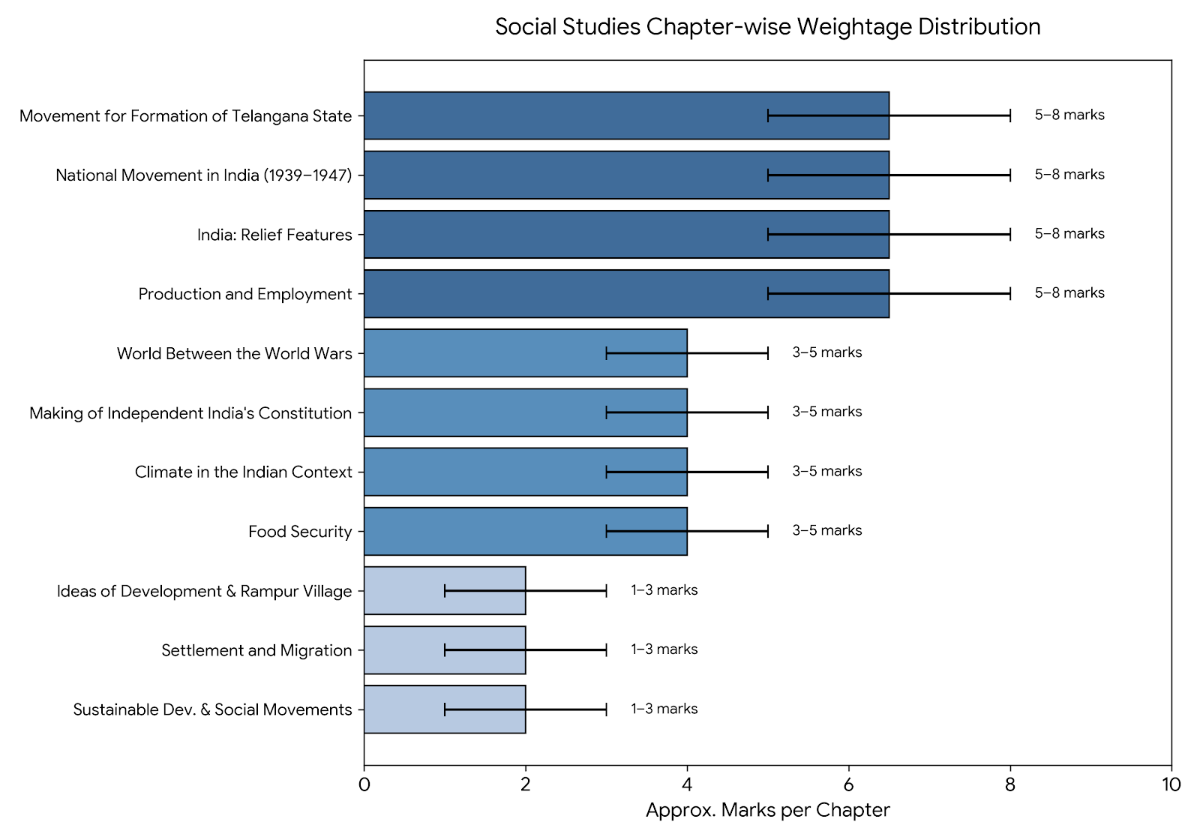
The BSE Telangana Class 10 Social Studies syllabus gives higher weightage to key topics across History, Geography, and Economics, while some chapters require only basic revision.
- The Telangana board places heavy emphasis on analyzing data tables, bar graphs, and pie charts. Students frequently see questions asking you to interpret an economic table.
- The Movement for the Formation of Telangana State has high weightage despite being the final chapter. In comparison, Ideas of Development, Rampur, Settlement and Migration, and Sustainable Development carry around 1–3 marks.
Map Work focus: India Geography Map (Himalayan peaks, Ganga/Indus/Godavari rivers, Western/Eastern Ghats, Thar Desert) and World History Map (Axis vs Allied powers, liberation movements in Vietnam and Nigeria).
| Chapter | Approx. Weightage | High-Yield Focus Areas |
|---|---|---|
| Movement for the Formation of Telangana State | 5–8 marks | 1969 agitation; political and civic fronts; AP Reorganisation Act |
| National Movement in India (1939–1947) | 5–8 marks | Quit India Movement; Cabinet Mission; Partition; Independence |
| India: Relief Features | 5–8 marks | Himalayas; Indo-Gangetic Plains; Peninsular Plateau; India map pointing |
| Production and Employment | 5–8 marks | Sectors; GDP; organized vs unorganized; data/table questions |
| World Between the World Wars | 3–5 marks | World Wars; Great Depression; Fascism and Nazism; world map pointing |
| Making of Independent India's Constitution | 3–5 marks | Constituent Assembly; Preamble; federal structure |
| Climate in the Indian Context | 3–5 marks | Monsoon mechanism; climographs and data interpretation |
| Food Security | 3–5 marks | PDS; buffer stocks; food security measures |
| Ideas of Development & Rampur Village Economy | 1–3 marks | Development indicators; HDI; land distribution |
| Settlement and Migration | 1–3 marks | Migration; urbanization; socio-economic effects |
| Sustainable Development with Equity & Social Movements | 1–3 marks | Environmental movements; Chipko Movement; ecological balance |
BSE Telangana Class 10 English Syllabus 2027
The BSE Telangana Syllabus 2027 for Third Language English is built around the SCERT textbook "Our World Through English." It is evaluated across Reading Comprehension, Grammar & Vocabulary, and Creative Writing.
- Reading Comprehension section tests your ability to extract and interpret information from unseen passages and text lessons.
- For 1 passage, questions are directly drawn from the major prose pieces in the textbook.
- Unseen Passages & Data Tables are also asked in this section, where you will get a poem or a prose passage, plus a visual element like a tree diagram, pie chart, or tabular data.
- Grammar and Vocabulary are considered the most critical section for scoring a perfect GPA, as it has concrete, absolute marking rules.
- When writing narratives or diary entries, stick strictly to the Simple Past / Past Continuous tenses. Switching back and forth to present tense is the number one reason students lose marks in editing and essay sections.
| Section | Approx. Marks | Chapters / Topics |
|---|---|---|
| Reading Comprehension | 30 marks | Textual passages; unseen passages; graphical and data-based passages |
| Grammar & Vocabulary | 20-24 marks | Relative clauses; prepositions; phrasal verbs; adverbial clauses; active/passive voice; direct/indirect speech; editing; cloze tests |
| Creative Writing | 20-24 marks | Major: biographical sketches, letters, drama scripts, essays, speeches. Minor: diary entries, notices, invitations, profiles |
| Literature | Embedded in RC and Writing sections | 8 units spanning Attitude is Altitude, The Dear Departed, The Journey, Rendezvous with Ray, The Storeyed House, Environment, and related extensive texts |
TS SSC Class 10 Hindi Syllabus 2027
The BSE Telangana Syllabus 2027 for Hindi (Second Language) is based on the SCERT textbook "Sugandh-2," following the CCE pattern.
- Prepare the main ideas, character sketches, and explanations from key chapters such as बरसते बादल, कण-कण का अधिकारी, ईदगाह, and अंतर्राष्ट्रीय स्तर पर हिंदी.
- Regularly practise काल परिवर्तन, समास, कारक चिन्ह, and मुहावरे to score well in the objective section.
- Practise the correct formats for formal and informal letters and structure essays into Introduction, Body, and Conclusion.
| Section | Topics | Approx Marks |
|---|---|---|
| Reading Comprehension (अपठित बोध) | पठित एवं अपठित गद्यांश/पद्यांश (Paragraph & Poem Comprehension) | 15 - 20 अंक |
| Literature Textual Answers (साहित्य) | लघु एवं दीर्घ उत्तरीय प्रश्न (Short & Long Answers); पाठ एवं काव्य-आधारित प्रश्न | 25 - 30 अंक |
| Grammar (व्याकरण) | काल, पर्यायवाची, विलोम, मुहावरे, समास, कारक, उपसर्ग-प्रत्यय, वचन एवं लिंग | 20 अंक (Part-B) |
| Creative Writing (रचनात्मक लेखन) | औपचारिक/अनौपचारिक पत्र लेखन, निबंध लेखन, संवाद लेखन | 15 - 20 अंक |
| Written Examination (लिखित परीक्षा) | कुल अंक (Total Marks) | 80 अंक |
Best Books for BSE Telangana Syllabus 2027
Each subject is linked to an official SCERT/state-prescribed textbook, showing that the BSE Telangana syllabus follows its own state curriculum rather than the CBSE/NCERT framework.
- Physical Science and Biological Science have separate textbooks, in line with their separate papers and examination structure.
- English and Hindi use Telangana-specific textbooks such as Our World Through English and Sugandh-2, instead of NCERT books like First Flight and Kshitij.
| Subject | Official Textbook | Purpose |
|---|---|---|
| Mathematics | TS SCERT Class 10 Mathematics | Core Mathematics textbook |
| Physical Science | Physics & Chemistry Combined Textbook | Physics and Chemistry concepts |
| Biological Science | Biology with Environmental Education | Biology and environmental science |
| Social Studies | Class 10 Social Studies | History, Geography, Civics, Economics |
| English | Our World Through English | English language and literature (Third Language) |
| Hindi | Sugandh-2 | Hindi language and literature (Second Language) |
BSE Telangana Syllabus 2027 Preparation Tips
Focused revision, smart time management, and regular practice can help students maximise their scores across all sections of the BSE Telangana Class 10 exam.
- Cover the complete syllabus: Do not leave chapters untouched; revise every textbook unit at least once.
- Use Bit Banks regularly: Spend the last 15 minutes of daily study solving quick MCQs and fill-in-the-blanks.
- Practise diagrams and maps: Regular practice can improve both accuracy and speed in diagram- and map-based questions.
| Area | Effective Tip |
|---|---|
| Science Answers | Underline key terms such as micelle, myopia, catenation, and refractive index.Write the relevant formula or balanced equation before solving numericals. |
| Time Management | Follow a steady pace of around 1.5–2 minutes per mark.Avoid spending too much time on difficult Physics numericals. |
| General Science | Treat Physical Science and Biological Science as two separate exams. Practise important labelled diagrams such as the Human Heart, Nephron, Neuron, and lens ray diagrams. |
| Social Studies | Give priority to Chapter 21: The Movement for the Formation of Telangana State and practise India and World map work regularly. |
| Languages | Memorise the correct formats for formal letters, diary entries, notices, invitations, and other prescribed writing tasks. |
Unlike CBSE, which trimmed roughly 30% of its curriculum during post-pandemic rationalization, BSE Telangana has not deleted any chapters for 2027.
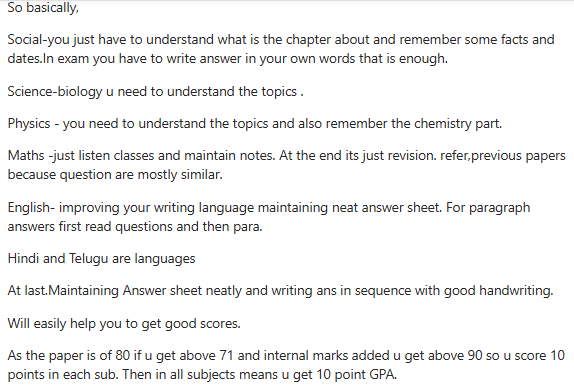
Students on Quora share the following tips for effective preparation for the TS SSC exam:
- Keep your answer sheet neat, answer questions in proper sequence, and maintain good handwriting to secure higher marks.
- The written paper is out of 80 marks. Scoring above 71 on the written exam, combined with internal assessment marks, will bring your score above 90. Achieving this across all subjects awards a 10-point GPA.

Source: Quora
BSE Telangana Syllabus 2027 FAQs
Ques. What is the BSE Telangana Syllabus 2027?
Ans. A 6-subject, 600-mark state curriculum: 3 languages, Mathematics, General Science (Physical + Biological) and Social Studies, each worth 100 marks (80 theory + 20 internal).
Ques. What are the TS SSC subjects for 2027?
Ans. First Language, Second Language, Third Language (English), Mathematics, General Science (split into Physical and Biological Science), and Social Studies — 6 subjects total under the Telangana SSC syllabus.
Ques. What is the passing criteria under the SSC Telangana board?
Ans. A minimum of 35% overall per subject, with at least 28 marks required in the written theory component — higher than CBSE's 33% threshold.
Ques. Has BSE Telangana deleted any chapters for 2027, like CBSE did?
Ans. No — unlike CBSE's roughly 30% syllabus reduction during rationalization, the BSE Telangana Syllabus 2027 keeps every textbook chapter active.
Ques. What is the TS SSC board name?
Ans. The conducting body is the Board of Secondary Education, Telangana (BSE Telangana), and the exam is officially called the Secondary School Certificate (SSC) Public Examination — commonly referred to as the Telangana SSC board name in everyday use.
Ques. How is the BSE Telangana Syllabus 2027 different from CBSE Class 10?
Ans. BSE Telangana follows a state-specific SCERT curriculum (600 marks, 35% pass mark, no syllabus deletions) rather than CBSE's centralized NCERT curriculum (500 marks, 33% pass mark, roughly 30% content trimmed in recent rationalization, and up to 50% competency-based questions).



Comments