



Content Curator
Butanoic Acid is an oily and colorless liquid. It has the chemical formula CH3CH2CH2-COOH. Butanoic Acid is a kind of short-chain saturated fatty acid that is found in the form of animal fats and esters in plant oils. Butanoic Acid is also referred to as butyric acid, which means butter acid as it was first discovered in rancid butter. Butanoic Acid was prepared by the oxidation of n-butyl alcohol and also by the butyric carbohydrates. Most commonly, Butanoic Acid is found in esterified form in plant oils and animal fats.
| Table of Content |
Read More: Second Order Reactions
Properties of Butanoic Acid
The key properties of Butanoic Acid have been tabulated below:
| IUPAC Name | Butanoic acid |
|---|---|
| C4H8O2 | Butanoic acid |
| Molecular Weight/ Molar Mass | 88.11 g/mol |
| Density | 960 kg/m3 |
| Chemical Formula | CH3CH2CH2-COOH |
| Melting Point | -7.9 °C |
| Boiling Point | 163.5 °C |
Structure of Butanoic Acid
Butanoic acid is a carboxylic acid with the structural formula CH3CH2CH2-COOH. where −COOH is the functional group.
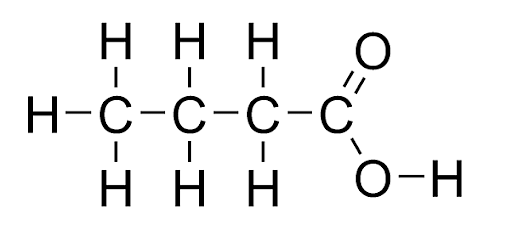
Structure of Butanoic Acid
Read more: Difference Between Acid and Base
Physical Properties of Butanoic acid (C4H8O2)
| Appearance | Colorless clear liquid |
|---|---|
| Odor | Unpleasant odor |
| Heat capacity | 298.15 K, 1 atm |
| Covalently-Bonded Unit | 1 |
| Solubility | Miscible in water and ethanol |
| Complexity | 49.5 |
Chemical Properties of Butanoic Acid (C4H8O2)
- Butanoic acid when reacts with sodium hydroxide forms carbon dioxide and water and salt of butanoic acid. The chemical equation is shown below:
21C4H8O2 + 20NaOH → 20 NaC4H6O + 4CO2 + 34H2O
- Butanoic acid when reacts with water forms ether and acetic acid. The chemical equation is shown below:
C4H8O2 + H2O → CH3COOH + C2H6O
Read Also:
| Electrophilic Aromatic Substitution | Copolymers |
| Polytetrafluoroethene (Teflon) | High Density Polythene |
Uses of Butanoic Acid (C4H8O2)
- Butanoic acid is used in the manufacturing of esters as a food additive, artificial flavorings in varnishes manufacturing, and decalcifying hides.
- Butanoic acid is used in the manufacturing of flavorings, perfume, disinfectants, and pharmaceuticals.
- Butanoic acid is used as a very important flavoring agent in beer, foods, detergent powder, and cosmetics.
- Butanoic acid is considered a safe food additive when it is used for feeding or manufacturing purposes.

Applications of Butanoic Acid
Occurrence of Butanoic Acid
Butanoic Acid is composed of 3 to 4 percent of butter. When butter goes rancid it liberates from glyceride by using the process of hydrolysis. Butanoic Acid is usually a typical carboxylic acid that reacts with bases and it affects various metals.
Butanoic Acid tastes like butter and has an unpleasant odor. Mammals like a dog can detect this at 10 parts per billion. On the other hand, humans can detect this acid only in a concentration of more than 10 parts per billion.
Read More: Properties Of Bases
Things to Remember
- The name ‘Butanoic Acid’ is also referred to as butyric acid, which means butter acid as it was first discovered in rancid butter. Butanoic Acid plays an important role as a human urinary metabolite and as a Mycoplasma genitalium metabolite. Butanoic Acid is also named as n-Butyric acid, butyric acid, and n-Butanoic acid. Butanoic acid is used in the manufacturing of esters as a food additive, artificial flavorings in varnishes manufacturing, and decalcifying hides.
- Butanoic Acid is an oily and colorless liquid. It has the chemical formula CH3CH2CH2-COOH. Butanoic Acid is a kind of short-chain saturated fatty acid that is found in the form of animal fats and esters in plant oils. Butanoic Acid is composed of 3 to 4 percent of butter.
-
Butanoic acid when reacts with sodium hydroxide forms carbon dioxide and water and salt of butanoic acid (21C4H8O2 + 20NaOH → 20 NaC4H6O + 4CO2 + 34H2O). And Butanoic acid when reacts with water forms ether and acetic acid (C4H8O2 + H2O → CH3COOH + C2H6O).
Read More: Calcination and Roasting
Sample Questions
Ques. What do you mean by Butanoic Acid? (1 Mark)
Ans. Butanoic Acid is an oily and colorless liquid. It has a very unpleasant odor. Butanoic acid has the chemical formula CH3CH2CH2-COOH. Butanoic Acid is considered a kind of short-chain saturated fatty acid that is found in the form of animal fats and esters in plant oils.
Ques. What are the other names of Butanoic Acid? (1 Mark)
Ans. This Butanoic Acid was discovered by Rossi and Lieben in the year of 1869. The name ‘Butanoic Acid’ is also referred to as butyric acid, which means butter acid as it was first discovered in rancid butter. Butanoic Acid was prepared by the oxidation of n-butyl alcohol and also by the butyric carbohydrates. The other names of Butanoic Acid are n-Butyric acid, butyric acid, and n-Butanoic acid.
Ques. Mention the uses of Butanoic Acid? (1 Mark)
Ans. Butanoic acid is used in the manufacturing of esters as a food additive, artificial flavorings in varnishes manufacturing, and decalcifying hides. It is also used in the manufacturing of flavorings, perfume, disinfectants, and pharmaceuticals. Similarly, Butanoic acid is used as a very important flavoring agent in beer, foods, detergent powder, and cosmetics.
Ques. How to prepare Butanoic Acid? (1 Mark)
Ans. Butanoic Acid was prepared by the oxidation of n-butyl alcohol and also by the butyric carbohydrates. Most commonly, Butanoic Acid is found in esterified form in plant oils and animal fats. It has a 4-carbon backbone and is a saturated short-chain fatty acid. Butanoic Acid plays an important role as a human urinary metabolite and as a Mycoplasma genitalium metabolite
Ques. What do you mean by Fructans? (1 Mark)
Ans. Fructans are the source of prebiotic soluble dietary fiber that is digested to form butyrate. Fructans are found in food soluble fibers that usually are high in fiber such as allium and cruciferous vegetables. Fructans are used for their health and prebiotic improving properties.
Ques. Where can we find Butanoic Acid? (1 Mark)
Ans. We can find Butanoic acid in esters as a food additive manufacture, artificial flavorings in varnishes manufacturing, and decalcifying hides. Butanoic acid is also helpful in flavorings, perfume, disinfectants, and pharmaceuticals. Apart from this, Butanoic acid is used as a very important flavoring agent in beer, foods, detergent powder, and cosmetics.
Ques. What is the role of Butanoic Acid in our body? (1 Mark)
Ans. Butanoic acid is essential to support digestive health, lessen the risk of diseases, reduce inflammation and promote the overall health of a human being. It has a very important role in our body to provide colon cells with the required energy for blood sugar regulation, to carry out normal functions, and maintain cholesterol levels.
Ques. How Butanoic Acid reacts? (3 Marks)
Ans. Butanoic acid when reacts with sodium hydroxide forms carbon dioxide and water and salt of butanoic acid. The chemical equation is shown below:
21C4H8O2 + 20NaOH → 20 NaC4H6O + 4CO2 + 34H2O
Butanoic acid when reacts with water forms ether and acetic acid. The chemical equation is shown below:
C4H8O2 + H2O → CH3COOH + C2H6O
Read Also:



Comments