



Education Journalist | Study Abroad Lead
Carbonate originated from alkaline earth metals and is primarily a member of the mineral family containing ions of carbonate and (CO3)2- is its basic structural unit. Found in lots within the Earth’s crust, these are some of the most prominently supplied minerals in the world. They have a crystal-like structure in a trigonometric manner where the carbon atom is located right at the centre of the equilateral triangle of the atoms of oxygen.
The salt of carbonic acid i.e. H2CO3 is referred to as carbonate. It is characterised as the carbonate ion and a polyatomic ion with the formula CO2-3. It may also refer to carbonate ester which is an organic compound having the carbonate group C(=O)(O-)2.
Key Terms: Basicity, Acidity, Compounds, Carbonate, Ions, Bicarbonate, Inorganic, Organic, Reaction
What are Carbonates?
[Click Here for Sample Questions]
The component of two types of chemical combinations which are derived from carbonic acid or carbon dioxide is referred to as carbonate. Carbonated alkaline earth metals are not soluble in water and can be precipitated through the addition of a sodium or ammonium carbonate method to the solution of a soluble salt of these metals.
- All the carbonates decompose on heating to provide carbon dioxide and oxide.
- When the positively charged ions of metal contact with the oxygen atoms of the carbonate ions then the formation of carbonates takes place.
- The carbonate compounds are generally insoluble in water and exhibit some level of basicity or acidity in an aqueous solution.
- Though the carbonate salts of most of the metals are insoluble in water, the same is false for bicarbonate salts.
- The salts of carbonic acid (H2CO3) having the ions of carbonate and the ions of metals like sodium or calcium are referred to as inorganic carbonates.
- The inorganic carbonates are composed of several minerals and are the principal constituents of the limestones and dolomites. They are even composed of the hard parts of many marine invertebrates.
- The organic carbonates are esters i.e. the compounds in which the hydrogen atoms of carbonic acid have been replaced by carbon-containing groups such as ethyl (C2H5).
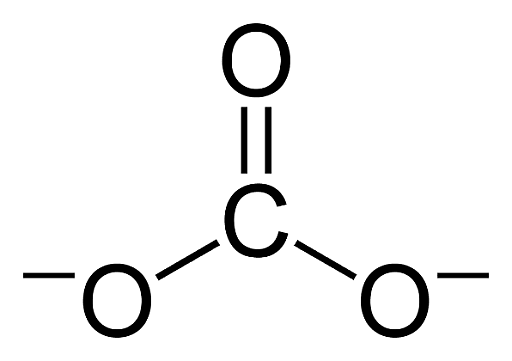
Carbonate Ion Formula
Types of Carbonates
[Click Here for Sample Questions]
It is estimated by the scientists that there exist approximately 80 different types of carbonate minerals most of which are scarcely found. Certain rocks contain varieties of carbonates such as dolomite, aragonite, calcite, etc. out of which dolomites are found as a substitute for calcite in limestones. The carbonates differ in their structure type. The most common water-free carbonates are classified into mainly 3 groups depending upon the type of their structure. The classifications are:
- Calcite: The calcite group of minerals shares a similar structure type. It tends to be considered as a subsidiary of the NaCl structure in which the carbonate (CO3) bunches substitute for the chlorine particles and calcium cations replace the sodium cations. Because of the three-sided state of the CO3 gatherings, the design is rhombohedral rather than isometric as in NaCl.
- Aragonite: Aragonite group is more limited and has a solid solution than the calcite group. The sort of cation present in aragonite minerals is to a great extent liable for the distinctions in actual properties among the individuals from the gathering. Explicit gravity, for instance, is generally corresponding to the atomic weight of the metal ions.

Structure of Calcite and Aragonite
- Dolomite: The dolomite construction can be considered as a calcite-type structure in which magnesium and calcium cations involve the metal locales in substitute layers. The calcium (Ca2+) and magnesium (Mg2+) particles vary in size and this produces cation requests with the two cations involving explicit and separate levels in the construction. Dolomite has a calcium-to-magnesium proportion of roughly 1:1, which gives it a creation transitional somewhere in the range of CaCO3 and MgCO3.

Structure of Dolomite
Read More:
Variations of Carbonates
[Click Here for Sample Questions]
The carbonates that help in the formation of rocks are classified mainly into two categories which are aragonite and calcite. The structure of calcite is developed by its resemblance to the structure of sodium chloride where the CO3 groups and atoms of calcium replace the chloride and sodium of halite.
In addition to the carbonates, the carbonate minerals constitute bicarbonates, hydrated carbonates, and compound carbonates that contain anions other than carbonates.
Properties of Carbonates
[Click Here for Sample Questions]
Some of the important properties of carbonates are:
- The carbonate ions have a planar structure due to which they are soft, soluble in hydrochloric acid, and have a significant anisotropy in many physical properties due to the planar form of the carbonate ion.
- When heated, the metal carbonate gets decomposed and liberates carbon dioxide (CO2). The process, therefore, is known as calcination or calcium oxide, CaO.
- The construction of Carbonate salt occurs when a positively charged ion M+, M2+, or M3+ contacts with the negatively charged oxygen atoms of the ion by assembling electrostatic draws with them, composing an ionic compound.
2M+ + (CO3)2- → M2CO3
M2+ + (CO3)2- → MCO3
2M3+ + 3 (CO3)2- → M2(CO3)3
- At a standard temperature and pressure, most of the carbonate salts are insoluble in water. However, there exists an exception that involves lithium, sodium, potassium, rubidium, ammonium carbonates, etc.
Difference between Carbonates and Bicarbonates
[Click Here for Sample Questions]
The carbonate and bicarbonate methods are mainly accountable for the maintenance of the pH value of the blood and function as the cushion in our blood. When the carbon dioxide dissolves in the water, the construction of bicarbonate and carbonic acid takes place.
The major difference between the carbonates and bicarbonates is that the ions of carbonates have -2 electrical charges, while the bicarbonate ions have a -1 electrical charge.

Formation of Carbonate and Bicarbonate Ions
The other differences between carbonate and bicarbonate have been mentioned in the table below:
| Carbonates | Bicarbonates |
| Carbonates have strong stability | Bicarbonates have less stability |
| The molar mass of carbonate is 60 g mol-1 | The molar mass of Bicarbonate is 61g mol-1 |
| The carbonate ion doesn’t have protons | Protons are present with oxygen in bicarbonate ions. |
| It occurs in the presence of strong basic conditions | It occurs with weak basic conditions. |
| Contains 3 carbon & 3 oxygen atoms. | Contains 1 carbon, 1 hydrogen & 3 oxygen atoms. |
| Insoluble in water (room temperature) | Bicarbonate salts are soluble in water (room temperature) |
Read More:
Things to Remember
[Click Here for Sample Questions]
- Carbonates are the inorganic ions having one carbon and three oxygen atoms.
- They have trigonal planar geometry and have a molecular weight which is equivalent to 60 g mol-1.
- The carbonate ions are formed when the carbon dioxide or bicarbonate dissolves in the water.
- The Lewis structure for carbonate ion comprises 1 carbon-oxygen double bond and 2 carbon-oxygen single bonds.
- The carbonate ions have a hybrid structure if all resonance structures are because its ions show resonance stabilisation.
- The ions of carbonate and bicarbonate contain carbon and oxygen atoms.
- Carbonate ions have a -2 electrical charge.
- There exist several types of carbonate rocks for example limestone, dolomite, potash, etc.
Sample Questions
Ques. Define the properties of carbonates? (3 marks)
Ans. Carbonate ions tend to have different properties in physical, soluble & thermal conditions. A couple of general properties of carbonate particles are mentioned underneath.
- Physical State: At room temperature carbonate stays in its initial form i.e. solid, carbonate has a molar mass of 60.008g/mol−1, and the composed base is bicarbonate.
- Liquid State: except for Li2CO3 group 1 carbonate gets dissolved in water, group 2 carbonates are partially solvent in water & group 3 carbonates get fairly dissolvable in water.
- Thermal Stability: After heating carbonates, decompose them into oxide and carbon dioxide.
Ques. Are Carbonates acidic or basic? What pH do carbonates contain? (2 marks)
Ans. Carbonates are reasonably solid bases. Aqueous solutions are basic as the carbonate anion can acknowledge a hydrogen particle from water.
(CO3)2− + H2O = HCO3− + OH−
Carbonates react with acids, shaping salts of the metal, vaporous carbon dioxide, and water. They are bases also for the reason that they neutralise the acids. That is why metal carbonates and metal hydro carbonates are considered bases. They have the ph value of 8 & 10.
Ques. What are the dissimilarities between calcium carbonate and calcium bicarbonate? (3 marks)
Ans. Below mentioned are the points:
- The main dissimilarity between calcium carbonate and calcium bicarbonate is that the molecule of calcium carbonate comprises chemical elements such as Ca, C, and O while the calcium bicarbonate consists of chemical elements that are Ca, C, O, and H.
- Calcium carbonate is a natural process and it appears in a white solid form, unlike calcium bicarbonate which exists in the liquid form only. Both have diverse molar masses as Carbonate is 100g/mol whereas bicarbonate is 162.11 g/mol.
Ques. What is the significance of calcium carbonates? What are its uses? (3 marks)
Ans. Calcium carbonate deteriorates to shape carbon dioxide and lime, significant material in making steel, glass, and paper. On account of its stomach-settling agent properties, calcium carbonate is utilised in modern settings to kill acidic conditions in both soil and water.
- The vital uses of carbonates are in raw materials in various manufacturing processes such as drug development, glass making or by paper industries, for making soaps & detergents, etc.
- Calcium carbonate is a diet supplement taken when the amount of calcium in food is not efficient enough. It is needed for the healthy growth of the body, muscles, and bones.
Ques. Explain the term antioxidants with a few examples. (2 marks)
Ans. An antioxidant is a chemical compound that protects cells against the results of loose radicals (molecules produced whilst the body breaks down meals or is uncovered to pollutants consisting of tobacco smoke or radiation). They ease back harm to cells brought about by free extremists, unsound particles that the body produces as a response to natural and different tensions. They contain nutrients, minerals, catalysts, and regular items. Also, they are the source of ageing and the reason for various degenerative diseases. In the human body, white platelets cooperate with the free radicals, shielding body cells from harm.
Example: Vitamin C & E, Lycopene, Ellagic Acid, etc
Ques. Does carbonate cause any side effects on health? (3 marks)
Ans. Yes, basically consumed in solid form, direct contact with the direct eye or skin contact with the pure form of carbonates (crystals or powder) can create bothering.
- Some carbonates like Calcium carbonate are taken in the form of various food supplements when the actual calcium amount is low in the human body or is not enough.
- As it is needed for the healthy growth of bones, muscles, nervous system & heart it must be taken under prescription by the doctors.
- It is not very poisonous but shouldn’t be used for a long interval of time. Side effects can include vomiting, constipation, dry mouth, upset stomach, etc. calcium may cause side effects like vomiting, constipation, dry mouth, upset stomach, etc. when consumed in excess amounts.
Ques. What is the reaction of carbonates with acids? (2 marks)
Ans. Acids on reaction with carbonates produce salt, water and carbon-dioxide.
acid + metal carbonate → salt + water + carbon dioxide
Let us consider the reaction of sulphuric acid and iron carbonate:
sulfuric acid + iron(II) carbonate → iron(II) sulphate + water + carbon dioxide
H2SO4 + FeCO3 → FeSO4 + H2O + CO2
These reactions are exothermic and can be used to detect the nature of unknown liquids.
Read More:



Comments