



Content Curator
Cartesian system deals with the representation of a point uniquely in the n-dimensional plane. These numerical values show the distances to the point from the two perpendicular lines known as the axis, measured in the same unit of length. Graphical representation of data in the form of graphs and bar charts make use of cartesian systems. The Cartesian system is the base of the analytical geometry and helps in the representation and understanding of points, lines, curves, and geometric figures in a single or multi-dimensional plane.
| Table of Content |
Key Takeaways- Cartesian System, Cartesian Coordinates, Cartesian planes, Complex Numbers.
Cartesian System
[Click Here for Sample Questions]
Cartesian Coordinate System in a plane is a coordinate system that specifies each point uniquely on the plane by a pair of two numerical coordinates. These numerical values show the distances to the point from the two perpendicular lines known as the axis. The Cartesian system is the base of the analytical geometry and helps in the representation and understanding of points, lines, curves, and geometric figures in a single or multi-dimensional plane.
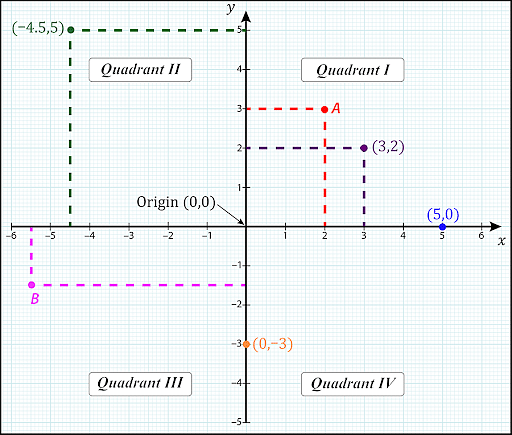
Cartesian System
The video below explains this:
Coordinate Geometry Detailed Video Explanation:
Also Read:
Cartesian Plane
[Click Here for Sample Questions]
Cartesian plane can be defined as a coordinate plane created by two perpendicular intersecting lines or axes. The horizontal line is called X-axis and the vertical line is called Y-axis. The coordinate points (X, Y) denote the horizontal and vertical distances. Some fundamental facts of the Cartesian Plane are:
- In a two- dimensional plane, two perpendicular lines or axes intersect each other at a right angle and the horizontal axis is called X-axis and the vertical axis is called Y-axis. They are also known as coordinate axes of the system.
- The two coordinate axes divide the two-dimensional plan into four segments called quadrants.
- The point at which two coordinate axes intersect each other is considered as zero of the Cartesian system. It is denoted as (0,0) and it is named as ‘origin’.
- To specify the position of a point P(x,y) on a Cartesian plane, the distance x has to be measured along the X-axis starting from the origin and the distance y has to be measured by moving parallel to the Y-axis.

Cartesian Plane
- The ordered pair in the cartesian plane is named cartesian coordinates and it is given in the form of (x,y). The ordered pairs in the two-dimensional plane are referred to as the abscissa and ordinate.
Abscissa- It is the first number of the ordered pair. In other words, the value of x of the ordered pair is to be named abscissa. It denotes the distance of the point on the plane from the Y-axis.
Ordinate- The second number of the ordered pair is called ordinate. It is the value of y and denotes the distance of any point on the plane from the X-axis.
For example, if the cartesian coordinate of a point is (5,6), 5 represents the abscissa and 6 represents the ordinate.
Also Read:
Cartesian Coordinates
[Click Here for Sample Questions]
As we have already mentioned, the X-axis and the Y-axis intersect each other perpendicularly to form four segments known as Quadrants. The quadrants are denoted as I, II, III, and IV in an anti-clockwise direction.

Quadrants
The quadrants are bound by two semi X and Y axes. The signs will be different in each coordinate. Depending on the values of each axis, the point can be found in different quadrants in the following manner:
- Quadrant I: x>o and y>o. Therefore, the sign of a point will be (+,+).
- Quadrant II: x<o and y>o. Therefore, the sign of a point will be (-,+).
- Quadrant III: x<o and y<o. Therefore, the sign of a point will be (-,-).
- Quadrant IV: x>o and y<o. Therefore, the sign of a point will be (+,-).
Also Read: Complex numbers and Quadratic equations
How to Plot a Point on a Cartesian Plane?
[Click Here for Sample Questions]
Let’s take the same example of a two dimensional cartesian coordinate (5, 10).
To plot the point (5,10) in the cartesian plane,
- First, we have to identify the abscissa and ordinate from the given ordered pair. Here, Abscissa = 5 and ordinate= 10.
- Next, let us plot the value of x (i.e.) “5” on the x-axis. We have to move 5 units from the origin to the right, as its value of x is positive.

- Next, we have to plot the value of y, (i.e.) “10” on the y axis. Here we have to move 10 units from the origin to the y-axis, as it has a positive value.
- Finally, we get the point (5, 10) which is located on the first quadrant of the cartesian plane.
Also Read:
Dimensions in a Cartesian System
[Click Here for Sample Questions]
In the Cartesian system, we generally start with the bifurcation with one dimension, the two-dimension and then we go for a three-dimensional or even higher dimensional system.
One Dimensional System
In the Cartesian Coordinate system for a one-dimensional space is a straight line with the Origin (O) and a positive side and the negative side of the line. Here the term ‘one dimensional’ refers to the plane having either a horizontal line or a vertical line. In the case of a horizontally plotted line, the right side is considered as the positive and the left side is considered as the negative. On the other hand, when the line is placed vertically, the upper part is considered as positive and the lower part is taken as the negative.

One-Dimensional System
Each point plotted on the line is specified with the reference to the origin (O). The coordinate of the point is prefixed with a ‘+’ or ‘–’ sign and the numeric value that represents its distance from the Origin o. Generally, the one-dimensional line is referred to as the Number line and used for the representation of the real numbers.
Also Read:
Two-Dimensional System
When a Cartesian Plane divides a plane into two dimensions it is referred to as a two-dimensional plane or a Coordinate Plane. Here, two axes: a horizontal X-axis and a vertical Y-axis intersect each other perpendicularly. The point of intersection of these two axes is called the Origin (0,0). Any point in the coordinate plane is referred to by a point (x,y).

Two dimensional System
Also Read:
Three-Dimensional Cartesian System
In a three-dimensional Cartesian system, there are three axes, the X-axis, the Y-axis, and the Z-axis. They are mutually perpendicular to each other. The point at which all three axes intersect is called the origin(O). Here, three axes divide the space into eight octants.

Three-Dimensional System
Any point in a three-dimensional space is represented by coordinates (x,y,z) where the x value of the point is referred to as the abscissa, the y value is called the ordinate, and the z value is referred to as the applicate.
Also Read:
Complex Numbers in the Cartesian System
[Click Here for Sample Questions]
Complex number has two components: a real number and an imaginary number. Now, we know that an imaginary number cannot be represented on a Cartesian plane. Hence, they are represented on a complex plane. A complex cartesian plane is represented just like a two-dimensional Cartesian System. However, here one axis represents the imaginary component of the number and the other axis represents the real part of the number. For example, for a complex number a+ib, the point will be (a,b).

Complex Plane Representation
Also Read:
Things to Remember
- A Cartesian Coordinate system can have an n-dimensional system to represent multiple quantities at once.
- In the case of a two-dimensional plane, two perpendicular axes intersect each other at right angles and the horizontal axis is called X-axis and the vertical axis is called Y-axis.
- The point they intersect is called origin (O).
- There are 4 quadrants in a two dimensional cartesian plane.
- The x-value is called abscissa and y value is called ordinate.
- The one-dimensional cartesian system is nothing but aNumber-line.
- In a three-dimensional Cartesian System, there are three axes, the X-axis, the Y-axis and the Z-axis which are mutually perpendicular to each other.
- Complex Numbers can be represented on a complex cartesian plane. Here, one axis represents the imaginary component of the complex number and the other axis represents the real part of the number.
Also Read:
Sample Questions
Ques: What is a Cartesian Plane? [2 marks]
Ans: A cartesian plane is a two-dimensional plane where two lines x-axis and y-axis intersect each other to divide the plane into four quadrants.
Ques: What are abscissa and ordinate? [3 marks]
Ans: The ordered pair in the cartesian plane is called cartesian coordinates and it is given in the form of (x,y). The Abscissa is the first number of the ordered pair- the value of x of the ordered. It denotes the distance of the point on the plane from the Y-axis. The Ordinate is the second number of the ordered pair and it indicates the value of y and denotes the distance of any point on the plane from the X-axis.
Ques: What is Origin? [2 marks]
Ans: In a cartesian plane the Origin is the point where both the X-axis and the Y-axis intersects each other perpendicularly. It is denoted as O (0,0).
Ques: What are the uses of the Cartesian Plane? [2 marks]
Ans: Cartesian planes can be used to plot the solutions of the equations with two variables. It may serve as a visual tool to pinpoint the position of a point in an n-dimensional space.
The higher dimensional systems have major applications in computer programming and AI.
Ques: Ravi and Sameer want to make a frame using the coordinates (1,2),(3,2),(3,0),(1,0). Based on the coordinates, Ravi says that the frame will be a square while Sameer says that the frame will be a parallelogram. Identify who is right? [2 marks]
Ans: let us draw the coordinates on a Cartesian Plane

From the image we can clearly obtain that figure will be square as the length of the sides are equal and they are intersecting each other at 90° angle. So, here, Ravi is right.
Ques: Find the distance between the points (4, 7) and (2, 3) in a two-dimensional cartesian coordinate system? [3 marks]
Ans: Here, the given points are (x1,y1) = (4, 7), and (x2,y2) = (2, 3).
The formula to find the distance between two points in a cartesian coordinate system are as follows-
D = \(\sqrt{(x_2-x_1)^2+(y_2-y_1)^2}\)
Putting the values we get, D= 2√5
Therefore, the distance between the two points is 25.
Ques: What will be the equation of the line in the cartesian system, having a slope of -2 and a y-intercept of 5? [2 marks]
Ans: Here, the given slope of the line is m = -2, and
the y-intercept of the line is c = 5.
The equation of the line is y = mx + c. Putting the values, we get.
y = -2x + 5
2x + y = 5.
Thus, the required equation of the line is 2x + y = 5.
Also Read:



Comments