



Education Journalist | Study Abroad Lead
Algebra is a discipline of mathematics that consists of solving numerical problems by constructing equations with the use of variables. Algebra aids in the development of mathematical fundamentals. Real numbers, complex numbers, vectors, matrices, and other mathematical representations are all included in algebra. In algebraic applications, equations are essential. Correlating and translating problems into equations, then solving them to discover the solution, is what algebraic reasoning basically entails. In this article, we will explore algebra and its branches, and sub-branches.
| Table of Content |
What is Algebra?
[Click Here for Sample Questions]
Algebra is a branch of Mathematics that is useful for the purpose of expressing a mathematical equation through the development of relationships with the use of letters or other symbols to represent the entities. The equation's unknown quantities can be solved using algebra. It deals with variables and symbols. Equations, terms, and expressions are used in various arithmetical statements and operations to draw a link between items that are not constant and change over time. Variables are another term for these objects in fundamental algebra.
- Variables are usually represented using letters of the English alphabet as well as Roman symbols.
- A mathematical sentence with an equal sign is called an equation, for instance, 3 + 5 = 8.
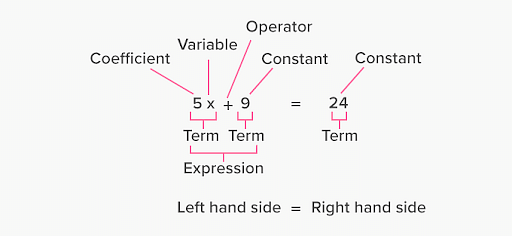
Algebraic equation
The algebraic formulas are used in our daily lives from finding out the distance between objects to calculating the prices of sales when needed. Some of the important topics covered under Algebra are Exponents, Polynomials, Quadratic Equations, etc.
Also Read:
Branches of Algebra
[Click Here for Previous Year Questions]
There are five different branches of algebra: elementary, advanced, abstract, linear, and cumulative. Let us know about these branches in depth.
Elementary Algebra
This branch of mathematics is concerned with the fundamental properties of numbers, variables, constants, and their relationships.
- Equations, formation, manipulation, expression evaluation, equalities, inequalities, equation solutions (both algebraic and linear), and other topics are covered in elementary algebra.
- It also enables the standard formulation of arithmetic principles such as a + b = b + a, and it is the first step in demonstrating the systematic study of all of the properties for a system of real numbers.

Equation formation in elementary algebra
Advanced Algebra
This is Algebra's intermediate level. In comparison to pre or elementary algebra, this algebra has a lot of equations to answer. Advanced algebra will assist you in understanding other aspects of algebra, such as:
- Matrices
- Series
- Trigonometry
- Equalities
- Conic Sections
- Polynomial Situations
- Inequalities
- Sequences
- Probability
- Graphic Representation
- Rational Expression
Linear Algebra
Linear algebra is an area of mathematics that has applications in both applied and pure mathematics. It is concerned with the linear mappings of vector spaces. The study of planes and lines is also part of it. It is the study of linear equation sets that have transformational features. It is universally used in mathematics. It deals with linear equations and their representation in vector spaces and matrices for linear functions.
The following are some of the most essential subjects studied in linear algebra:
- Linear Equations
- Matrices
- Matrix Decomposition
- Vector Spaces
- Relations
- Relations and Computation
Cumulative Algebra
It is a branch of algebra that investigates commutative rings and their respective ideals. Commutative algebra is required for algebraic number theory and algebraic geometry. Rings of algebraic integers, polynomial rings, and so on are examples of this branch. Commutative algebra is used in many other fields of mathematics, including differential topology, invariant theory, order theory, and general topology. In modern pure mathematics, it has played a significant role.
Abstract Algebra
Abstract algebra is one of the divisions of algebra that seeks to discover truths about algebraic systems that are independent of the nature of particular operations. In some circumstances, these operations have particular features. As a result, we can draw certain conclusions about the ramifications of such features. Fields, groups, modules, rings, lattices, vector spaces, and other algebraic structures are studied in abstract algebra.
The abstract algebra concepts are as follows:
- Binary Operations - The binary operations are created when the concept of addition is imagined. Without a set, the concept of all binary operations will be useless.
- Inverse Elements - The term "inverse elements" refers to a concept that involves a negative integer. In addition, we write “-a” as the inverse of “a,” and for multiplication, we write “a-1′′ as the inverse form.
- Sets - A set is defined as a collection of things whose existence is determined by a given property. For example, a collection of all 2 x 2 matrices, a collection of two-dimensional vectors in the plane, and many types of finite groups.
- Associative- When integers are added together, there is a property known as associativity, which states that grouping the numbers does not impact the sum. Consider the following equation: (9 + 6) + 3 = 9 + (6 + 3).
- Identity Element - For a certain operation, the numbers 0 and 1 are viewed as an identity element. For the addition operation, 0 is the identity element, but for the multiplication operation, 1 is the identity element.

Basic Algebraic Properties
Algebraic Equations
[Click Here for Sample Questions]
An algebraic equation is a balanced equation consisting of constants, variables, and coefficients. It can be expressed in the form of P=0, where P denotes a polynomial. For instance, a + 7 = 0. There are 5 types of algebraic equations which are as follows:
- Cubic Equations
- Polynomial Equations
- Quadratic Equations
- Rational Polynomial Equations
- Trigonometric Equations
Parts of Algebra
[Click Here for Previous Year Questions]
The different aspects of algebra and the related topics are given below.
Overview of Algebra
- Basics of Algebra
- Algebraical Expressions through Addition and Subtraction
- Algebraical Expressions through Multiplication
- BODMAS and Simplification of Brackets
- Substitution Method
- Solving Inequalities
Exponents in Algebra
- Introduction to Exponents
- Exponent
- Square Roots and Cube Roots
- Surds
- Simplifying Square Roots
- Laws of Exponents
- Exponents in Algebra
Simplification
- Associative Property, Commutative Property, Distributive Law
- Cross Multiplication
- Fractions in Algebra
Polynomials
- What is a polynomial?
- Adding & Subtracting Polynomials
- Multiplying Polynomials
- Rational Polynomials
- Dividing Polynomials
- Polynomial Long Division
- Conjugate
- Rationalizing the Denominators
Quadratic Equations
- Solving Quadratic Equations
- Completing the Square
Also Read:
Things to Remember
- Equations, terms, and expressions are used in various arithmetical statements and operations to draw a link between items that are not constant and change over time.
- There are five different branches of algebra: elementary, advanced, abstract, linear, and cumulative algebra.
- Elementary algebra enables the standard formulation of arithmetic principles such as a + b = b + a, and it is the first step in demonstrating the systematic study of all of the properties for a system of real numbers.
- Advanced algebra will assist you in understanding other aspects of algebra, such as polynomials, trigonometry, probability, etc.
- Linear algebra is an area of mathematics that has applications in both applied and pure mathematics. It is concerned with the linear mappings of vector spaces. The study of planes and lines is also part of it.
- Commutative algebra is used in many other fields of mathematics, including differential topology, invariant theory, order theory, and general topology.
- Abstract Algebra includes binary operations, identity elements, associativity, sets, and inverse elements.
- Algebra was found by Muhammad ibn Musa al-Khwarizmi, a Muslim astronomer and mathematician in the 9th century.
Sample Questions
Ques. What are polynomials? What kinds of algebraic equations are there? What are the fundamentals of algebra? (5 marks)
Ans. An equation including more than two algebraic terms, particularly the sum of numerous phrases containing different powers of the same variable(s) is known as polynomials. The various kinds of algebraic equations are:
- A monomial is an algebraic expression that comprises just one term.
- A binomial expression is an algebraic expression comprising two terms.
- A trinomial is an algebraic expression comprising three terms.
- A quadrinomial is an algebraic expression that has four terms.
Addition, subtraction, multiplications, and division of algebraic expressions are the fundamental concepts of algebra. It also includes solving equations, applied verbal problems, etc.
Ques. What is the best way to describe an algebraic expression? (3 marks)
Ans. The phrases and operations with the terms are used to describe an algebraic expression.
For instance, x + 3 can be defined as "sum of three and x." While a + b - 7 can be stated as "the sum of a and b, less by 7."
Numbers, variables, along with atleast one arithmetic operation constitute an algebraic expression.
For instance, 2x + 4y - 7, is an algebraic expression.
Ques. Solve for x5– 41x3+ 400x = 0. (5 marks)
Ans. x(x4 - 41x2 + 400) = 0
∴ x = 0 or x4– 41x2+ 400 = 0
Let x2= a
∴ a2 – 41a + 400 = 0
∴ a2 – 25a − 16a + 400 = 0
∴ (a – 16) (a – 25) = 0
∴ a = 16 or a = 25
∴ x2= 16 or x2= 25
∴ x = ±4 or x = ±5
∴ x = −4 or -5 or 0 or 5 or 4
Ques. Solve for y2– 14y + 30 = −18. (3 marks)
Ans. y2– 14y + 48 = 0
∴ y 2– 8y − 6y + 48 = 0
∴ (y – 6) (y – 8) = 0
∴ y = 6 or y = 8
Ques. Solve for 4x3+ 24x2– 64x = 0. (3 marks)
Ans. 4x(x2+ 6x – 16) = 0
∴ 4x = 0 or x2+ 6x – 16 = 0 (4x = 0, x = 0)
∴ x2 + 6x – 16 = 0
∴ x2 + 8x − 2x – 16 = 0
∴ (x − 2)(x + 8) = 0
∴ x = 2 or x = −8
∴ x = −8, 0 or 2
Ques. Name the types of equations that exist in algebra. (3 marks)
Ans. There are 5 types of algebraic equations which are:
- Cubic Equations
- Polynomial Equations
- Quadratic Equations
- Rational Polynomial Equations
- Trigonometric Equations
Ques. Solve for: (5 marks)
2x + 3y = 77................ (i)
3x + 5y = 124............... (ii)
Ans. Multiplying eq. (i) by 3 and eq. (ii) by 2, we get
6x + 9y = 231.............. (iii)
6x + 10y = 246.............. (iv)
Subtracting eq. (iv) from (iii) we get
y = 17
we get,
⇒ 2x + 3 × 17 = 77
⇒ 2x = 51
∴ x = 1
Do Check Out:



Comments