



Education Journalist | Study Abroad Lead
Cathode Ray Experiment was conducted by J.J Thomson to discover electrons. Michael Faraday demonstrated in 1830 that when electricity is transmitted through an electrolyte solution, chemical reactions occur at the electrodes, resulting in the liberation and deposition of matter at the electrodes. In this article, we will learn the procedure to perform the Cathode Ray Experiment and its applications.
| Table of Content |
What is a Cathode Ray Tube (CRT)?
A cathode ray tube(CRT) is a kind of vacuum tube producing images when an electron beam collides with a phosphorescent surface. CRTs are used in the majority of desktop computer displays.
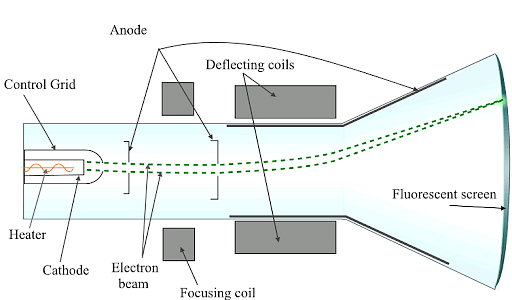
As seen in the image, a cathode ray tube is made up of numerous fundamental components:
- The electron gun or heater produces a narrow electron beam. Anodes accelerate the electrons.
- Deflecting coils generate an extremely low-frequency electromagnetic field that allows the electron beam's direction to be adjusted continuously.
- Deflecting coils are of two types: horizontal and vertical.
- The beam's intensity can be adjusted. When the electron beam hits the phosphor-coated screen, it creates a small, brilliant visible spot on the fluorescent screen.
Explanation for Cathode Rays
- In vacuum tubes, cathode rays (electron beams or e-beams) are electron streams. When a voltage is given to an evacuated glass tube with two electrodes, electrons emitted from the cathode cause the glass opposite the negative electrode to glow. The constituents of cathode rays were the first to be found. A focused beam of electrons is deflected by magnetic or electric fields in cathode ray tubes, in order to produce the image in a traditional television set (CRTs).

Cathode Rays used to produce images in traditional Television
- In simple words, rays traveling from the negative end to the positive end of an electrode within a vacuum are known as Cathode Rays.
- Cathode rays are not visible, but they were first identified in early vacuum tubes when they impacted the tube's glass wall, energizing the atoms and causing them to emit light—a glow known as fluorescence.
Cathode Ray Experiment
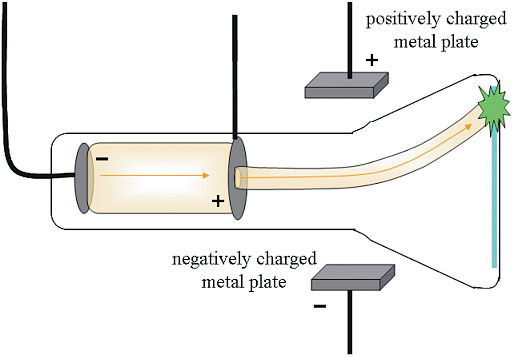
J.J. Thomson, a scientist, began working with cathode ray tubes in the late 1800s. Thomson used two opposingly charged electric plates around the cathode ray to test the particles' characteristics. The cathode ray was redirected away from the negatively charged plate and towards the positively charged plate.
Procedure
- The equipment is set up so that the terminals have a high voltage and the internal pressure is decreased by eliminating air from the tube.
- Ionization of partial air inside the terminal due to high voltage causes gas to become the conductor.
- A closed-loop circuit propagates electric current.
- A dipole is used to detect and measure the beam that was created.
- The cathode rays begin deflecting and repelling from the dipole and moving towards the anode as a result.
- The phosphorescent substance was put in such a way that when the rays strike it, little sparks of light appear, allowing the stream of rays to be detected.
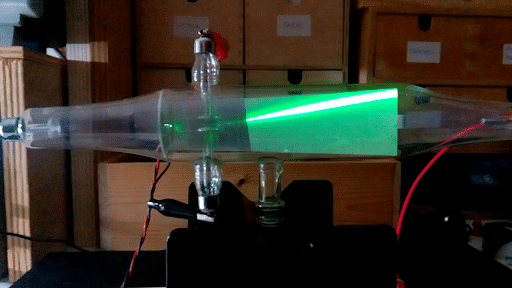
Cathode Ray Experiment
Conclusion
J. J. Thomson derived a conclusion after the experiment that the rays that moved from the cation to the anion were negative. The theory helped future physicists in understanding the modern structure of an atom. They also discovered that the quantity of voltage, kind of gas, and constituent ratios did not affect the natural, physical, and behavioral features of electrons.
This ensured that the electron is a separate subatomic particle with its own set of traits and behaviors that would later be defined by physicists.
Aside from this finding, the experiment might be used to describe the characteristics of its inherent propensity to attract positive charges, protons, or holes. They also revealed the size of the charge it carries, as well as the mass ratio. The number of positively charged protons in the nucleus is equal to the number of electrons distributed outside the nucleus. This explains an atom's overall electrical neutrality.
Applications of Cathode Ray Tubes
- A vacuum tube holding an electron cannon and a screen lined with phosphors are the main components of a cathode ray tube (CRT). Images are created with CRTs.
- Televisions and computer monitors used to use CRT technology. Three electron cannons correlate to corresponding types of phosphors in color CRTs, one for each main color (red, green, and blue).
- Black and white televisions and ancient computer terminals are examples of monochromatic CRTs.
- CRT screens are also used in oscilloscopes, which are machines that measure and display voltages.

Cathode Ray Oscilloscope
Things to remember
- Cathode Rays are rays that flow from the negative end to the positive end of an electrode in a vacuum.
- When cathode rays are impeded by obstacles they produce a shadow and normally move in straight lines
- The electrodes and gas present in the cathode ray tube do not affect their properties and gas can be ionized by cathode rays.
- They can pierce thin aluminum plates and have the ability to make phosphors glow.
- The Cathode Ray Experiment was performed by J.J Thomson which led to the discovery of electrons.
Sample Questions
Ques. What characteristics do cathode rays have? 2 marks
Ans. Cathode rays develop in an evacuated tube and travel toward the anode via the negative electrode or cathode. They travel in a straight line and cast long shadows. They're strong and capable of completing the task. They are negatively charged and are blocked by electric and magnetic forces.
Ques. Which material is used to make cathode ray tubes and why? 2 marks
Ans. Cesium is used in the formation of cathode-ray tubes. This is because cesium readily releases electrons when it is hit by the light or is heated.
Ques. How was the electron found? 2 marks
Ans. Electron was found by J.J Thomson through the cathode ray tube. He found out that the cathode rays were charged negatively.
Ques. What are the two ways that Cathode Rays can be Deflected? 2 marks
Ans. Cathode rays can be deflected by electric and magnetic fields.
Read more : Hund’s Rule
Ques. What color does a cathode ray have? 2 marks
Ans. As a stream of charged electrons, a cathode ray has no color. When a stream of electrons is propelled to a phosphor-coated screen in a CRT (cathode ray tube), it activates the phosphor and produces color illumination. The phosphor utilized determines the color of the illumination.
Ques. What do cathode rays consist of? 2 marks
Ans. Cathode rays were made up of a negatively charged particle called the electron. Cathode ray tubes (CRTs) use a focused stream of electrons deflected by electrical or magnetic fields to display a picture on a screen.
Ques. When the beam goes through the electric field, what happens to it? 2 marks
Ans. The beam is made up of negatively charged electrons that move quickly. The electron will experience a force towards the positive electrode as a result of the electric field, and hence will be deflected towards it.
Ques. State the applications of cathode ray tubes. 3 marks
Ans. Cathode rat tubes are used in:
- Monitors
- Traditional Television Sets
- Oscilloscopes
- Production of X-rays takes place when cathode rays that are moving fast are suddenly stopped.



Comments