



Content Curator
Combined gas law combines four major laws in chemistry. The general gas equation, commonly known as the ideal gas law, is the state equation of a hypothetical ideal gas. Although it has significant drawbacks, it is a good approximation of the behaviour of various gases under many conditions.
Read More: Atomic Radius
What is Combined Gas Law?
The combined gas law is the combination of the following four laws.
- Charles' law
- Gay- Lussac's law
- Avogadro’s law
- Boyle's law
These laws connect one thermodynamic variable to another while keeping all other variables constant. The interdependence of these variables is represented by the combined gas law, which asserts that the ratio of a system's pressure-volume-temperature product remains constant.

Combined Gas Law
That indicates that if the pressure and volume were increased by two, the temperature would have to rise by four or the number of atoms would have to alter.
The ideal gas constant is indicated by the letter R. This allows you to formulate the relationship between all of these variables as
PV=nRT
which is known as the ideal gas law.
Where,
P → Pressure
V → Volume
T → Temperature
R → Ideal gas constant
n → Number of gas molecules in unit volume
| Read Also: | |
|---|---|
| Electrophilic Aromatic Substitution | Copolymers |
| Polytetrafluoroethene (Teflon) | High Density Polythene |
Formula of Combined Gas Law
The combined gas law can be stated mathematically as
k= PV/T
Where,
P → Pressure
T → Temperature in Kelvin
V → Volume
K → Constant (since units of energy get divided by temperature)
The law can be stated as follows when two chemicals are compared in two separate conditions:
PiVi/ Ti = PfVf / Tf
Where,
Pi → Initial pressure
Vi → Initial volume
Ti → Initial temperature
Pf → Final pressure
Vf → Final volume
Tf → Final temperature
Read More: Interstitial Defect
Evolution of Combined Gas Law
Let's have a look at the evolution of gas laws, from Boyle to Charles and Gay-Lussac to Avogadro, from the steady progression of gas laws to the discovery of combined gas law.
Boyle's Law
According to Boyle's Law, the Pressure Is Inversely Proportional to Volume.
In 1662, Irish chemist Robert Boyle investigated the relationship between pressure and volume, which was the first examination of the linkages between temperature, pressure, and volume of a gas. He put liquid mercury into a J-shaped glass tube that had been filled with air. He changed the pressure in the air by adjusting the amount of mercury he poured in.
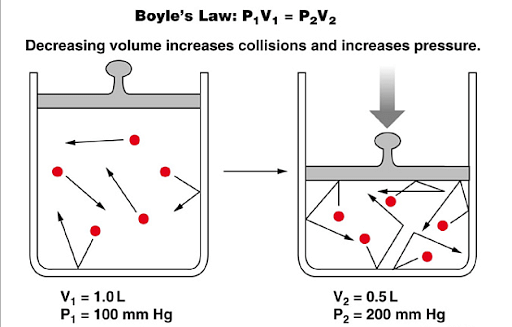
Boyle’s Law
He discovered that pressure and volume were inversely proportional, meaning that as pressure grew, volume decreased.
P α \(\frac {1}{V}\)
Where,
P → Pressure
V → Volume
Charles's Law
According to Charles' Law, the Volume Is Directly Proportional to Temperature.

Charles’s Law
Jacques Charles, a French scientist, started experimenting with the link between the volume and temperature of a gas in 1787. He discovered that if the pressure was held constant, the volume of a gas was proportional to its temperature. You can double the volume of a gas by doubling its temperature.
T α V
Where,
T → Temperature
V → Volume
Gay Lussac’s Law
According to Gay Lussac's law, Pressure Is Directly Proportional to Temperature.

Gay Lussac’s Law
In 1802 that a French scientist named Joseph-Louis Gay-Lussac examined the relationship between pressure and temperature. He also wrote that pressure P divided by temperature T was a constant, again in terms of a formula. When the pressure is doubled, the temperature is doubled, and vice versa. Of course, we must use Kelvin to measure temperature.
P α T
Where,
T → Temperature
P → Pressure
Avogadro’s Law
According to Avogadro's Law, the Volume Is Directly Proportional to the Number of Atoms.

Avogadro Law
In 1811, Italian chemist Amedeo Avogadro discovered that the volume of a gas is proportional to the number of atoms in the container under constant temperature and pressure. The concept is the same as before. You may double the volume by doubling the number of atoms. This is referred to as Avogadro's law.
V α n
Where,
V → Volume
n → Number of moles
Things to Remember
- The general gas equation, commonly known as the ideal gas law, is the state equation of a hypothetical ideal gas. Although it has significant drawbacks, it is a good approximation of the behaviour of various gases under many conditions.
- The law that combines Charles' law, Gay- Lussac's law, Avogadro’s law, and Boyle's law is known as the combined gas law. These laws connect one thermodynamic variable to another while keeping all other variables constant.
-
This law indicates that if the pressure and volume were increased by two, the temperature would have to rise by four or the number of atoms would have to alter.
-
The ideal gas constant is indicated by the letter R. This allows you to formulate the relationship between all of these variables as PV=nRT, which is known as the ideal gas law.
Read More: Electrophilic Aromatic Substitution
Sample Questions
Ques. When a plane flies to greater altitudes, how does the atmospheric pressure change? Explain using Boyle's law as a guide. (2 marks)
Ans. Because air isn't an ideal gas, it deviates from Boyle's law. At greater altitudes, atmospheric pressure diminishes, much as water pressure reduces when you travel from deep to shallow water. The change is not linear, however, because air is compressible, and its temperature affects its pressure. When flying at roughly 10000 meters above sea level, the temperature is around - 50 degrees Celsius and the ATM is around 0.2-0.3.
Ques. Why do compressed air cans grow so chilly after a lengthy period of use, but are room temperature when you buy them? What is the chemical process that is taking place within the can? (3 marks)
Ans. For a jar containing compressed air that cools adiabatically, Achilleas is accurate, but not for "canned air." When the pressure is reduced slightly, the liquid in the cans you buy to blow the dust off gadgets quickly evaporates. As a result, a huge amount of gas can be held as a liquid in a small, low-pressure container.
A considerable quantity of heat is absorbed during the phase transition from liquid to gas (boiling). When you press the nozzle, the vapour is released, allowing the liquid to evaporate by lowering the internal pressure. As the liquid boils away within the can, it cools.
If you turn the can upside down and spray the liquid out, you can clearly see this. Whatever it encounters will be frozen. (This effect is also used in home wart removal kits.)
Ques. Why is Boyle's law only valid for perfect gases? (2 marks)
Ans. V = 0 at infinite pressure, according to Boyle's law.
In the real world, unlimited pressure is a ridiculous concept. Extremely high pressures, on the other hand, are not amusing.
It is feasible to create pressures that would reduce the volume of the gas to a value less than the nuclei of its constituent atoms (according to Boyle's law). For an ideal gas, which is assumed to be a point mass with 0 volume, this may happen. Real gases, on the other hand, do not have this advantage.
Ques. Why does the amount of air in Boyle's law experiment drop when additional air is pumped into the tube? (2 marks)
Ans. Boyle's law states that when the pressure of an ideal gas is increased, the volume drops if the temperature remains constant.
At constant temperatures, the molecules are forced against the walls and squeezed. When the temperature rises, molecules can exert pressure. Then there's a chance that the volume won't be reduced.
Ques. When the temperature rises, the pressure rises with it. Is it true that as pressure rises, the temperature rises as well? (2 marks)
Ans. Yes, because when you heat up a substance, the particles absorb heat energy and convert it to kinetic energy. So, in the case of a gas in a container with a fixed volume, when the temperature rises, the average kinetic energy of a particle rises, causing the particle to travel faster and collide more frequently with the container's wall and with each other. Because the particles lose heat because of the continual collisions, heat is dissipated. The temperature will rise as pressure rises because the formula PV=nRT states that temperature and pressure are directly related.
Ques. The gas has a 5L initial volume and a 3L final volume. Given an initial temperature of 273 K, a final temperature of 200 K, and a starting pressure of 25 kPa, calculate the gas's final pressure. (2 marks)
Ans. Using the parameters provided,
Pi= 25 kPa
Vi = 5L
Vf = 3L
Ti = 273K
Tf = 200K
According to the law of combined gases,
PiVi/Ti = PfVf/Tf
We obtain by substituting in the formula
25 x 5 / 273 = Pf x 3 / 200
As a result, Pf = 30.525 kPa.
Ques. Calculate the volume of a gas based on the information provided. Vi = 3L, Ti = 300K, Tf = 250K, Pi = 35 kPa, and Pf= 50 kPa. (2 marks)
Ans. Using the parameters provided,
Pi = 35 kPa
Vi = 3L
Ti = 300K
Pf= 50 kPa
Tf = 250K
According to the law of combined gases,
PiVi/Ti = PfVf/Tf
We obtain by substituting in the formula
35 x 3 / 300 = 50 x Vf / 250
As a result, Vf = 1.75 L
Ques. When we blow air into a balloon, both the pressure and the volume rise at the same time. Is it in violation of Boyle's law? (2 marks)
Ans. When we blow air into a balloon, we continue to blow more and more air into the balloon.
However, Boyle's Law does not consider the addition of more and more air mass. It is a situation of comparison in which the same amount of air is seen.
The volume of a constant gas mass at constant temperature grows owing to external air mass insertion, not pressure, which has an inverse effect on the volume of a constant gas mass at a constant temperature.
Ques. What is the relationship between pressure, temperature, and volume in a vacuum chamber heated to 800 degrees C, and how does it relate to Boyle's or Charles' law? (2 marks)
Ans. The behaviour of an ideal gas is described by Boyle's Law and Charles' Law. Because there is no gas in a vacuum chamber, those laws have no influence on the system's behaviour. More than likely, the increase in volume is due to the expansion of the chamber's substance. Because it's a vacuum, the pressure inside would always be zero. The temperature would simply be the temperature of the chamber's internal wall. There is no material with a temperature inside the vacuum.
Ques. At 100 kPa, a piston with a gas volume of 1.0 m3 is compressed to a final volume of 0.50 m3. Find final pressure. (2 marks)
Ans. Given that,
P1= 100 kPa
V1= 1 m3
V2= 0.5 m3
P2 =?
We know that,
P1V1= P2V2
So, P2= P1V1/V2
= (100 x 1)/0.5
= 200 kPa



Comments