


A cubic polynomial can be defined as a polynomial of degree three. In other words, when we consider the highest exponent of the variable of a cubic polynomial, it will be three. Hence, the general form of a cubic polynomial would be ax3+bx2+cx+d, where a≠0. If a=0, it would be a quadratic polynomial rather than a cubic polynomial.
Some examples of a cubic polynomial are: x3+6x2+6, 3x3+2x2+9x+4
Check out: Who is the father of mathematics?
| Table of Content |
Polynomials General Terms and Definitions
[Click Here for Sample Questions]
A polynomial function, defined as function P(x), is an algebraic expression consisting of variables, coefficients, and exponents separated by mathematical operators.
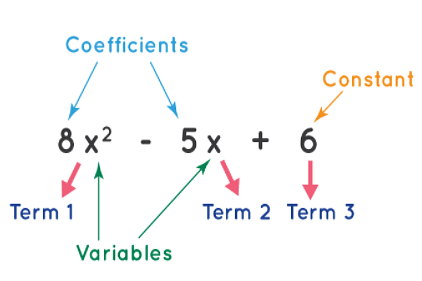
Several mathematical operations can be performed on polynomials. Addition, subtraction, multiplication, and division can be performed but never division by variable.
For example, 1x+1/Y , x-4/X are not polynomials. They can also be called non-polynomials.
Based on the number of terms in a polynomial it can be termed as a monomial, binomial and trinomial. Examples can be seen in the table below.
| Type of Polynomial | No of Terms | Example |
|---|---|---|
| Monomial | 1 | 5x4 |
| Binomial | 2 | 2x2+5 |
| Trinomial | 3 | 5x3+6x+5 |
The degree of a polynomial is defined as the highest exponent of the variable of the polynomial. For example, the degree of x2+4x-6 is 2. The classification of polynomials based on their degrees can be seen in the table below:
| Polynomial | Degree |
|---|---|
| Constant or Zero Polynomial | 0 |
| Linear Polynomial | 1 |
| Quadratic Polynomial | 2 |
| Cubic Polynomial | 3 |
| Quartic Polynomial | 4 |
The video below explains this:
Polynomials Detailed Video Explanation:
Zeros of a Polynomial
[Click Here for Sample Questions]
The zeros of a polynomial are values of the variable for which the value of the polynomial becomes zero. They are also referred to as roots of a polynomial. A linear polynomial has one root, a quadratic polynomial has two roots, a cubic polynomial has three roots, etc. In general, a polynomial of n degree has n number of roots.
For example: Consider the quadratic polynomial x2+2x+1. The value of the polynomial becomes zero when x=-1. Hence, we can say that -1 is a zero of the polynomial.
Factor Theorem
For a polynomial P(x) of degree greater than or equal to one,
- If Pa=0, x-a is a factor of Px.
- If x-a is a factor of P(x), P(a)=0.
Read more:
Factors of a Polynomial
[Click Here for Sample Questions]
In mathematics, factors are integers which produce the original number, when multiplied. For example, take the number 16. Its factors would be 1,2,4,8,16. The same principle can be applied in the case of polynomials. Factors of a polynomial are polynomials that when multiplied produce the original polynomial.
Consider the polynomial x2+5x+6.
x2+5x+6= x2+2x+3x+6
=x(x+2)+3(x+2)
=(x+2)(x+3)
Here, x+2 and x+3 are factors of the polynomial.
Factorization of a Cubic Polynomial
[Click Here for Sample Questions]
- Factorization by Grouping
This method is quite easy but it is not applicable for every case. Consider the polynomial.
Px= x3+5x2-x-5
We group the polynomials into two groups.
= x2(x+5)-1(x+5)
=(x2-1)(x+5)
Factorizing the quadratic polynomial, we get,
=(x+1)(x-1)(x+5)
Hence, we get the three factors of the cubic polynomial.
- Factorization Using Identities
We can use algebraic identities, to simplify cubic polynomials and factorize them. The important identities often used are:
- a2 – b2 = (a – b) (a + b)
- (a + b)2 = a2 + 2ab + b2
- a2 + b2 = (a + b)2 – 2ab
- (a – b)2 = a2 – 2ab + b2
- (a + b + c)2 = a2 + b2 + c2 + 2ab + 2bc + 2ca
- (a – b – c)2 = a2 + b2 + c2 – 2ab + 2bc – 2ca
- (a + b)3 = a3 + 3a2b + 3ab2 + b3; (a + b)3 = a3 + b3 + 3ab (a + b)
- (a – b)3 = a3 – 3a2b + 3ab2 – b3 = a3 – b3 – 3ab (a – b)
- a3 – b3 = (a – b) (a2 + ab + b2)
- a3 + b3 = (a + b) (a2 – ab + b2)
- Factorization Using the Rational Root Theorem and Long Division
This method works only if all coefficients and the constant of the polynomial are rational numbers. If a, b, c, and d in a polynomial, Px=ax3+bx2+cx+d are all rational numbers, the Rational Root Theorem states that the possible roots of the polynomial are the factors of the last term divided by the factors of the first term. In other words, when we consider a cubic polynomial x=ax3+bx2+cx+d, possible roots are ±factors of factors of a .
Consider the polynomial P(x) =x3 + 5x2 - 2x – 24
Using the rational root theorem, possible roots of P(x) are ±factors of-24factors of 1. Hence the possible roots are ±1, 2, 3, 4, 6, 8, 12, 24. Of these, we can quickly see that when x=2, Px=0. So, 2 is a root and x-2 is a factor of a polynomial.
Next, we divide P(x) =x3 + 5x2 - 2x – 24 by x-2. We get, x2+7x+12.
Proceeding to factorize the quadratic polynomial x2+7x+12 :
x2+7x+12=x2+4x+3x+12
=x(x+4)+3(x+4)
=(x+4)(x+3)
Hence, the cubic polynomial can be factorized as
Px=x3 + 5x2 - 2x – 24=(x-2)(x+3)(x+4)
Graphing a Cubic Polynomia
[Click Here for Sample Questions]
Before graphing a cubic polynomial, it is to be noted that the equation for basic cubic graph is-
y=x3
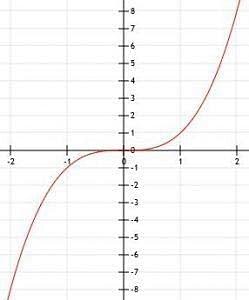
Some key points can be seen in the graph.
- The parent function passed through the origin. Its shape is like that of two parabolas pasted together.
- The vertex is the point at which the graph changes direction. In the parent function, the vertex is the origin. When numbers are added or subtracted to the cubed part of the parent function, the function shifts to the left or right. When numbers are added or subtracted outside the cubed part of the function, the graph shifts up or down.
- When we multiply the cubic function with a number a, we change the stretch of the graph. In the case of the parent function, multiplying with 0.5 compresses it while multiplying with 2 expands it. If the number is negative, it flips the graph upside down.
- The y-intercept is the points at which x=0.
- Cubic polynomials will always have one real root. The x-intercept is the points at which y=0.
Things to Remember
- A cubic polynomial is a polynomial of degree three. The general form of a cubic polynomial is ax3+bx2+cx+d, where a≠0.
- A polynomial can be defined as function P(x), an algebraic expression consisting of variables, coefficients, and exponents separated by mathematical operators. Based on the number of terms in a polynomial it can be termed as a monomial, binomial or trinomial.
- The degree of a polynomial is defined as the highest exponent of the variable of the polynomial. A polynomial can be classified based on its degree.
- The zeros of a polynomial are values of the variable for which the value of the polynomial becomes zero. Zeros are also referred to as roots of a polynomial. A polynomial of n degree has n number of roots.
- Factor Theorem states that, for a polynomial P(x) of degree greater than or equal to one,
If Pa=0, x-a is a factor of Px.
If x-a is a factor of P(x), P(a)=0.
- A cubic polynomial can be factorized by grouping, simplifying with algebraic identities or using rational root theorem and long division.
- Using the properties of the parent graph y=x3 , we can graph cubic functions.
Sample Questions:
Ques: What are the zeros or roots of a polynomial? (1 Mark)
Ans: The zeros of a polynomial are values of the variable for which the value of the polynomial becomes zero. The “zeroes” are also termed as “roots” of the polynomial.
Ques: Define a cubic polynomial. Give examples. (2 Marks)
Ans: A cubic polynomial can be defined as a polynomial of degree three. In other words, when we consider the highest exponent of the variable of a cubic polynomial, it will be three. Hence, the general form of a cubic polynomial would be ax3+bx2+cx+d, where a≠0.
Ques: Find the roots of the polynomial x2-x-2. (2 Marks)
Ans:
x2-x-2= x2+x-2x-2
=x(x+1)-2(x+1)
=(x+1)(x-2)
The roots of the polynomial are x=2 and x=-1
Ques: Solve this equation for x to find the x-intercept(s): (2 Marks)
Ans: 0=(x-2)3-4
4=(x-2)3.
?(4)+2=x.
The decimal approximation is 3.59, so the x-intercept is approximately (3.59, 0).
Ques: Graph the cubic function (x-2)3-4. (3 Marks)
Ans:
- 2 is subtracted from x, which represents a vertex shift two units to the right.
- 4 is subtracted from the function as a whole. This means that the vertex shifts four units down.
- Other than these two shifts, the function is very much the same as the parent function. The vertex will be at the point (2, -4).
- The y-intercept will be,
(0-2)3-4
-8-4
Thus, the point is (0, -12).
Ques: Explain factorization by grouping with an example. (3 Marks)
Ans: Consider the polynomial.
Px= x3+5x2-x-5
We group the polynomials into two groups.
= x2(x+5)-1(x+5)
=(x2-1)(x+5)
Factoring the binomial polynomial, we get,
=(x+1)(x-1)(x+5)
Hence, we get the three factors of the cubic polynomial.
Ques: What is meant by the degree of a polynomial? (3 Marks)
Ans: The degree of a polynomial is defined as the highest exponent of the variable of the polynomial. For example, the degree of x2+4x-6 is 2. The classification of polynomials based on their degrees can be seen in the table below:
| Polynomial | Degree |
|---|---|
| Constant or Zero Polynomial | 0 |
| Linear Polynomial | 1 |
| Quadratic Polynomial | 2 |
| Cubic Polynomial | 3 |
| Quartic Polynomial | 4 |
Ques: What is meant by a monomial, binomial and trinomial with examples? (3 Marks)
Ans: On the basis of the number of terms in a polynomial, it can be categorized as a monomial, binomial and trinomial. The table represents some examples for the same:
| Type of Polynomial | No of Terms | Example |
|---|---|---|
| Monomial | 1 | 5x4 |
| Binomial | 2 | 2x2+5 |
| Trinomial | 3 | 5x3+6x+5 |
Ques: What is the Rational Root Theorem? How is it used to factorize a cubic polynomial? (5 Marks)
Ans: This method works only if all coefficients and the constant of the polynomial are rational numbers. When a, b, c, and d in a polynomial, Px=ax3+bx2+cx+d are all rational numbers, the Rational Root Theorem states that the possible roots of the polynomial are the factors of the last term divided by the factors of the first term.In other words, when we consider a cubic polynomial x=ax3+bx2+cx+d, possible roots are ±factors of factors of a.
Suppose P(x) =x3 + 5x2 - 2x – 24
Applying the rational root theorem, it is observed that the possible roots of P(x) are ±factors of-24factors of 1. Hence the possible roots are ±1, 2, 3, 4, 6, 8, 12, 24. Of these, we can quickly see that when x=2, Px=0. So, 2 is a root and x-2 is a factor of a polynomial.
Next, we divide P(x) =x3 + 5x2 - 2x – 24 by x-2. We get, x2+7x+12.
Proceeding to factorize the quadratic polynomial x2+7x+12 :
x2+7x+12=x2+4x+3x+12
=x(x+4)+3(x+4)
=(x+4)(x+3)
Hence, the cubic polynomial can be factorized as
Px=x3 + 5x2 - 2x – 24=(x-2)(x+3)(x+4)



Comments