



Education Journalist | Study Abroad Lead
A cuboid is a three-dimensional shape with six rectangular faces, 8 vertices, and 12 edges. We come across a cuboid almost every day in our lives. Think about those rectangular boxes, or your pencil box, all of them are cuboids. A cuboid comprises three dimensions, length, height, and width. When these three dimensions are equal to each other, we call that structure cube, its faces are square. In this article, we will learn about the properties of cuboids, cuboid formulas, and look into some sample questions.
Read Also:- Difference between Area and Volume
| Table of Contents |
Keyterms: Cuboid, Cube, Box, Length, Height, Width, Rectangle, Breadth, Diagonal, Degree, Perimeter
What is a cuboid?
A cuboid is a solid three-dimensional shape with six rectangular faces. You can imagine a cuboid like a rectangle but three-dimensional. It has three different and unequal dimensions; length, width, and height. Whereas a rectangle is a two-dimensional shape, with only length and breadth. A transparent cuboid would look something like this:
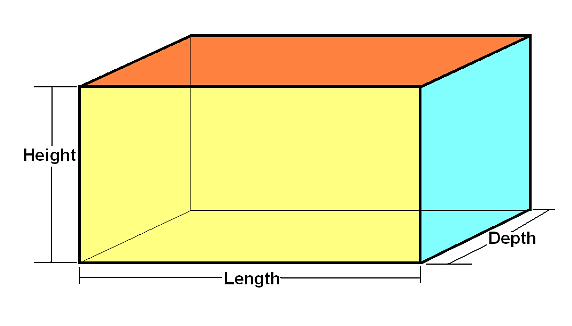
Cuboid showing length, width, and height
Properties of cuboid
A cuboid has the following properties:
- A cuboid has six faces, 12 edges, and 8 vertices.
- All the faces of a cuboid are rectangular and flat.
- The two opposite faces are parallel to each other.
- The angle between two dimensions, say length and width or width and height is always equal to 90 degrees.
- There are two diagonals of a cuboid; a face diagonal and a space diagonal. A face diagonal is a diagonal drawn for a particular face. Whereas a space diagonal is drawn by connecting two opposite vertices of the cuboid.
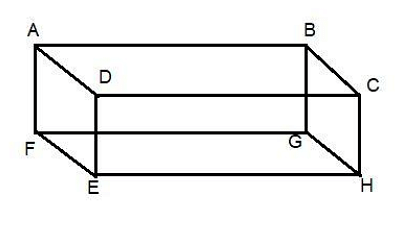
Cuboid with labeled vertices
Diagonals of a cuboid
Being a three-dimensional structure, a cuboid has two types of diagonals:
- Face diagonal
- Space diagonal
The face diagonal is the diagonal that we get by joining two vertices of the same face of the cuboid. Each face of the cuboid would have two such diagonals, just as we see in a rectangle. There are a total of 6 faces in a cuboid, so there would be 12 face diagonals.
In fig 2, the face diagonals are AG, BF, CE, DH, AE, FD, BH, and CG.
Whereas a space diagonal is not present in a two-dimensional shape, it is present in only three-dimensional structures. A space diagonal is drawn by connecting two opposite vertices of the cuboid. It passes through the core or interior of the cuboid. There are 8 vertices in a cuboid, so there would be 4 space diagonals in a particular cuboid.
In fig 2, the space diagonals are AH, BE, DG, and CF.
Also Read:
Surface area of a cuboid
The surface area of a cuboid is the total area covered by all its six faces, i.e, the sum of the area of all the faces. There can be two surface areas of a cuboid that are required in calculations, one is lateral surface area, and the other is total surface area.
-
Lateral surface area
The lateral surface area is the sum of the area of all the faces except the top and the bottom.
Let us consider the three dimensions of a cuboid as
Length = l
Width = w
Height = h
Hence, the lateral surface area of the cube can be calculated by:
= (w × h) + (w × h) + (l × h) + (l × h)
= 2(w × h) + 2(l × h)
= 2h(l + w)
LSA = 2h(l + w) sq units
-
Total surface area of cuboid
The total surface area of a cuboid includes all the faces of the cuboid. We can calculate the total surface area by simply adding the areas of all six faces. Let us consider the dimensions of the rectangle to be (l x w x h).
So, the total surface area of cuboid,
(TSA)= (w × h) + (w × h) + (l × h) + (l × h) + (w × l) + (w × l)
= 2(w × h) + 2(l × h) + 2(w × l)
= 2 [(w × h) + (l × h) + (w × l)]
TSA = 2 [(w × h) + (l × h) + (w × l)]
Volume of cuboid
Just as we calculate the area of a 2D shape, we calculate the volume of a 3D shape. Volume is nothing but the space occupied inside the shape, cuboid in this case. The volume of a solid shape is given by the product of its base area and height.
Volume of cuboid = base area x height
Base area = l x w
Height = h
So, V = l x w x h cubic units
Perimeter of cuboid
The perimeter of a cuboid is equal to the sum of the length of all the edges.
Let us consider a cuboid of length = l, width = w, and height = h.
There are 12 edges of which 4 edges are equal to l, 4 are equal to w, and 4 are equal to h.
AB = DC = GF = EH = l
AD = FE = BC = GH = w
AF = DE = CH = BG = h
So, the perimeter of cuboid is = 4( l + w + h)
Cuboid formulas
Below is the list of all the formulas for any cuboid with length = l, width = w, and height = h.
| 1. | Total Surface area = 2 (Length x width + width x height + Length x height) |
| 2. | Lateral Surface area = 2 height(length + width) |
| 3. | The volume of the cuboid= (length × width × height) |
| 4. | Diagonal of the cuboid =√( l2 + w2 +h2 ) |
| 5. | Perimeter of cuboid = 4 (length + width + height) |
Read more: Surface area and volume
Things to remember
- A cuboid is a solid three-dimensional structure with six rectangular faces, eight vertices, and twelve edges.
- The difference between a cube and a cuboid is that all the dimensions of a cube are equal (l = w= h).
- A cuboid has two types of diagonals; face diagonal and space diagonal. The length of the diagonal is given by √( l2 + w2 +h2 ).
- There can be two types of the surface area of cuboids, the lateral surface area, and total surface area.
Lateral surface area of cuboid = 2 height(length + width)
Total surface area of cuboid= 2 (Length x width + width x height + Length x height)
- Volume of a cuboid refers to the space that is occupied by the cuboid.
Volume of cuboid = (length x width x height)
- The perimeter of a cuboid is equal to the sum of the length of all the edges
Perimeter of cuboid = 4 (length + width + height)
Sample Questions
Ques. Raju has bought a gift box for his friend and wants to wrap it with a gift wrapper. The length, width, and height of the gift box are 30cm, 20cm, and 15cm respectively. Calculate the length of the gift wrapper should he buy if one side of the wrapper is fixed at 40 cm? (5 marks)
Ans. The quantity of the paper required is equal to the surface area of the gift box.
Given: Length (l) = 30cm,
Width (w) = 20 cm,
And, height (h) = 15cm.
We know, Total surface area of cuboid= 2 (Length x width + width x height + Length x height)
So, total surface area of the box
= 2 (30x20 + 20x15 + 30x15)
= 2(600 + 300 + 450)
= 2(1350)
= 2700 sq cm.
If one side of the gift wrapper is fixed at 40 cm, then,
Length of gift wrapper should he buy = total surface area of box / 40cm
= 2700/40
= 67.5 cm
So, Raju should buy a 67.5 cm gift wrapper to wrap the gift box.
Ques. Tina wishes to organize her tools into a box. She bought an open box without a lid where she can organize all her tools. She wants to wrap the box with paper. How much paper would she require to wrap the whole box? The length, breadth, and height of the box are 20cm, 10cm, and 7cm respectively. (4 marks)
Ans. Tina wants to wrap the box with paper except for the top face. So the amount of paper she would require is (total surface area of the box - the area of the top face).
Total surface area of the box = 2 (Length x width + width x height + Length x height)
= 2(20x10 + 10x7 + 20x7)
= 2(200 + 70 + 140)
= 2(410)
= 820 sq cm.
Amount of paper Tina would require is,
= 820 - (20 x 10)
= 820 - 200
= 620 sq cm.
So, Tina would require 620 sq cm of paper to wrap her box.
Ques. Raghu has 40 boxes of edible oil in his shop. The length, breadth, and height of the boxes are 30cm, 25cm, and 50cm. How many liters of edible does he have in his shop? (5 marks)
Ans. The total amount of edible oil Raghu has is equal to the sum of the volume of all the boxes.
Volume of cuboid= (length x breadth x height)
= 30 x 25 x 50
= 37500 cubic cm.
He has 40 such boxes, so the total amount of edible oil he has is
37500 x 40 = 1500000 cubic cm = 1.5 cubic m
As we know, 1 cubic m = 1000 L
So, Raghu has 1500 L of edible oil in his shop.
Ques. A cubical box of edge 10 cm and another cuboidal box is 15 cm long, 10 cm wide and 5 cm high. Which box has more volume than the other one? (2 marks)
Ans. The volume of the cube = 10 x 10 x 10 = 1000 cubic cm
And the volume of the cuboid = 15 x 10 x 5 = 750 cubic cm
The volume of the cube is larger than the volume of the cuboid by 250 cubic cm.
Ques. Consider box A of dimension l x b x h. If each of the dimensions is doubled in box B,
i) Calculate the ratio of the volume of the two boxes.
ii) calculate the ratio of the surface area of the two boxes. (3 marks)
Ans. i) Volume of box A = l x b x h
Volume of box B = 2l x 2b x 2h = 8lbh
So, the ratio of the volume of box A and box B is 1:8
ii) Surface area of box A = 2 (lb + bh + lh)
Surface area of box B = 2 (2lx2b + 2bx2h + 2lx2h)
= 2 (4lb + 4bh + 4lh)
= 2 x 4 ((lb + bh + lh)
= 8 (lb + bh + lh)
So, the ratio of the surface area of box A and box B is 2/128 = 1:64
Ques. A small box made of plywood is held together with pins. It is 40cm long, 35 cm wide, and 20cm high. What is the total area of plywood required? (2 marks)
Ans. The total area of plywood required to make the box is equal to the surface area of the box.
Total surface area of cuboid = 2 (lb + bh + lh)
= 2 (40 x 35 + 35 x 20 + 40 x 20)
= 2 (1400 + 700 + 800)
= 2 (2900)
= 5800 sq cm
Also Read:



Comments