



Education Journalist | Study Abroad Lead
Bayes' theorem is a process for updating probabilities related to a specific reason that was first proposed by Rev.Thomas Bayes. It presents a probability law that connects a posteriori and priori probabilities. When it comes to calculating conditional probability, Bayes' theorem formula comes in handy. For determining conditional probabilities, Bayes' Theorem formula is useful. It is utilized to figure out how to calculate posterior probabilities. The probability of an event is described by Bayes' theorem, which is based on conditions that may be relevant to the event.
| Table of Content |
Key Terms: Bayes theorem, Conditional probability, Probability theory, Proof of Bayes Theorem, Formula of Bayes' theorem, Probability, Events
Bayes Theorem Formula
[Click Here for Sample Questions]
The Bayes theorem, often known as the Bayes rule, is a mathematical formula used to calculate the conditional probability of events in statistics and probability theory. The Bayes theorem describes the likelihood of an event based on a prior understanding of the specific conditions.
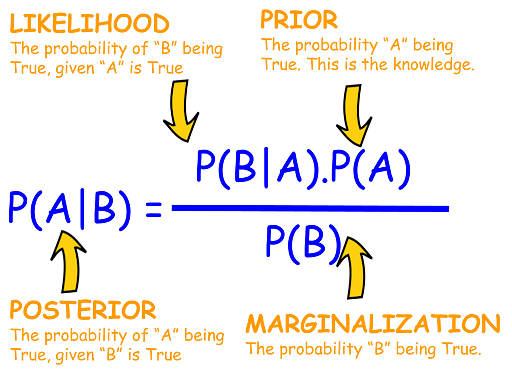
Bayes Theorem Formula
Thomas Bayes began by presenting an equation that permits new evidence to be used to update opinions. We can use the Bayes rule to find the reverse probabilities P(A|B) provided the conditional probability is P(B|A). According to this theorem,
When new or extra information is provided by a random experiment or previous records, we can modify probabilities. The ability of business and management executives to revise existing (provided) probabilities in light of new information is crucial in arriving at a correct judgment in the face of uncertainty.
P(A|B) = P(B|A) × P(A) / P(A)
The following is a broad statement that can be used to illustrate the above assertion:
P(Ai|B) = P(B|Ai)
×P(Ai)∑i = 1n
(P(B|Ai) × P(Ai))
P(Ai) is the probability of the ith occurrence, Ai.
The video below explains this:
Baye's Theoram Detailed Video Explanation:
Also Read:
| Related Articles | ||
|---|---|---|
| Independent Events in Probability | Multiplication Theory on Probability | Conditional Probability Formula |
| Calculus Formula | Inverse Matrix Formula | Application of Integrals |
Conditional Probability
[Click Here for Sample Questions]
Conditional probability happens when an event or outcome occurs as a result of earlier occurrences of events or outcomes. If we multiply the probability of the preceding event by the revised likelihood of the next, or conditional, occurrence, we get the conditional probability.

Conditional Probability
Conditional probabilities occur naturally in the study of experiments when the results of one trial may influence the results of subsequent trials. Given that the first event, event A, has already occurred, we can try to determine the likelihood of the second happening, event B. If the probability of the second occurrence varies while the probability of the first event is taken into account. Then we may safely say that the occurrence of event A will influence the probability of event B.
Also Read: Linear Programming
The conditional probability can be written as P(A|B), which is the likelihood of event A occurring if event B has already occurred.
P(A|B)= \(\frac{P(\text {A and B})}{P}\)= \(\frac{\text {Probability of the occurrence of both A and B}}{\text{Probability of B}}\)
Bayes’ Theorem Formula Derivation
[Click Here for Sample Questions]
From conditional probability, the Bayes theorem can be given as follows.
P(A|B) = P(A \(\bigcap\)B)/ P(B)
Where, P(B) ≠ 0
P(B|A) = P(B\(\bigcap\)A)/ P(A)
Where, P(A) ≠ 0
Here, the joint probability P(A \(\bigcap\) B) of both events A and B being true such that,
P(B \(\bigcap\) A) = P(A \(\bigcap\) B)
P(A \(\bigcap\) B) = P(A | B) P(B) = P(B | A) P(A)
P(A|B) = [P(B|A) P(A)]/ P(B)
Where, P(B) ≠ 0
Also Read: Differentiation and Integration Formula
Bayes’ Theorem Proof
[Click Here for Sample Questions]
If A1, A2, A3..., An are mutually exclusive and exhaustive events with P(Ai) > 0, I = 1, 2, 3,....n, and B is an event with P(B) > 0,
We have the law of the total probability of B.
P (A1) = P (B) P(B/A1) + P(A2) = P (B/A2) = P (B/A2) = P(B/A P(B / A2)+...+P(B / A2)+...+P(B / A2)+...+P(B (An) P(B/An) and P(Ai ∩ B) = P (B /Ai) by the multiplication theorem the letter P(Ai).
Conditional probability is defined as follows:

The link between P( Ai / B) and P (B / Ai ) is given by the formula above.
Also Read: Maxima and Minima
Things to Remember
[Click Here for Sample Questions]
- The Bayes theorem, often known as the Bayes rule, is a mathematical formula used to calculate the conditional probability of events in statistics and probability theory.
- The Bayes theorem describes the likelihood of an event based on a prior understanding of the specific conditions.
- Conditional probabilities occur naturally in the study of experiments when the results of one trial may influence the results of subsequent trials.
- The conditional probability can be written as P(A|B), which is the likelihood of event A occurring if event B has already occurred.
P(A|B)= \(\frac{P(\text {A and B})}{P}\)= \(\frac{\text {Probability of the occurrence of both A and B}}{\text{Probability of B}}\)
Also Read:
Sample Questions
Ques. There are two machines in a factory: I and II. Machine I produces 40% of the total production, while Machine II produces 60% of the total output. Additionally, 4% of products produced by Machine I and 5% of items produced by Machine II are faulty. A random item is chosen. Find the chance that the drawn object was made by Machine II if it is defective. (3 marks)
Ans. Let A1 be the event in which Machine-I produces the items, and A2 be the event in which Machine-II produces the items. Let B be the occurrence of drawing a faulty item. The conditional probability P (A2 / B) must now be determined. By Bayes' theorem, A1 and A2 are mutually exclusive and exhaustive events.
P(A2/B) =\(\frac{P(A2)P(\frac{B}{A2})}{P(A1)P(\frac{B}{A1}) +P(A2)P(\frac{B}{A2})}\)
Given,
P(A1) = 0.40, P(B/A1) = 0.04
P(A2) = 0.60, P(B/A2) = 0.05
P(A2/B) =\(\frac{(0.60)(0.05)}{(0.40)(0.04) + (0.60)(0.05)}\)= 15/23
Ques. Two executive engineers work for a building company. Engineer-1 is responsible for 60% of the company's jobs. Engineer-2 is responsible for 40% of the company's jobs. Engineer-1's work has a 0.03% error rate, but engineer-2's work has a 0.04 error rate. If a big mistake is made in the work, whose engineer do you think did it? (5 marks)
Ans. Let A1 and A2 represent the occurrences of a task done by the company's engineer-1 and engineer-2, respectively. Let B be the occurrence of the error in the work.
We need to figure out what conditional probability is.
P (A1 / B) and P (A2 / B) were used to compare their job mistakes.
We have derived the following conclusions based on the information provided.
P (A1) = 0.60, and P (B / A1) = 0.03.
P (A2) = 0.40, and P (B / A2) = 0.04.
The events A1 and A2 are mutually exclusive and exhaustive.
Using Bayes' theorem as a guide,
P(A1/B) =\(\frac{P(A1)P(\frac{B}{A1})}{P(A1)P(\frac{B}{A1}) +P(A2)P(\frac{B}{A2})}\)
P(A1/B) = 9/17
P(A2/B) = \(\frac{P(A2)P(\frac{B}{A2})}{P(A1)P(\frac{B}{A1}) +P(A2)P(\frac{B}{A2})}\)
P(A2/B) =\(\frac{(0.40)(0.04)}{(0.60)(0.03) + (0.40)(0.04)}\)
P(A2/B) =8/17
Because P (A1 / B) > P (A2 / B), engineer-1 has a higher risk of making a mistake than engineer-2. As a result, it's reasonable to assume that engineer-1 made the critical error.
Ques. X, Y, and Z have a 4:2:3 chance of becoming managers of a particular company. If X, Y, and Z become managers, the chances of a bonus plan being implemented are 0.3, 0.5, and 0.4, respectively. What is the likelihood that Z will be appointed as the manager if the bonus program is implemented? (5 marks)
Ans. Let A1, A2, and A3 represent the events of X, Y, and Z becoming the company's managers, respectively. Let B be the occurrence in which the bonus scheme is implemented.
The conditional probability P (A3 / B) must be determined.
Because A1, A2, and A3 are mutually exclusive and exhaustive events, Bayes' theorem is applied.
We know that,
P(A3/B) =\(\frac{P(A3)P(\frac{B}{A3})}{P(A1)P(\frac{B}{A1}) +P(A2)P(\frac{B}{A2}) + P(A3)P(\frac{B}{A3})}\)
P(A1) =4/9, P(B/A1) =0.3
P(A2) =2/9, P(B/A2) =0.5
P(A3) =3/9, P(B/A3) =0.4
P(A3/B) =\(\frac{P(A3)P(\frac{B}{A3})}{P(A1)P(\frac{B}{A1}) +P(A2)P(\frac{B}{A2}) + P(A3)P(\frac{B}{A3})}\)
P(A3/B) =\(\frac{(\frac{3}{9})(0.4)}{(\frac{4}{9})(0.3) +(\frac{2}{9})(0.5) +(\frac{3}{9})(0.4)}\)
= 12/34 = 6/17
Ques. Amy is carrying two bags. Bag I contains seven red and two blue balls, whereas Bag II contains five red and nine blue balls. Amy draws a ball at random, which happens to be red. Using the Bayes theorem, calculate the likelihood that the ball came from bag I. (3 marks)
Ans. Let X and Y represent the events that occur while the ball is in bag I or bag II, respectively. Assume that A is the occurrence of a red ball. We know that choosing a bag for drawing a ball has a 50% chance of being chosen.
Because there are 7 red balls in the bag I out of a total of 11, P(drawing a red ball from the bag I) = P(A|X) = 7/11
P (drawing a red ball from bag II) = P(A|Y) = 5/14 in the same way.
We need to find the value of P(X|A), which is P (the ball drawn is from the bag I gave that it is a red ball). The Bayes Theorem will be used to determine this. We can derive the following using Bayes' theorem:
\(P(\frac{X}{A}) = \frac{P(\frac{A}{X})P(X)}{P(\frac{A}{X})P(X) + P(\frac{A}{Y})P(Y)}\)
= [((7/11) (1/2)/(7/11)(1/2)+(5/14)(1/2)] = [((7/11)(1/2)/(7/11)(1/2)+(5/14)(1/2)]
equals 0.64
As a result, the likelihood of the ball being drawn from the bag I is 0.64.
Ques. A man is said to tell the truth 3/4 of the time. He pulls out a card and declares it to be the king. Determine the likelihood that it is a king. (5 marks)
Ans. Let E be the occurrence in which the man claims that the king is pulled from the deck.
If the king is drawn, it will be A.
B is the case where the king isn't drawn.
Then there's P(A) = probability of drawing a king = 1/4.
P(B) = probability of drawing a king = 3/4
P(E/A) = Chances that the man is telling the truth when he says king is drawn when king is actually drawn = P(truth) = 3/4
P(E/B) = Probability that the man lies about the king being drawn when it isn't = P(lie) = 1/4
The chance that it is indeed a king = P(A/E) according to Bayes theorem.
=\(\frac{P(A)P(\frac{E}{A})}{P(A)P(\frac{E}{A}) +P(B)P(\frac{E}{B})}\)
= [1/4 3/4] [(1/4 3/4) + (1/4 3/4)] = [1/4 3/4] [(1/4 3/4) + (1/4 3/4)]
= 3/16 x 12/16 = 3/16 x 12/16 = 3/16 x 12/16
= 3/16 x 16/12 = 3/16 x 16/12 = 3/16 x 16/12
= 0.5 = ½
Ques. In machine learning, what is the Bayes Theorem? (2 marks)
Ans. The Bayes theorem is a method for calculating a hypothesis's probability depending on its prior probability, the chances of observing specific data given the assumption, and the seen data itself. It greatly aids in obtaining a more precise result. As a result, the Bayes Formula in Machine Learning is applied whenever a conditional problem arises.
Ques. What does it mean to have a mutually exclusive event? (2 marks)
Ans. If two events A and B associated with a random experiment E cannot happen at the same time, they are said to be mutually exclusive. When A∩B = ? or P(A∩B) = 0, the occurrences A and B are exclusive symbolically, where ? is the impossible event. Two simple events associated with a random event are always mutually exclusive, however, two compound events are not necessarily mutually exclusive. In the random event of tossing an unbiased die, let A, B, and C represent the events "even face," "odd face," and "a multiple of three," respectively. Events A and B cannot happen at the same time, therefore they are mutually exclusive; nevertheless, occurrences B and C happen at the same time if the experiment's result is three, so they are not mutually exclusive.
Ques. What is an Exhaustive Event? (3 marks)
Ans. A set of events associated with a random experiment is said to be exhaustive if at least one of the events is guaranteed to occur during each repetition of the experiment. A random experiment's simple events always constitute an exhaustive set of events. Consider the experiment of tossing unbiased dice from a box at random. Let A1, A2, ......A6 represent the occurrences "one," "two," "three," and "six," respectively. Clearly, at least one of these events will occur throughout each run of the experiment, and so they constitute an exhaustive set of events. Allow A, B, and C to be the events ‘even face,' ‘multiple of three,' and ‘five,' respectively, in the same experiment. Obviously, none of these event’s A, B, or C occur when the experiment's outcome is 'one,' and so the collection of events A, B, and C is not exhaustive, where D denotes that at least one of these four events must occur at every experiment performance.
Ques. A laboratory blood test is 99% effective in detecting a certain disease when it is, in fact, present. However, the test also yields a false-positive result for 0.5% of the healthy person tested (i.e. if a healthy person is tested, then, with probability 0.005, the test will imply he has the disease). If 0.1 percent of the population actually has the disease, what is the probability that a person has the disease given that his test result is positive? (2 marks)
Ans. Let
E1 → The person selected is suffering from certain disease
E2→ The person selected is not suffering from a certain disease.
A → The doctor diagnoses correctly
Now,
P (E1) = 0.1% = 1/1000 = 0.001
P (E2) = 1- 1/1000 = 999/1000 = 0.999
Ques. Two groups are competing for the position on the Board of directors of a corporation. The probabilities that the first and the second groups will win are 0.6 and 0.4 respectively. Further, if the first group wins, the probability of introducing a new product is 0.7 and the corresponding probability is 0.3 if the second group wins. Find the probability that the new product introduced was by the second group. (2 marks)
Ans. Given p(G1) = 0.6
P(G2) = 0.4
P represents the launching of new product P(P|G1) = 0.7 and P(P|G2) = 0.3
By Bayes theorem,
P(G2 |P) = \(\frac{P(G2)P(\frac{P}{G2})}{P(G1)P(\frac{P}{G1}) +P(G2)P(\frac{P}{G2})}\)
→ \(\frac{0.4 \times 0.3}{0.6 \times 0.7 + 0.4 \times 0.3}\)
→ \(\frac{2}{9}\)
For Latest Updates on Upcoming Board Exams, Click Here: https://t.me/class_10_12_board_updates
Check-Out:



Comments