



Content Curator
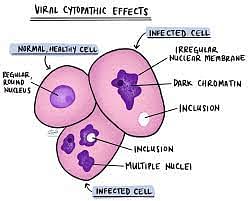
Cytopathic effect is when a virus invades or attacks a host cell, it can lead to serious structural modifications of the host cell. It is also called CPE in short. The variation in modification of the host cells depends on the intensity of destruction caused by the virus, composition of the host cell and such factors. The cell membrane of the host cell gets degenerated (lysis) or reproduction is halted which makes it dead. The virus responsible for cytopathic effects is termed cytopathogenic. Tests are conducted by either staining or unstained cells and observing them under the microscope.
| Table of Content |
Key Takeaways: Cytopathic Effect, Host cell, Inclusion Bodies, Total Destruction, Subtotal destruction, Swelling & Clumping.
What is the Cytopathic Effect?
[Click Here for Sample Questions]
Cytopathic Effect is referred to as the changes in the cell composition due to a virus attack. There are certain categories of viruses responsible for the Cytopathic effect, not every virus has the ability to cause the Cytopathic Effect. Usually, such structural changes in cells are observed during a viral infection.

Cytopathic Effect
When a virus affected cell is seen under a microscope, these changes are starkly visible. As soon as the virus is introduced in the monolayer, it can be seen shrinking. In some cases, change is less while in some categories the change can be observed even without staining. It requires quite an experience to effectively use specific chemicals to stain cells with variable Cytopathic effects.

Different Cytopathic Effects
Read Also:
Types of Cytopathic Effect
[Click Here for Sample Questions]
There are distinct variants of Cytopathic Effect varying on the extent of the damage done to the host cell. But the crux remains the same i.e., each of these variants induces morphological alterations in the cell.
Total Destruction
As the name suggests, this type of Cytopathic Effects involves the complete dismantling of the host cell. A view of the monolayer of the host cell can be seen shrinking on the glass surface when coming in contact with the virus. After some time, the monolayer gets gathered in a few pockets on the glass surface. Ultimately, within 72 hours, all the host cells are detached from the glass surface. This type of insane annihilation of the host cell is done by enteroviruses.
Viral Cytopathic Effect
Subtotal Destruction
In Subtotal Destruction, the intensity of the damage due to the virus is less. Hence, complete detachment of monolayer does not take place, rather the host cell is partially removed. After being subjected to the virus, the host layer shrinks but does not get collected at places in the cytoplasm. Subtotal Destruction is the outcome of Picornavirus, togavirus, paramyxovirus, etc.
Also Read:
Focal Degeneration
In this case, the virus spreads in concentric circles. Unlike previous cases where the virus is transferred cell-to-cell. The term focal is associated with the areas where the virus affects the cells which are known as foci. Here, enlargement, rounding and scattering of the host cell occur. And within a few days time, the monolayer gets ejected. Herpesviruses and Poxviruses exhibit focal degeneration.
Swelling and clumping
Detachment of host cells takes place here but before that the affected cells enlarge to the greatest extent and form clumps. This type of detachment is observed when a host cell is infected with adenovirus.
Also Read: Antibodies
Foamy Degeneration
Numerous vacuoles are produced in the cytoplasm of the host cell. These vacuoles are invisible under the microscope unless properly stained. This process is synonymous with vacuolization. Flaviviruses, paramyxoviruses and retroviruses incur this method of degeneration.
Also Read: Human Digestive System
Polykaryon Formation
Polykaryon Formation also known as Cell Fusion refers to the case where four cells join together to form a single enlarged cell. The newly formed cell has included at least four nuclei and the plasma membranes of each cell are combined. This variant of CPE is also known as Syncytium, paramyxoviruses and herpesviruses lead to cell fusion.
Also Read:
Inclusion Bodies
[Click Here for Sample Questions]
Inclusion bodies are insoluble particles in the cytoplasm of the host cell. These bodies are not visible under the microscope unless stained. It is present in the sites where the virus has produced its needy proteins to spread in the host cell. Depending on the type of virus and cytopathic effect the size of inclusion bodies may differ. They can be single, multiple, eosinophilic, basophilic, intranuclear, intracytoplasmic etc.

Inclusion Bodies
Also Read:
Things to Remember
- Cytopathic Effect is caused by a few viruses, not all of them.
- In all the different types of Cytopathic Effects, degeneration of cells (lysis) takes place, in some extent is less while in some extent is more.
- There are distinct variants of Cytopathic Effect varying on the extent of the damage done to the host cell.
- Cytopathic Effect is highly useful in medical science to determine viral infections.
- Inclusion bodies are insoluble particles in the cytoplasm of the host cell.
Also Read:
Sample Questions
Ques. What changes occur due to Cytopathic Effects in the cells? (2 marks)
Ans. Cytopathic effects result in decisive changes in the structure of the cytoplasm of the host cell. When the virus is introduced to the host cell, its membranes are first attacked and ruptured. Slowly the virus damages the reproductive ability of the host cell and can even kill the cell. So, the extent varies with the severity of the virus and other factors.
Ques. How is the Cytopathic Effect beneficial? (2 marks)
Ans. The inclusion bodies after Cytopathic Effect are studied under the microscope to study the virus. Cytopathic Effects adds to the convenience of virologists as in many cases you don’t even need to stain the cells to observe it under a microscope.
Ques. What is the first sign of infection/Cytopathic Effect? (2 marks)
Ans. The rounding and gathering of the host cells is the first indication of any viral infection that triggers the Cytopathic Effect. At this point, it is difficult to tell which type of Cytopathic effect it is.
Ques. Describe the treatment of Cytopathic Effect. (2 marks)
Ans. Cytopathic Effect is kept under control by the use of antiviral drugs. These drugs inhibit the synthesis of viral proteins, adsorption of virus in the host cell and replication of the virus’s DNA. Thus, the virus is unable to multiply and spread to other parts of the cell.
Ques. Can Cytopathic Effect be prevented? (2 marks)
Ans. The preventive measure for the Cytopathic Effect would be strengthening the cells’ resistance against the attack of the virus. This can be done by making the immune system stronger.
Ques. Can Cytopathic Effect be felt instantly? (2 marks)
Ans. Cytopathic Effect occurs at the micro-level, hence people recognize only when the viral infection has considerably affected a few portions of the body. It can look like small red rashes on your body.
Ques. Does Coronavirus also result in a Cytopathic Effect? (2 marks)
Ans. Yes, Coronavirus also leads to the degeneration of the cell membrane and morphological modifications. And it is the cytopathic effect that helps in diagnosing the virus.
Ques. Should we worry about the Cytopathic Effect? (2 marks)
Ans. Cytopathic Effect is synonymous with a viral infection. So, you must be cautious about it and prevent indulging in activities that increase the threat of a viral infection. Flu, influenza, common cold, hypers all of these induce some kind of Cytopathic Effect.
Read More:



Comments