



Exams Prep Master
The words centre and gravity are derived from the Latin or Greek words which mean “centrum” and “gravitation”. The centre of gravity (CG) of any object is referred to as the point where gravity acts on the body. While the centroid refers to the geometrical centre of a uniform density object. Let’s discuss the topic in detail along with a few important questions.
What is Centre of Gravity?
The centre of gravity or centre of mass is the point, where the whole mass of the body is concentrated. It means that the point where the gravitational force, the weight of the body, acts generally in any orientation of the body. As we know that the centre of gravity is directly proportional to the stability of the body. For example, if the center of gravity of a car is low then its stability is higher. The centre of gravity of any object can be calculated by summing the weight of the body and dividing it by its origin.

What is Centroid?
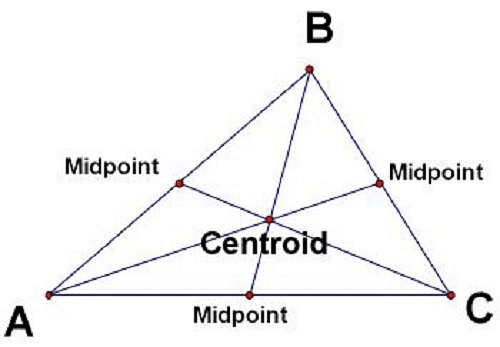
The centroid is the point of the geometric centre of any object, where the density is wholly distributed over the body. For example, make a cutout on an object and try to balance the object over the tip of the pin.

Hence, the point where the cutout is balanced perfectly is the centre of the object. The centroid of a body can be calculated by using the plumb line method proposed by Archimedes.
Difference between Centre of Gravity and Centroid
The Centre of Gravity is located at the point of an elementary body where the whole weight of the body is concentrated and Centroid is the geometrical centre of an object where the cutout of the shape of an object is perfectly balanced. Both of these terms have been involved in the concepts of weight, density, and balance of an object. Since both of them are related to each other in terms of the density of the object. If the given object does not have a uniform density, then the focus point is known as the Centre of Gravity. However, if the density of the object throughout the body is the same i.e. the body is homogeneous, then the centre of gravity is equivalent or equal to the centroid. The concepts of Centroid, as well as Center of Gravity, are important in finding out the central focus point of the body where the gravitational force acts.
The position that is considered as the centre of gravity for the particle in the Cartesian coordinate system can be found out by the vector or the radius vector rS = Σmiri / Σmi. Where the mi is the mass of the particles and ri is the radius vector of the particles. The position that indicates the centre of the mass of the rigid body in the Cartesian coordinate system is to be found out by the radius vector that is rS = (∫rρdV) / M, where letter r is the unit vector, symbol ρ is the body’s density, symbol V volume, and M is the mass of the body.
Below we have discussed the center of gravity and centroid on various parameters.
| Parameters | Centre of Gravity | Centroid |
|---|---|---|
| Perception | Point where the total weight of the body is concentrate. | It is the geometric centre of the body where the whole density is distributed. |
| Symbol | It is denoted by the symbol 'g' | It is denoted by the symbol 'c' |
| Calculation | This can be calculated by the equation W=S x dw. | It is calculated using the plumb line method or by taking the mean of the median. |
| Object density | It is applicable for objects of any density. | It is applicable for the point object with uniform density. |
| Subject association | Centre of gravity is related to physics. | It is related to the centre of a triangular body. |
The principle of Archimedes was the first to describe the process by which the centroid can be found out. He introduced the cutting process of cardboard according to the objects’ shape and piercing several holes in it. Then it has to be nailed on the wall on one of the holes and be hanged freely. Then we need to hang plumb on the same nail and draw with a pencil the direction which is determined by the end of the plumb. This direction is the centre of gravity which is of the object. Hang the body on the other holes as well and repeat the procedure.
Download the PDF on Difference Between Centre of Gravity and Centroid
Things to Remember
- The centre of gravity or centre of mass is the point, where the whole mass of the body is concentrated.
- The Centre of gravity can be calculated by the equation W=S x dw.
- The centroid is the point of the geometric centre of any object, where the density is wholly distributed over the body.
- The centroid is calculated using the plumb line method or by taking the mean of the median.
- Both of these terms have been involved in the concepts of weight, density, and balance of an object.
Sample Questions
Ques. What is the location of the centre of mass of the sphere, cylinder, and ring? Does it lie inside the body? (2 marks)
Ans. In all the given bodies, the centre of mass is located at the focal point where all the masses are concentrated or at their geometrical centers. No, the centre of mass of a body does not lie inside the body.
Ques. What is the formula of centre of mass? (1 mark)
Ans. The formula of the center of mass can be determined by multiplying the total mass of the system and the position vector of the center of mass and dividing it by the total masses of the body.
Ques. How do you find the center of gravity? (2 marks)
Ans. The centre of gravity of a body can be calculated by taking the sum of the moments divided by the total overall weight of an object. The moment is the product of the weight and its location as measured from the origin or set point of the body.
Ques. Where will the center of gravity of a uniform rod lie? (1 mark)
Ans. The centre of gravity of the uniform rod lies at its middle point. It is an imaginary point at which the weight of an object is taken as the average.
Ques. What do you mean by centroid? (2 marks)
Ans. The geometric center point of any object, where the density is wholly distributed over the body is known as centroid. For example, make a cutout on an object and try to balance the object over the tip of the pin. Hence, the point where the cutout is balanced perfectly is the centre of the object.
Ques. Is the Centre of mass and gravity the same? (1 mark)
Ans. In a uniform gravitational field, the centre of gravity is almost equivalent to the centre of mass. However, both of them do not coincide.
Ques. Does the center of gravity change? (1 mark)
Ans. The centre of gravity of an object changes whenever the body bends or moves. The act of balancing the body requires the maintenance of the centre of gravity.
Ques. Is the center of gravity always at the center of an object? (2 marks)
Ans. All the objects as though their masses are concentrated at one point which is known as the centre of gravity. A simple object like a football or volleyball in a very commonplace has its centre of mass at the right of its centre.
Ques. The centre of gravity is always located in the centroid. Explain. (3 marks)
Ans. The centre of mass is located in the centroid for the simple and rigid objects which are with the uniform density. For instance, the centre of mass which is uniform disc-shaped would be at its centre. At times, we can also say that the centre of mass does not fall anywhere on the object.
Ques. Explain the difference between centre of mass and the centre of gravity. (3 marks)
Ans. The centre of mass is referred to as the point t which the distribution of mass is said to be equal in all directions and also it does not depend on the gravitational field. Whereas, the centre of gravity is the point at which the distribution of weight is said to be equal in all directions and also depends on the gravitational field.
Ques. The centre of gravity of a body on the earth coincides with the centre of mass for a “small” object while for an “extended” object it may not. What is the qualitative meaning of “small” and “extended” in this case? For which of the following the two coincides- a building, a pond, a lake, a mountain? (4 marks)
Ans. The centre of gravity is the centre of its geometry or the given structure while the centre of mass is a point wherein the entire mass of the body can be considered. When vertical height or geometric centre of an object is very small as well as very near to the earth’s surface as compared to the earth’s radius. Hence, these objects are small, if they are larger, they are extended objects.
- Buildings are high and ponds are small objects.
- Mountains and lakes are extended objects.



Comments