



Education Journalist | Study Abroad Lead
Ectomycorrhizae and Endomycorrhizae are two types of mycorrhizae fungi, that form a symbolic relationship with roots and plants. All the plants depend on Ectomycorrhizae and Endomycorrhizae as they provide water and minerals to the plants. They take sugar from the plants through the process of photosynthesis. Along with water and minerals, Ectomycorrhizae and Endomycorrhizae also supply phosphorus to the plants. Ectomycorrhizae do not penetrate deeper into the cortical cells. However, Endomycorrhizae penetrates deeper into the plants. In this article, we will have a look at the differences between Ectomycorrhizae and Endomycorrhizae and also look at some related sample questions.
| Table of Content |
Keyterms: Ectomycorrhizae, Endomycorrhizae, Mycorrhizae fungi, Photosynthesis, Cortical Cell, Air, Water, Minerals
What are Ectomycorrhizae?
[Click Here for Sample Questions]
Ectomycorrhizae do not penetrate deeper into the plants i.e. in the cortical cells. Ectomycorrhizae do not form vesicles and arbuscules. They are one of the most important elements for plants as they provide nutrition to plants. The hyphae Ectomycorrhizae form a sheath around the root from outside. Ectomycorrhizae is less common. The fungi involved in Ectomycorrhizae are Ascomycota and Basidiomycota.
What are Endomycorrhizae?
[Click Here for Sample Questions]
Endomycorrhizae penetrates deeper into the plants i.e. in the cortical cells. Endomycorrhizae do forms vesicles and arbuscules. Orchids totally depend on Endomycorrhizae for survival. They immensely benefit a large number of desert plants and other plants. Endomycorrhizae is found in more than 85% of vascular plants.
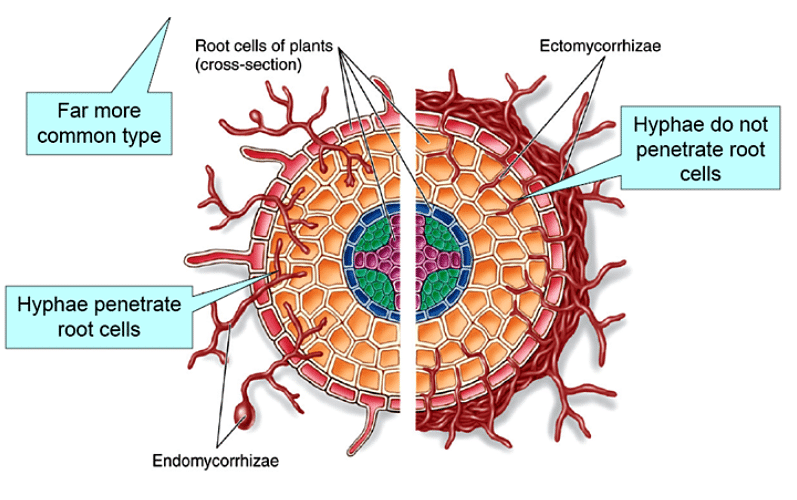
Fig: Endomycorrhizae and Ectomycorrhizae
Similarities between Ectomycorrhizae and Endomycorrhizae
[Click Here for Sample Questions]
Ectomycorrhizae and Endomycorrhizae also have some similarities such as:
- Ectomycorrhizae and Endomycorrhizae are two types of mycorrhizae fungi.
- They maintain symbolic relationships with roots and plants.
- Ectomycorrhizae and Endomycorrhizae also provide phosphorus to the plants.
- They take sugar from the plants through the process of photosynthesis
- All the plants depend on Ectomycorrhizae and Endomycorrhizae as they provide water and minerals to the plants.
Difference between Ectomycorrhizae and Endomycorrhizae
[Click Here for Sample Questions]
The differences between Ectomycorrhizae and Endomycorrhizae are as follows-
| BASIS OF DIFFERENCE | Ectomycorrhizae | Endomycorrhizae |
|---|---|---|
| Definition | Ectomycorrhizae is a type of mycorrhizal association wherein fungal hyphae do not penetrate deep in the plants i.e. in the cortical cells. | The type of mycorrhizae where fungal hyphae do penetrate deep in the plants i.e. in the cortical cells are known as endomycorrhizae |
| Hyphae Mantle | Ectomycorrhiza produces a hyphae mantle. | Endomycorrhizae does not produce hyphae mantle |
| Prevalence | Ectomycorrhiza are less prevalent | Endomycorrhiza are more prevalent |
| Vesicles and arbuscules | Vesicles and arbuscules are absent | Vesicles and arbuscules are present |
| Abundance | Ectomycorrhiza is less abundant (4%) | Endomycorrhiza is highly abundant (80%) |
| Fungi involved | The fungi involved in Ectomycorrhiza are Ascomycota and Basidiomycota | The fungi involved in Endomycorrhiza is Glomeromycota |
| Example of Plants | Pine trees, Cedrus, Arbies, Oak, beech, etc | Almost 85% of vascular plants- like orchids, shrubs, and foliage plants |
| Hartig Net | Ectomycorrhiza produce Hartig net | Endomycorrhiza do not produce Hartig net |
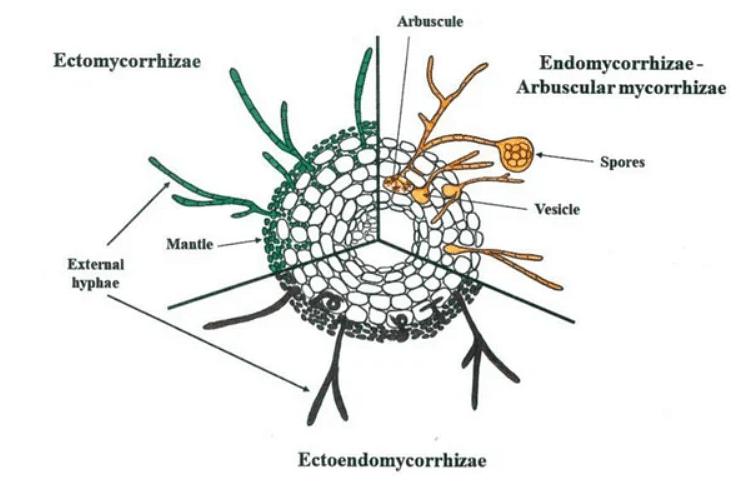
Difference between Ectomycorrhizae and Endomycorrhizae
What are Mycorrhizae?
[Click Here for Sample Questions]
Mycorrhizae are of two types - Ectomycorrhizae and Endomycorrhizae. Mycorrhizae are formed as the result of a mutual relationship between fungi and plants. Mycorrhizae are found in desert plants. They are less susceptible to water stress. They help plants to resist infections caused due to bacteria and fungi.

Fig: Mycorrhiza
Mycorrhizae is one of the most important symbolic relationships between fungi and the roots of higher plants. Ectomycorrhizae and Endomycorrhizae are two groups of Mycorrhizae found in different varieties of plants. Endomycorrhizae is found in more than 85% of vascular plants. Ectomycorrhizae are found in rare types of plants like pine trees, Cedrus, Arbies, Oak, beech, etc.
Things to Remember
- All the plants depend on Ectomycorrhizae and Endomycorrhizae as they provide water and minerals to the plants.
- Mycorrhizae is one of the most important symbolic relationships between fungi and the roots of higher plants
- Ectomycorrhizae and Endomycorrhizae also provide phosphorus to the plants.
- Mycorrhizae are mostly found in desert plants.
- Ectomycorrhiza produces hyphae mantle.
- Endomycorrhiza does not produce hyphae mantle.
- They take sugar from the plants through the process of photosynthesis
Sample Questions
Ques. What is Ectomycorrhizae? (2 marks)
Ans. Ectomycorrhizae do not penetrate deep in the plants i.e. in the cortical cells. Ectomycorrhizae do not form vesicles and arbusucles. They are one of the most important elements for plants as they provide nutrition to them.
Ques. What is Endomycorrhizae ? (3 marks)
Ans. Endomycorrhizae penetrates deep in the plants i.e. in the cortical cells. Endomycorrhizae does form vesicles and arbusucles. They immensely benefit a large number of desert plants and other plants. Endomycorrhizae is found in more than 85% of vascular plants.
Ques. What are Mycorrhizae? (3 marks)
Ans. Mycorrhizae is one of the most important symbolic relationships between fungi and the roots of higher plants. Mycorrhizae are formed as the result of a mutual relationship between fungi and plants. Mycorrhizae are found in desert plants. They are less susceptible to water stress. They help plants to resist infections caused due to bacteria and fungi.
Ques. Which fungus are present in Ectomycorrhizae and Endomycorrhizae? (3 marks)
Ans. Both Ectomycorrhizae and Endomycorrhizae contain some fungus. The fungi involved in Ectomycorrhiza are Ascomycota and Basidiomycota.
The fungi involved in Endomycorrhiza is Glomeromycotan.
Ques. Endomycorrhizae is present in which plants? (1 mark)
Ans. Endomycorrhizae is present in almost 85% of vascular plants- like orchids, shrubs, and foliage plants. Endomycorrhizae provides phosphorus to the plants which is needed for their growth.
Ques. What are the differences between Ectomycorrhizae and Endomycorrhizae? (5 marks)
Ans. The differences between Ectomycorrhizae and Endomycorrhizae are as follows
Ectomycorrhizae – It is a type of mycorrhizal which do not penetrate deep in the plants i.e. in the cortical cells. It produces hyphae mantle. It is less prevalent. Also, the vesicles and arbusucles are not present in Ectomycorrhizae. The fungi involved in Ectomycorrhizae are Ascomycota and Basidiomycota.
Endomycorrhizae- It is a type of mycorrhizal that penetrates deep in the plants i.e. in the cortical cells. It does not produce hyphae mantle. It is more prevalent. Also, the vesicles and arbusucles are present in Endomycorrhizae. The fungi involved in Endomycorrhizae is Glomeromycota.
Ques. What is the type of symbolic relationship between fungi and plants? (2 marks)
Ans. There are two types of symbolic relationships between fungi and the roots of higher plants. These two symbolic relationships are known as Ectomycorrhizae and Endomycorrhizae.
Ques. What is the role of Hyphae Mantle? (2 marks)
Ans. Ectomycorrhiza produces hyphae mantle. The hyphae Ectomycorrhizae form a sheath around the root from outside. This helps plants in proper growth and nutrition. They are indeed essential for the survival of plants.



Comments