



Content Curator
Prokaryotic and Eukaryotic DNA replicates in a semi-conservative way. However, depending upon the size and complexity in genetic material there exist few dissimilarities among the prokaryotic and eukaryotic DNA replication. In molecular biology, DNA replication is the process by which a double-stranded DNA molecule is replicated to produce two identical DNA molecules. After the replication of DNA in the cell, the cell can be divided into cells, each of which will have an identical replica of the original one.
| Table of Content |
Key Takeaways: DNA replication, prokaryotic, eukaryotic, genetics, DNA molecule, Okazaki fragment, nucleotides, replication, elongation, polymerase, nucleotides
Prokaryotic DNA Replication
The DNA replication of prokaryotes is the technique with the help of which a prokaryote replicates its DNA into another replica which is delivered to the daughter cells. The process of replication is typically a bi-directional process and it originates at a single origin of replication. The complete procedure of replication occurs in the cell cytoplasm.

Prokaryotic DNA Replication
The DNA replication of prokaryotes occurs in three stages which are:
- Initiation
- Elongation
- Termination
The prokaryotic DNA replicates by the third type of polymerase in the prokaryotes called DNA polymerase III in the 5’ to 3’ direction at a rate of 1000 nucleotides per second.
Read More:
Eukaryotic DNA Replication
The Eukaryotic DNA replication is a conserved mechanism that restricts the DNA replication to once per cell cycle. The process of Eukaryotic DNA replication occurs inside the cell nucleus and only occurs at many chromosomal origins in the ‘S’ phase. Just like the prokaryotic DNA replication, the eukaryotic cells also use the semi-conservative process of replication however there are multiple origins of replication.

Eukaryotic Cells
Read More: Difference between Prokaryotic and Eukaryotic Transcription
Difference between Prokaryotic and Eukaryotic Replication
The prokaryotic and eukaryotic DNA replication differs from each other in many ways. The differences between both types of DNA replication is mentioned in the table below:
| Prokaryotic DNA Replication | Eukaryotic DNA Replication |
|---|---|
| Prokaryotic DNA replication happens in the cytoplasm of the cell. | The eukaryotic replication takes place in the nucleus of the cell. |
| Per DNA molecule, there exists only a single point of origin. | This DNA molecule consists of multiple points of origin on a single. |
| The origin is composed of about 100-200 or more nucleotides. | The origin of replication is constructed of roughly 150 nucleotides. |
| The replication process is bi-directional and only two replication forks are formed. | Several replication forks are formed in multiple replication beads. |
| The prokaryotic chromosome contains only one replicon. | The eukaryotic chromosome contains around 50,000 replicons. |
| The procedure is carried out by DNA Polymerase I and III. | The procedure is carried out by the DNA Polymerase α, δ, and ε |
| It requires DNA gyrase | It doesn't require DNA gyrase. |
| The Okazaki fragments are large. They are approximately 1000-2000 nucleotides in length. | The Okazaki fragments are small and are roughly 100-200 nucleotides in length. |
| It is a quick approach with nearly 2000 nucleotides added per second. | It is a slow approach having around 100 nucleotides added per second. |
| It includes circular and double-stranded DNA. | It includes linear and double-stranded DNA. |

Prokaryotes and Eukaryotes DNA replication differences
Read More:
Similarities Between Prokaryotic and Eukaryotic Replication
Apart from the differences discussed among the Prokaryotic and Eukaryotic DNA replication, there exist certain similarities between both of them. The list of similarities between both the types of DNA replications have been mentioned in the list below:
- The procedures of both the Prokaryotic and Eukaryotic DNA replication occur before the division of the nucleus.
- Both the approaches involve double-stranded DNA.
- The replication process occurs in a 5’ to 3’ direction.
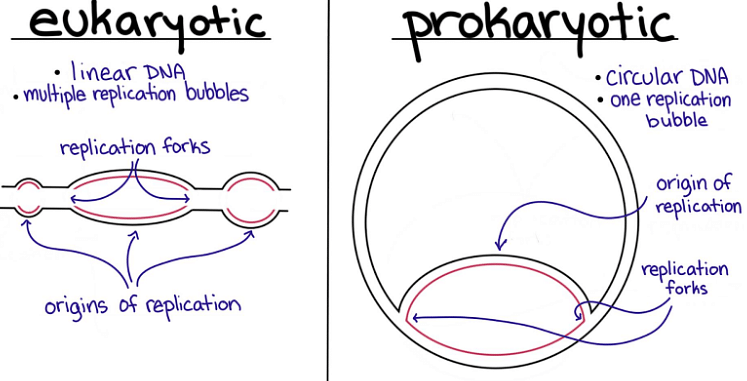
Prokaryotic and Eukaryotic DNA Replication
- The unwound DNA is stabilized by the single-strand binding protein.
- The enzyme primase is responsible for the synthesis of the RNA primer.
- Both the Prokaryotic and Eukaryotic DNA replications are bi-directional.
- Prokaryotic and Eukaryotic DNA replication follows the semi-conservative model of replication.
Read More: Packaging of DNA
Things to Remember
- DNA replications are of two types, Eukaryotic and Prokaryotic.
- The process of DNA replication occurs in bi-direction.
- It occurs at the point on a DNA molecule called the origin of replication.
- The DNA replication of eukaryotes occurs in the cell nucleus.
- Both the process of eukaryotic and prokaryotic DNA replication occurs before the division of the nucleus.
- Only the eukaryotic cells contain Mitosis as well as meiosis.
- The process of splitting binary cells into two daughter cells is called binary fission.
- The reproduction of prokaryotes takes place through binary fission whereas eukaryotic reproduction can be done asexually or sexually.
Read More:
Sample Questions
Ques: What is the importance of replication? (2 marks)
Ans: The process of replication is an essential procedure as whenever cell division occurs, the two new daughter cells obtained must contain the same genetic information, or DNA, as contained by the parent cell. It relies on the fact that each of the DNA strands can serve as a template of duplication.
Ques: Explain how the prokaryotic and eukaryotic reproduce? (2 marks)
Ans: The reproduction of Prokaryotic cells can be done sexually only through binary fission. The procedure of binary fission is very fast and contributes to the rapid evolution and replication of the bacteria. However, the reproduction of unicellular eukaryotes can be done either sexually or asexually. The asexual reproduction of unicellular eukaryotes involves mitosis.
Ques: Define Okazaki Fragments. (2 marks)
Ans: The Okazaki fragments are the short sections of the DNA nucleotides which are formed during the discontinuous synthesis of the lagging strand and are later linked together by the enzyme DNA ligase to form the lagging strand during DNA replication.
Ques: What is the origin of DNA replication? (2 marks)
Ans: In DNA replication, an origin refers to the specific point from where the DNA replication is initiated. At this point of origin, the DNA double helix is relaxed.
Ques: Explain how DNA replication takes place? (2 marks)
Ans: The process of DNA replication occurs in three key steps which are as follows:
- The opening of the dual helix and detachment of the DNA strands
- Priming of the template strand
- Assembly of the new DNA segment.
The above three-stage process generally applies to all the cells however, depending upon the organism and the cell types, there may occur specific variations within the procedure.
Read More:
Ques: Name three types of polymerases in the prokaryotes. (2 marks)
Ans: The prokaryotes consist of three important types of polymerases which are as follows:
- DNA pol I
- DNA pol II
- DNA pol III
Out of these three types, DNA pol III is the main enzyme that is essential for the synthesis of DNA.
Ques: How do prokaryotic cells respire? (2 marks)
Ans: All living cells are expected to carry out cellular respiration. The respiration can either be aerobic or anaerobic. In the case of Prokaryotic cells, cellular respiration is carried out within the cytoplasm or on the inner surfaces of the living cells.
Ques: Explain binary fission. (2 marks)
Ans: Binary fission is the procedure through which any bacterial cell splits into two identical daughter cells. This process of binary fission is quite different from binary fusion and occurs faster.
Ques. What is DNA fingerprinting? Mention its application. (3 marks)
Ans. DNA fingerprinting or DNA typing is a technique of determining nucleotide sequences of certain areas (VNTRs) of DNA which are unique to each individual. Each person has a unique DNA fingerprint. Unlike a conventional fingerprint that occurs only on the fingertips and can be altered by surgery, a DNA fingerprint is the same for every cell, tissue and organ of a person. It cannot be changed by any known treatment. Applications of DNA fingerprinting are as follows:
- Paternity disputes can be solved by DNA fingerprinting.
- DNA fingerprinting technique is being used to identify genes connected with hereditary diseases.
- It is useful in the detection of crime and legal pursuits.
- It can identify racial groups, their origin, historical migrations and invasions.
Ques. Why is the Human genome project called a megaproject? (2 marks)
Ans. The human genome project is called a megaproject because
(i) It required bioinformatics databases and other high-speed computational devices for analysis, storage and retrieval of information.
(ii) It generated a lot of information in the form of sequence annotation.
(iii) It was carried out in a number of labs and coordinated on an extensive scale.
Read More:
Ques. In the medium where E. coli was growing, lactose was added, which induced the lac operon. Then why does lac operon shut down sometime after the addition of lactose in the medium? (2 marks)
Ans. Lac operon is switched on, on adding lactose in medium, as lactose acts as inducer and makes repressor inactive by binding with it. When the lac operon system is switched on, β-galactosidase is formed, which converts lactose into glucose and galactose. As soon as all the lactose is consumed, the repressor again becomes active and causes the system to switch off (shut down).
Ques. If a double-stranded DNA has 20 percent of cytosine, calculate the percent of adenine in the DNA. (2 marks)
Ans. In a DNA molecule, the number of cytosine molecules is equal to guanine molecules & the number of adenine molecules is equal to thymine molecules. As a result, if a double-stranded DNA has 20% of cytosine, it has 20% of guanine. The remaining 60% includes both adenine & thymine which are in equal amounts. So, the percentage of adenine is 30%.
Read More:



Comments