



Content Curator
Rhombus and parallelogram are quadrilaterals that are identical in shapes but have some unique features that differentiate them. A quadrilateral has four vertices, four sides, and four angles. A rhombus is a quadrilateral having four sides equal whose opposite sides are congruent to each other whereas a parallelogram is a quadrilateral having four sides whose opposite sides are parallel to each other. Every rhombus is a parallelogram whereas the converse is not.
| Table of Content |
Key Terms: Area of a parallelogram, Area of Rhombus, Scalene Triangles, Congruent Triangles, perimeter of rhombus, perimeter of parallelogram
Definition of Rhombus and Parallelogram
[Click Here for Sample Questions]
Rhombus
A Rhombus is a quadrilateral with four sides having equal lengths on all sides. Rhombus is also known as slanting square. The diagonals of the rhombus intersect each other at 90 degrees and form a scalene triangle.
The opposite sides of a rhombus are congruent to each other and are also parallel to each other. Also, the opposite angles are equal. The unique property of the rhombus is if all the sides are equal to 90 degrees then it is considered a square. Every rhombus is considered a parallelogram but every parallelogram is not a rhombus.
Properties of Rhombus
- Diagonals of a rhombus bisect the internal angles.
- Adjacent sides of a rhombus are of equal lengths.
- Diagonals of a rhombus bisect each other at 90 degrees

The above image represents a Rhombus ABCD.
where AB=BC=CD=DA.
AC and BD are the diagonals intersecting each other at 90 degrees.
Angle DCA = Angle BAC
Parallelogram
A parallelogram is defined as a quadrilateral having four sides. The opposite sides of a parallelogram are congruent and parallel to each other. Both parallelogram and rectangle are similar to each other but the only difference between them is that a rectangle has all the angles of 90 degrees each while a parallelogram does not. The diagonals of a parallelogram intersect each other thereby forming two congruent triangles.
Here are some important properties of Parallelogram:
- Opposite sides of a parallelogram are parallel to each other.
- The diagonals of a parallelogram bisect each other.
- The opposite angle of a parallelogram is congruent.
- The diagonals of a parallelogram bisect each other into two equal triangles.
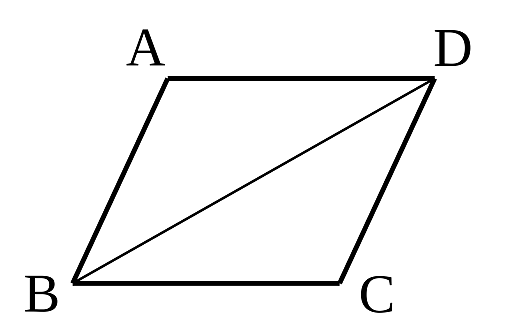
The above picture represents a parallelogram ABCD.
Parallelogram vs Rhombus
[Click Here for Sample Questions]
- Rhombus and Parallelogram apart from being quadrilaterals as their similarities are two-dimensional shapes.
- The opposite sides of both Rhombus and Parallelogram are parallel with equal opposite angles.
- The sum of the interior angle of both Parallelogram and rhombus is 3600.
- Rhombus and parallelogram being closely similar to each other have some unique features. A rhombus has all four sides equal whereas a parallelogram has only opposite sides equal.
Difference between Rhombus and Parallelogram
[Click Here for Sample Questions]
| Sr.no | Rhombus | Parallelogram |
|---|---|---|
| 1. | A rhombus is a two-dimensional figure whose all four sides are parallel to each other. | A parallelogram is a two-dimensional figure whose opposite sides are only equal to each other. |
| 2. | The area of a rhombus can be calculated as Area= d1,d2/2.Here d1 and d2 represent the diagonals of a rhombus. | The area of a parallelogram can be calculated as Area= bh. Here b is the base and h is the height of the parallelogram. |
| 3. | The length of all four sides is equal. | The length of only opposite sides is equal. |
| 4. | The perimeter of a rhombus can be calculated by P=4a. Here a represents the side of the rhombus. | The perimeter of a parallelogram can be calculated by P=2(a+b). Here a represents the side and b represents the base of the rhombus. |
| 5. | The diagonals of a rhombus intersect each other at 90 degrees thereby forming a scalene triangle. | The diagonals of a parallelogram intersect each other thereby forming congruent triangles. |
| 6. | Every rhombus is a parallelogram. | Every parallelogram is not a rhombus. |
| 7. | The term rhombus originated from a Latin word. | The term parallelogram originated from a Greek word. |
Also read: Area of Parallelogram
Things to Remember
- All rhombus is a parallelogram but all parallelogram is not rhombus.
- All sides of a rhombus are parallel to each other whereas only opposite sides are parallel to each in a parallelogram.
- The diagonals of the rhombus intersect each other to form a scalene triangle whereas they intersect in parallelogram forming congruent triangles.
- Although rhombus and parallelogram look identical they are different from each other.
Sample Questions
Ques. What is a parallelogram? [1 Marks]
Ans. A parallelogram is a two-dimensional figure whose opposite sides are parallel to each other. The adjacent angles and sides of a parallelogram are of equal length and measures respectively.
Ques. Is square a rhombus? [1 Marks]
Ans. Both rhombus and squares are quadrilaterals having all four sides of equal length but the internal angle of the square is 900 but that of a rhombus is less. Hence a square is not a rhombus. All the sides of a square are of equal length but all sides of a rhombus are not of equal length.
Ques. How to calculate the area of a parallelogram? [2 Marks]
Ans. The area of a parallelogram can be calculated by the given formula:
- Area of parallelogram = b x h
- Area of parallelogram = ½ x d1 x d2 sin(y)
- Area of parallelogram = ab sin(x)
Where b is the base, h is the height, d1,d2 are the diagonals of the parallelogram.
Y represents the angle between the diagonals, a, b are the sides of the parallelogram and x is the angle between the sides a and b.
Ques. What will be the area of a parallelogram if its base and height are 6cm and 8cm respectively? [2 Marks]
Ans. Here, b = 6cm and h = 8cm
As we know,
Area of parallelogram = b x h
= 6 x 8
= 48 sq. cm
The area of a parallelogram with a given base and height can be calculated from this formula.
Ques. If one angle of a parallelogram is 30° less than twice the smallest angle, then find the measure of each angle. [2 Marks]
Ans.

We can calculate the missing angles by using the properties of a parallelogram and then substituting the values.
Ques.Two consecutive angles of a parallelogram are (x + 60)° and (2x + 30)°. What special name can you give to this parallelogram? [2 Marks]
Ans.

Ques. If one angle of a parallelogram is twice of its adjacent angle, find the angles of the parallelogram. [2 Marks]
Ans.

Ques. In the given figure, ABCD is a parallelogram in which ∠DAB=70° and ∠DBC=65°, then find the measure of ∠CDB. [2 Marks]

Ans.

Ques. Find the perimeter of a rhombus whose adjacent sides are 12 m respectively. [2 Marks]
Ans.
The perimeter of a rhombus=4a
=4*12
=48 sq meter.
Read also:



Comments