NCERT Solutions for Class 9 Maths Chapter 9: Areas of parallelograms and triangles

Collegedunia Team logo

Collegedunia Team

Content Curator

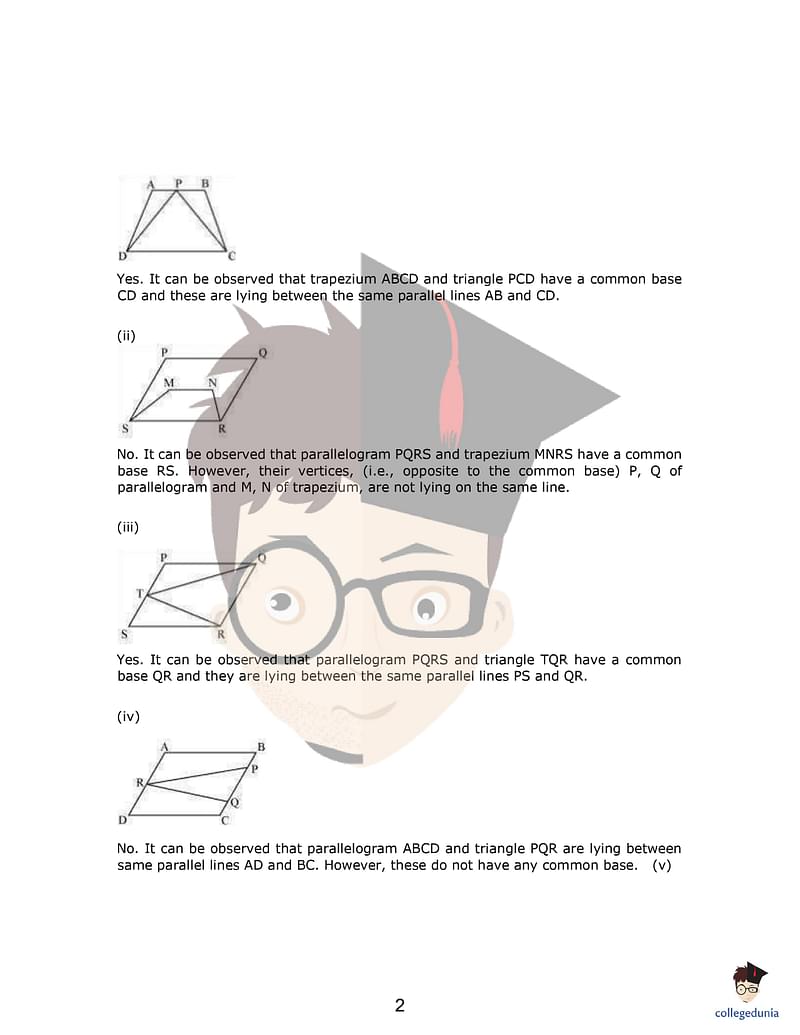
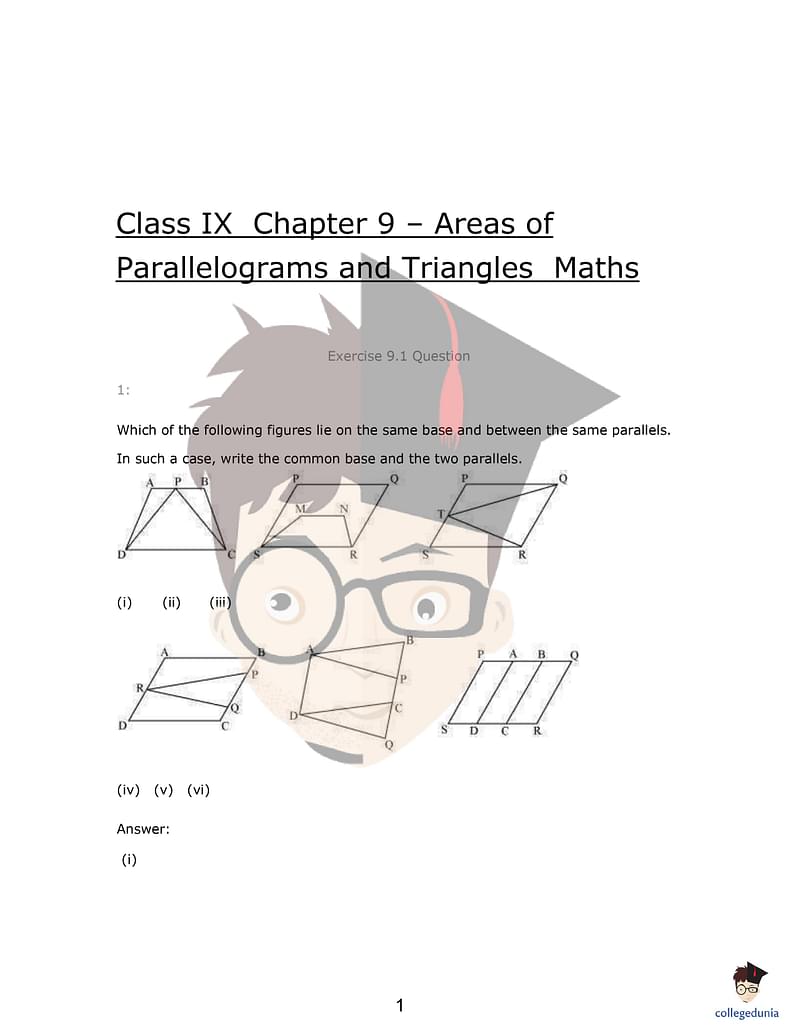
The NCERT Solutions for Class 9 Mathematics are provided in this article. Areas of Parallelograms And Triangles deal with the area parallelograms and triangles have, and figures present on the same base and between the same parallels.

Class 9 Maths Chapter 9 Areas of Parallelograms And Triangles has a weightage of 14 marks in the Class 9 Maths Examination. NCERT Solutions for Class 9 Maths for Chapter 9 covers the following important concepts: 

  1. Area of Parallelogram
  2. Perimeter of a Parallelogram
  3. Area of a Trapezoid Formula

Download: NCERT Solutions for Class 9 Mathematics Chapter 9 pdf


NCERT Solutions for Class 9 Mathematics Chapter 9
NCERT Solution

NCERT Solution

NCERT Solution

NCERT Solution

NCERT Solution

NCERT Solution

NCERT Solution

NCERT Solution

NCERT Solution

NCERT Solution

NCERT Solution

NCERT Solution

NCERT Solution

NCERT Solution

NCERT Solution

NCERT Solution

NCERT Solution

NCERT Solution

NCERT Solution

NCERT Solution

NCERT Solution

NCERT Solution

NCERT Solution

NCERT Solution

NCERT Solution

NCERT Solution

NCERT Solution

NCERT Solution

NCERT Solution

NCERT Solution

NCERT Solution

NCERT Solution

NCERT Solution

NCERT Solution

NCERT Solution

NCERT Solution

NCERT Solution

NCERT Solution

NCERT Solution

NCERT Solution

NCERT Solution

NCERT Solution

NCERT Solution


Important Topics in Class 9 Maths Chapter 9 Areas of Parallelograms And Triangles 

Important Topics in Class 9 Maths Chapter 9 Areas of Parallelograms And Triangles are elaborated below:

Area of a Paralellogram

The area of a parallelogram can be defined by the region a parallelogram bounds in a respective two-dimensional space.

The Area of a Parallelogram, Area = b × h (sq. units)
Here,

  1. ​“b” is the base of the parallelogram
  2. “h” is the height of the parallelogram.

Perimeter of a Parallelogram

The Perimeter of parallelogram is the same as the sum of all four sides of the respective parallelogram.

The Perimeter of a Parallelogram:
First, consider a Parallelogram with two adjacent sides, a and b.
Hence, the Perimeter of parallelogram = a + b + c + d
⇒ 2a + 2b = 2(a+b)
⇒ P = 2(a+b).

Area of a Trapezoid Formula

The area of a trapezoid can be defined as its total space covered by the sides. If the length of the sides are known, the area of the trapezoid can be evaluated by splitting it into smaller polygons, including rectangles and triangles.

Example: Determine the area of a trapezoid that has parallel sides 32 cm and 12 cm respectively. The height of the trapezoid is mentioned as 5 cm. Evaluate the area of the trapezoid.

Solution: As per the equation, the following data is known,
a = 32 cm
b = 12 cm
h = 5 cm
Thus, the area of the trapezoid  is = A = ½ (a + b) h
A = ½ (32 + 12) × (5)
= ½ (44) × (5)
= 110 cm2.


NCERT Solutions for Class 9 Maths Chapter 9 Exercises:

The detailed solutions for all the NCERT Solutions for Areas of Parallelograms and Triangles under different exercises are:

Also Read:

Check out:

CBSE X Related Questions

  • 1.
    In the given figure, point D divides the side BC of $\Delta ABC$ in the ratio $1 : 2$. Find length AD.


      • 2.
        Two water taps together can fill a tank in $8\frac{8}{9}$ hours. The tap of larger diameter takes 4 hours less than the smaller one to fill the tank separately. Find the time in which each tap can separately fill the tank.


          • 3.
            The value of p for which roots of the quadratic equation $x^2 - px + 6 = 0$ are rational, is

              • $1$
              • $-5$
              • $25$
              • $\sqrt{5}$

            • 4.
              If the zeroes of a polynomial p(x) are $-3$ and 8, then p(x) equals

                • $x^2 + 5x - 4$
                • $(x + 3) (-x + 8)$
                • $a(x^2 + 5x - 24)$
                • $x^2 - 24$

              • 5.
                Assertion (A) : The system of linear equations $3x - 5y + 7 = 0$ and $-6x + 10y + 14 = 0$ is inconsistent.
                Reason (R) : When two linear equations don't have unique solution, they always represent parallel lines.

                  • Both Assertion (A) and Reason (R) are true and Reason (R) is the correct explanation of the Assertion (A).
                  • Both Assertion (A) and Reason (R) are true, but Reason (R) is not the correct explanation of the Assertion (A).
                  • Assertion (A) is true, but Reason (R) is false.
                  • Assertion (A) is false, but Reason (R) is true.

                • 6.
                  Two dice are rolled together. The probability of getting an outcome $(x, y)$ where $x \gt y$, is

                    • $\frac{5}{12}$
                    • $\frac{5}{6}$
                    • $1$
                    • $0$

                  Comments


                  No Comments To Show