



Content Curator
Rust and Smuts are diseases caused in plants due to pathogenic fungi. They are limiting factors in successful cultivation of crops. Rusts are known to be the most dangerous pathogens to horticulture, forestry, and agriculture in general. On the other hand, smuts are a group of multicellular fungi that are characterized by numerous teliospores.
| Table of Content |
Key Terms: Rust, Smut, Pathogenic fungi, teliospores, Ustilaginomycetes
Also Read: Reproductive Health
Rust and Smut Definition
[Click Here for Sample Questions]
Fungal disease rust that affects plants is named as such because the infected plant has an outward rusty appearance. All of the rusts are parasites and require a living host. They can severely affect the yield and growth of host plant. Examples of rust affecting important crops: wheat stem rust, white pine blister rust, soybean rust, coffee rust.
Also Read:
Smut is also a fungal disease that affects plants, mostly grasses. It is called such because of the sooty, black appearance of the affected plants. They are mostly Ustilaginomycetes belonging to the phylum Basidiomycota. Cereal and crops which are members of the grass family are mostly affected by smut.
Some examples of host plants affected by smut: maize, barley, wheat, oats, forage grasses, and sugarcane.
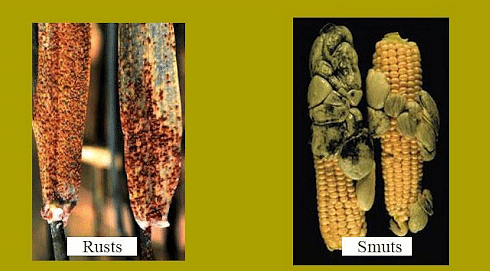
Rust and Smut Diseases
Mechanism of Rusts
[Click Here for Sample Questions]
They have patterns of association with host plant groups that they parasitize. Examples of such host plants are Uromyces and Puccinia. Some rust genera are restricted to specific plant groups of heteroecious species. Host restriction may apply to both phases of the lifecycle or only one phase.
Spores of rust may be dispersed by wind, insect vectors, or water. When the spores meet the host, they germinate and infect plant tissues. Rust spores germinate on plant surface via a short hypha called a germ tube. A stoma is located by the germ tube and the hyphal tip produces an infectious structure called an appressorium. A slender hypha grows downward below the structure to infect plant cells.
Also Read:
The calcium ion channels located in the hypha tip mediate the whole process. They also produce electric currents that alter gene expression. That also includes appressorium formation. Once the invasion of the fungus into the plant is done, the fungus grows into the mesophyll cells and produces hyphae called haustoria.
Haustoria contain amino acids and other favorable energy products that help transport nutrients to the fungus from the plant. They can only penetrate cell walls, not cell membranes. This causes the fungus to grow and spread rapidly, penetrating more plant cells till the spore growth takes place. The whole process takes 10-14 days and hence produces multiple spores that can not only spread to different parts of the plant but to other possible hosts as well.
Also Read:
Mechanism of Smuts
[Click Here for Sample Questions]
Smuts are mostly cereal and crop pathogens. They have teliospores. Smuts usually invade the reproductive systems of their hosts that form galls that darken and burst. The galls release teliospores.
The released teliospores infect the nearby plants. The smuts have to perform a successful mating before infection. The mating results in the formation of dikaryotic hyphae i.e. two haploid cells fusing to form a dikaryon.
In the example of sugarcane, fungi use its smut whip to spread the disease to other plants. The process takes about three months to happen. In Mexico, corn smut that infects maize is called huitlacoche. It is used in several recipes like stews, steak, and soups. Corn smuts turn kernels into powdery, black fungal tissues.
Also Read: Human Health and Diseases
Difference Between Rust and Smut
[Click Here for Sample Questions]
Here are the key differences between Rust and Smut:
| SMUT | RUST |
|---|---|
| Characteristic Symptoms | |
| Characteristic Symptoms appear at Uredospore stage. | Characteristic Symptoms appear at Teliospore Stage. |
| Host Dependency | |
| Either Heteroecious (requires two unrelated hosts to complete its life cycle) or Autoecious | Autoecious (Stages of the fungal life cycle occur on the same host) |
| Nutrition | |
| Using haustoria(Intercellular) | Either intercellular or intracellular |
| Clamp Connection | |
| Quite rare | Common |
| Spores | |
| Up to five kinds of spores are produced-aeciospores, teliospores, pycniospores, basidiospores, and uredospores. | Produces only smut spores which are equivalent to teliospores. |
| Teliospores are produced by the terminal cells of the mycelium. | Smut spores are produced by intercalary cells. |
| Teliospores are stalked, bifurcated, and two-celled. | Smut spores can be uninucleated or binucleated. |
Things to Remember
- Rust affects plants and has been named as such because the infected plant has an outward rusty appearance. All of the rusts are parasites and require a living host.
- Smut is a fungal disease that affects plants, mostly grasses. It is called such because of the sooty, black appearance of the affected plants. They are mostly Ustilaginomycetes belonging to the phylum Basidiomycota.
- Spores of rust may be dispersed by wind, insect vectors, or water. When the spores meet the host, they germinate and infect plant tissues.
- Smuts usually invade the reproductive systems of their hosts that form galls that darken and burst. The galls release teliospores.
Also Read:
Sample Questions
Ques. How are the spores of rust dispersed? (1 mark)
Ans. Wind, insect vectors, or water can help disperse spores of rust. When the spores come in contact with the host, they germinate and infect plant tissues.
Ques. How are teliospores in smut released? (1 mark)
Ans. Smuts invade the reproductive systems of their hosts that form galls. The galls then darken and burst releasing teliospores.
Ques. Can keeping plants healthy reduce the chances of smut? (2 marks)
Ans. Keeping plants healthy makes them more resistant to a smut infection but if the disease is very severe, a fungicide may need to be used. Using a balanced fertilizer may also help plants resist a smut infection.
Ques. How can huitlacoche or corn smut be prevented? (2 marks)
Ans. Following the rules of crop rotation is an excellent way to prevent corn smut. Do not plant corn in the same garden bed two years in a row. Any corn smut spores left in the soil will hence die out and prevent further infection.
Ques. Is rust a virus? (2 marks)
Ans. Rust is not a virus. It is a fungal parasite that affects plants. It occurs in mild, moist conditions and is named so because the affected plants have the outward appearance of rust.
Ques. How does smut affect sugarcane? (3 marks)
Ans. The most recognizable characteristic of sugarcane smut is the black or grey growth known as the smut whip. They are visible two or four months after the fungus has infected the plant and reaches maturity between the sixth and seventh month. The spores in the whip are released infecting nearby plants.
Ques. Give examples of plants affected by rust and smut (3 marks)
Ans. Examples of crops affected by rust: wheat, white pine, soybean, coffee.
Examples of plants affected by smut: maize, barley, wheat, oats, forage grasses, and sugarcane.
Ques. Explain the differences between spores of smut and rust? (3 marks)
Ans. Difference between Spores and Smut has been tabulated below:
| SMUT | RUST |
|---|---|
| Up to five kinds of spores are produced - aeciospores, teliospores, pycniospores, basidiospores, and uredospores. | Produces only smut spores which are equivalent to teliospores. |
| Teliospores are produced by terminal cells of the mycelium. | Smut spores are produced by intercalary cells. |
| Teliospores are stalked, bifurcated, and two-celled. | Smut spores can be uninucleated or binucleated. |
Also read:



Comments