



Exams Prep Master
Distance is the numerical measurement that is used to find out the distance between two objects or points in a 2D space. Perhaps, this parameter is an integral part of mathematical quantities. It is generally used in advanced mathematics and physics to model such quantities as the velocity of a moving body, the magnitude and direction of gravitation force and in signal processing, and so on.
Distance between Two Points
[Click Here for Sample Questions]
There is precisely one line segment connecting any two places. The length of the line segment connecting the two places is known as the distance between them. It is important to keep in mind that the distance between the two places is always positive. Congruent segments are segments that are of the same length. The distance between two points can be simply calculated using the distance formula.

If point P is m units away from the y-axis and n units away from the x-axis in the two-dimensional plane, then its coordinates are (m, n). Take the coordinates of two places between which you want to find the length or distance. Make one point, P1 (m1, n1), and the other point, P2 (m2, n2). It doesn't matter which point is which as long as the notations are used properly throughout. The horizontal distance is determined by the difference between the x-axis coordinates, while the vertical distance is determined by the difference between the y-axis coordinates. Let's look at how to find the distance between two different points in a two-dimensional and three-dimensional plane using the formula.
Distance between Two Points Formula
[Click Here for Sample Questions]
The distance formula can be used to determine the distance between two points provided their coordinates are given to us. We can use the 2D distance formula or the Euclidean distance formula to calculate the distance between any two points in the 2-D plane.
The distance, ‘d’ between two points with coordinates (m1,n1) and (m2,n2) can be calculated using the following formula:
d = √(m2 - m1)2 + (n2 - n1)2
This is known as the distance formula.
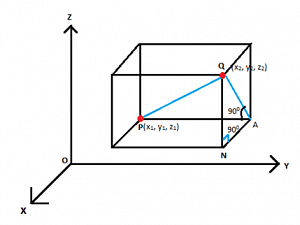
The 3D distance formula can be used to calculate the distance between two points whose coordinates are (m1,n1,o1) and (m2,n2,o2) in a 3-D plane, which is :
d = √(m2 - m1)2 + (n2 - n1)2 + (o2 - o1)2
Derivation of Distance Formula using Pythagoras Theorem
[Click Here for Sample Questions]
Let us suppose there are two points with coordinates A(x1,y1) and B(x2,y2), and we want to find a formula to determine the distance between them in a two-dimensional plane.
The line segment connecting A and B will then be assumed to be 'd'. We'll now plot the points on the coordinate plane and connect them with a line.

Now, we will make a right-angled triangle with AB as the hypotenuse.
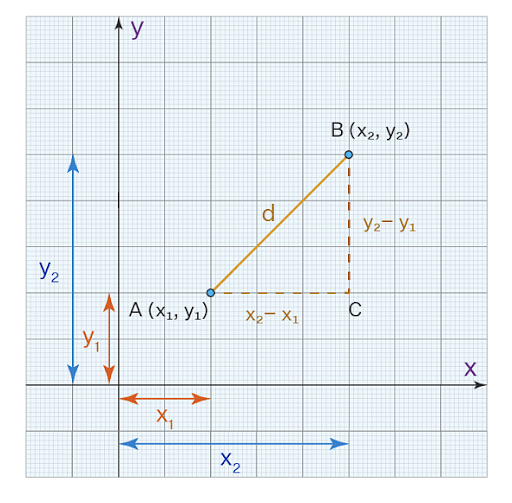
On applying pythagoras theorem in triangle ABC, we get :
AB2 = AC2 + BC2
=> d2 = (x2 - x1)2 + (y2 - y1)2
On talking square root on both sides of the equation, we get:
=> d = √(x2 - x1)2 + (y2 - y1)2
Hence, the distance formula for finding the distance between two points is proved.
How to Find Distance Between two points
[Click Here for Sample Questions]
The following steps can be used to calculate the distance between two points using the given coordinates:
- A(m1,n1) and B(m2,n2) are the coordinates of the two given points in the coordinate plane.
- The distance between the two points can be calculated using the distance formula, d = √(m2 - m1)2 + (n2 - n1)2
- Finally, express the given solution in proper units.
Note: If the two points are in a 3D plane, we can use the 3D distance formula, d = √(m2 - m1)2 + (n2 - n1)2 + (o2 - o1)2 .
Solved Examples
Example 1: Calculate the distance between two points with the coordinates A = (2, 3) and B = (3, 4). ( 2 marks)
Solution: Distance between the two points can be calculated using the distance formula, d = √(m2 - m1)2 + (n2 - n1)2 ,where (m1, n1) and (m2, n2) are the given coordinates.
⇒ d = √[(3 − 2)2 + (4 − 3)2]
⇒ d = √2 units
Example 2: Find an equidistant position on the y-axis between the points (-1, 2) and (2, 3). (3 marks)
Solution: We know that any point on the y-axis has an x-coordinate of 0.
As a result, we can consider the point equidistant from the provided points to be (0, k). Distance between (0, k) and (-1, 2) is equal to distance between (0, k) and (2, 3).
=> √[(−1 − 0)2 + (2 − k)2] = √[(2 − 0)2 + (3 − k)2] ( By distance formula)
Squaring both sides, we get:
=> (−1 − 0)2 + (2 − k)2 = (2 − 0)2 + (3 − k)2
=> 1 + 4 + k2 − 4k = 4 + 9 + k2 − 6k
=> 2k = 8
=> k = 4
So, required point is, (0, k) = (0, 4)
Things to Remember
- To obtain the distance between any two points in space, the distance formula plays an integral role.
- In two- and three-dimensional Euclidean space, the distance formulas for points in rectangular coordinates are based on the Pythagorean theorem.
- The distance formula can be obtained by creating a triangle and using the Pythagorean theorem to find the length of the hypotenuse.
- The hypotenuse of the triangle will be the distance between two points.
Sample Questions
Ques: Show that the vertices of any right-angled triangle can be the points (2, -1), (0, 1), and (2, 3). (5 marks)
Ans: Let P = (2, -1) , Q = (0, 1) and R = (2, 3)
Now, we can calculate the distance between the points taken two at a time:
PQ = √[(0−2)2 + (1−(−1))2]
= √[(−2)2 + (2)2]
= √(4 + 4)
= √8
QR = √[(2 − 0)2 + (3 − 1)2]
= √[(2)2 + (2)2]
= √(4 + 4)
= √8
PR = √[(2 − 2)2 + (3−(−1))2]
= √(02 + 42)
= √16
= 4
Now we can put the distances obtained in the pythagoras theorem,
PQ2 + QR2 = PR2
=> (√8)2 + (√8)2 = 42
=> 8 + 8 = 16
=> 16 = 16
As, P, Q and R satisfy the pythagorean theorem
So ΔPQR is a right-angled triangle.
Ques: Calculate the distance between two points with the coordinates A = (2, 3, 5) and B = (3, 4, 6). (3 marks)
Ans: Distance between the two points can be calculated using the distance formula, d = √(m2 - m1)2 + (n2 - n1)2 + (o2 - o1)2 ,where (m1, n1, o1) and (m2, n2, o2) are the given coordinates.
⇒ d = √[(3 − 2)2 + (4 − 3)2 + (6 − 5)2]
⇒ d = √3 units
Ques: Find a relationship between m and n such that the points (7, 1) and (3,5) are equidistant from (m, n). (4 marks)
Ans: Let us suppose that A(m, n) is the point which is equidistant from the points P(7, 1) and Q(3, 5).
Given,
PA = QA
⇒ PA2 = QA2
=> (m – 7)2 + (n – 1)2 = (m – 3)2 + (n – 5)2 (using distance formula)
=> m2 – 14m + 49 + n2 – 2n + 1 = m2 – 6m + 9 + n2 – 10n + 25
=> -14m + 50 – 2n + 6m + 10n – 34 = 0
=> -8m + 8n = -16
=> m – n = 2
So, the required relation between m and n is ‘m – n = 2’.
Ques: Find the distance between P(x1, y1) and Q(x2, y2) when
i) PQ is parallel to y-axis
ii) PQ is parallel to the x-axis (3 marks)
Ans: The idea of the distance formula- distance between two points A(x1, y1), and B(x2, y2) is given: AB = √(x1 - x2)2 + ( y1 - y2)2
Given, P(x1, y1) and Q(x2, y2) are two points
- i) When PQ is parallel to y-axis, x coordinate is constant
→ x2 = x1
From the distance formula,
PQ = √(x1 - x2)2 + ( y1 - y2)2 = √(0 + ( y1 + y2)2 = | y1 - y2 |
- ii) And, when PQ is parallel to x-xis, y coordinate is constant.
→ y2 = y1
From the distance formula,
PQ = √(x1 - x2)2 + ( y1 - y2)2 = √(0 + ( x1 + x2)2 = | x1 - x2 |
Ques: If the line segment joining the points P(x1, y1) and Q(x2, y2) subtends an angle ? at the origin O, prove that, OP. OQ cos ? = x1x2 + y1y2.(5 marks)
Ans: The idea of the distance formula- distance between two points A(x1, y1), and B(x2, y2) is given: AB = √(x1 - x2)2 + ( y1 - y2)2
Given, two points P and Q subtends an angle ? at the origin as shown in the figure below:

From the above figure, we can see that O, P, and Q form a triangle
In ΔOPQ,

→ 2OP.OQ cos a = OP2 + OQ2 - PQ2 … (1)
From the distance formula we have,

Using (a - b) = a2 + b2 - 2ab
OP2 + OQ2 - PQ2
→ 2 x1 x2 + 2y1 y2 … (2)
From the equation 1 and 2 we get,

Ques: The distance between two points A and B is 3 cm. A circle of radius 1.7 cm is drawn to pass through these points. Find the distance AB from the centre of the circle. (3 marks)
Ans: Let O be the centre of the circle of radius 1.7 cm is drawn to pass through these points. From O draw OD ? AB.
Then OD is the required distance.
Therefore, AD = DB = 1.5 cm
In right angle d, ΔODB

OD2 = OB2 - DB2 (Pythagorous theorem)
= 1.72 - 1.52 = 2.89 - 2.25 = 0.64
Therefore, OD = √0.64 = 0.8 cm.
Ques: Find the distance between the following pair of points: (2 marks)
(a, b), (-a, -b)
Ans: Let the given points be A(a, b) and B (-a, -b)
As we know the distance between the two points is given by:
Ques: Find the coordinates of the points which divide the line segment joining A(-2, 2) and B(2, 8) into four equal parts. (2 marks)
Ans: Let P, Q and R be the three points that divide the line segment joining the points A(-2, 2) and B(2, 8) into four equal parts.
For point P, we have,

Therefore, m1 = 1, m2 = 3
X1 = -2, y2 = 2
X2 = 2, y2 = 8
Then coordinates of P are given by,

Also Read:



Comments