



Content Curator
The eccentricity of the conic section is the only way to identify a shape that should have a non-negative real number. In general, eccentricity refers to the degree to which a curve has deviated from the circularity of a given shape. We know that the conic section is the section formed when a plane intersects a cone. Depending on the angle formed by the vertical axis of the cone and the position of the plane's intersection with respect to the plane, we will get different types of conic sections. The term "eccentricity" is defined in terms of a fixed point called focus and a fixed line called the directrix in the plane.
Read Also: Eccentricity of an Ellipse
| Table of Content |
Eccentricity
The eccentricity can be defined by the extent to which a conical phase (circle, ellipse, parabola, or hyperbola) differs from that of a circle. A circle has an eccentricity equal to zero, so the difference shows you how a given curve is not round. Big eccentricities are slightly less curved. It is denoted by the symbol ‘e’.
Discover about the Chapter video:
Conic Sections Detailed Video Explanation:
Eccentricity Formula
We can find eccentricity of any conic section by applying this formula -
e = c/a
Where e = eccentricity
- c = distance from the center to the focus
- a = distance from the center to the vertex
So, for a conic section, the general equation of the quadratic form is -
Ax² + Bxy + Cy² + Dx + Ey + F = 0
Also Check:
Eccentricity of Circle
A circle can be defined as a set of points in a plane that is equal to the exact point on the surface of the plane known as the ‘center’. Then, what is meant by the radius? The term ‘radius’ is used to describe the distance from the center to the point of a circle. If the center of the circle is the root, it is easier to find the derivation of a circle.
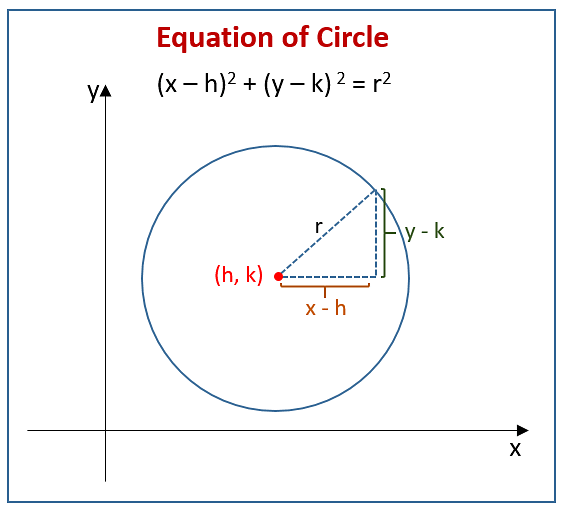
Eccentricity of Circle
So, here we can derive the eccentricity equation of a circle,
If ‘r’ is equal to the radius and C (h, k) is equal to the center of the circle, then by the definition of circle and eccentricity, we get,
| CP | = radius(r)
We know that the formula to find the distance is,
√[(x –h)2+( y–k)2]= radius(r)
Taking Square on both sides, we get the following equation,
(x –h)2+( y–k)2= radius2
Therefore, the equation of the circle with center C (h, k) and radius equal to ‘r’ can be written as (x –h)2+( y–k)2= r2
Thus, e = 0 for a circle.
Also Read:
Eccentricity of Hyperbola
Hyperbola is defined as a set of all points in a plane in which the difference in its distances from two fixed positions remains constant. In other words, the distance from the fixed point of the plane carries a much higher value than the distance from the fixed line on the plane. Therefore, we can say that the magnitude of hyperbola remains greater than 1.
e > 1
Therefore, the general equation of a hyperbola is,
√ a²+b²/ a
(The value of ‘a’ and ‘b’ are the lengths of semi-major and semi-minor axes.

Eccentricity of Hyperbola
Read Also: Hyperbola Defination
Eccentricity of Ellipse
An ellipse is defined as a set of points on a plane in which the number of distances from two fixed locations remains constant. In other words, the distance from the fixed point of the plane carries less than a distance from the fixed line of the plane. Therefore, we can say that the magnitude of an ellipse is always less than 1.
e < 1
Therefore, the general equation of an ellipse is,
√1 - b²/a²

Eccentricity of Ellipse
Eccentricity of Parabola
A parabola is defined as a set of points P where the distances from a fixed point F (focus) on a plane are equal to their distances from a fixed line (directrix) in a plane. In other words, the distance from the fixed point of the plane carries an equal value equal to the distance from the fixed line of the plane. Therefore, we can conclude that the eccentricity of a parabola is always equal to 1.
e = 1
Therefore, the general equation of a parabola is,
x²= 4ay
Things to Remember based on Eccentricity
- If Eccentricity = 0, we will get a formula for circle
- If Eccentricity is > 1, we will get a formula for hyperbola
- If Eccentricity is < 1, we will get formula for an ellipse
- If Eccentricity = 1, we will get a formula for parabola
- The eccentricity of a conic phase is defined as the distance from any point to its focus, separated by an equal distance from that point to its nearest directrix.
- The amount of eccentricity is always constant in any conic figure.
- The formula of eccentricity, e = c/a.
- The eccentricity is always given as 1 and the general equation of a parabola is x2 = 4ay.
- If the focus distance from the ellipse's centre is 'c,' and the end distance from the centre is 'a,' eccentricity e = c/a. e=1b2a2 e = 1 b 2 a 2 is another formula for determining the eccentricity of an ellipse.
Also Read Further:
Important Questions based on Eccentricity
Ques: Which of the following represents the eccentricity of a parabola? (1 Mark)
- e>1
- e<1
- e=1
- e=0
Ans. c) e=1
Ques. What is an eccentricity in science? ( 1 Mark)
Ans. In science,eccentricity is the measure of how an orbit deviates from a circle. A completely round orbit has zero eccentricity; higher numbers indicate more detailed rotation. Neptune, Venus, and Earth are planets in our solar system with tiny orbits around them.
Ques. What do you mean by directrix and eccentricity of an ellipse? ( 1 Mark)
Ans. In an ellipse, a line formed by a minor axis, at a point ‘d’ from the center is called the ellipse directrix. Eccentricity (e) is measured as an ellipse extension. Therefore, the value ‘e’ lies between 0 and 1, with an ellipse.
Ques. Name the different types of conic sections. (1 Mark)
Ans. There are four types of conic sections, which are as follows -
circle, parabola, ellipse, and hyperbola.
Ques. Can an eccentricity be positive or negative? ( 1 Mark)
Ans. Mathematically, the variation of a conic section is a non-real number that separates its character in particular.
Ques. If an orbit has an eccentricity of value zero, what shape is it? (1 Mark)
- Perfectly flat
- Perfectly circular
- Slightly oval/elliptical
- Oval/elliptical
Ans. b) Perfectly circular
Ques: In the given equation 16x² + 25y² = 400, find out the eccentricity of the ellipse. ( 2 Marks)
Ans: Given, 16x2 + 25y2 = 400
General equation for an ellipse: x2/a2+y2/b2= 1
Now, we need to convert the given information to its general form and we get: 16x2/400 + 25y2/400 =1
By solving this we get, a=5 and b=4.
We need to substitute the values of a, b, and simplify it -
The general form:
√(1-b2/a2).
After solving the above form, we will get that the e=3/5 for this ellipse.
Ques: Find the equation of the ellipse whose equation of its directrix is 3x + 4y - 5 = 0, and coordinates of the focus are (1,2) and the eccentricity is ½. ( 3 Marks)
Ans: Let P (x, y) be any point on the required ellipse and PM be the perpendicular from P upon the directrix 3x + 4y - 5 = 0
So according to the definition, SP/PM = e
SP = e.PM
⇒ √(x - 1)² + (y - 2)² = | 3x + 4y - 5/ √3² + 4² |
⇒ (x - 1)² + (y - 2)² = ¼ . (3x +4y -5)/ 25 , (squaring both sides)
⇒ 100 ( x² + y² - 2x - 4y + 5) = 9x² + 16y² + 24xy - 30x - 40y + 25)
⇒ 91x² + 84y² -24xy - 170x -360x + 475 = 0, is the required equation for the ellipse.
Ques: If a hyperbole passes through the point (10,16) and it has vertices (±6, 0), then the equation of the normal P is? (3 Marks)
Ans: Given, vertex of hyperbola - (±a, 0) = (± 6, 0) => a = 6
So we know, equation of hyperbola is, x2/a2 – y2/b2 = 1
⇒ x2/36 – y2/b2 = 1
Point P(10,16) lies on parabola, therefore,
100/36 – 256/b2 = 1
⇒ 64/36 = 256/b2
⇒b2 = 144
Equation of hyperbola will be x2/36 – y2/144 = 1 and
Equation of normal - a2x/x1 + b2y/y1 = a2 + b2
⇒ 36x/10 + 144y/16 = 180
⇒ x/50 + y/20 = 1
or 2x + 5y = 100
Ques: Find the eccentricity of the conic x² + 2x + 2y² + 4y - 13 = 0. ( 2 Marks)
Ans: Given, x² + 2x + 2y² + 4y - 13 = 0.
(x+1)² + 2(y+1)² = 16
(x+1)²/16 + (y+1)²/8 = 1
Comparing with standard equation, a = 4 and b = 2√2
So, e = √1 - (b²/a²)
⇒ e = √1 - (8/16)
⇒ e = 1/√2
Ques: Determine the equation of the circle with radius 4 and centre (-2, 3). (5 Marks)
Ans: Given that:
Radius, r = 4, and center (h, k) = (-2, 3).
We know that the equation of a circle with centre (h, k) and radius r is given as
(x – h)2 + (y – k)2 = r2 ….(1)
Now, substitute the radius and center values in (1), we get
Therefore, the equation of the circle is
(x + 2)2+ (y – 3)2 = (4)2
x2+ 4x + 4 + y2 – 6y + 9 = 16
Now, simplify the above equation, we get:
x2 + y2+ 4x – 6y – 3 = 0
Thus, the equation of a circle with center (-2, 3) and radius 4 is x2 + y2+ 4x – 6y – 3 = 0
Ques: Determine the focus coordinates, the axis of the parabola, the equation of the directrix and the latus rectum length for y2 = -8x (5 Marks)
Ans: Given that, the parabola equation is y2= -8x.
It is noted that the efficiency of x is negative.
Therefore, the parabola opens towards the left.
Now, compare the equation with y2= -4ax, we obtain
-4a= -8
⇒ a = 2
Thus, the value of a is 2.
Therefore, the coordinates of the focus = (-a, 0) = (-2, 0)
Since the given equation involves y2, the axis of the parabola is the x-axis.
Equation of directrix, x= a i.e., x = 2
We know the formula to find the length of a latus rectum
Latus rectum length= 4a
Now, substitute a = 2, we get
Length of latus rectum = 8
Mathematics Related Links:



Comments