



Education Journalist | Study Abroad Lead
Enthalpy Change refers to the difference between the heat content of the initial and final state of the reaction. Change in enthalpy can prove to be of great importance to find whether the reaction is exothermic or endothermic. In the following article, we will shed light upon various aspects and formulas used in the concept of Change in enthalpy and discuss some solved sample questions to strengthen understanding of the concepts.
Read Also : Thermodynamics
Enthalpy and Change in enthalpy (H and dH)
Enthalpy is the sum of the internal energy(U) held within the molecules of a matter with its volume(V), and the pressure(P). It is the heat content of the system at a constant pressure. But it is impossible to know the amount of internal energy as it can be enormous at any measurable volume and pressure. Although we cannot measure the total enthalpy, we can measure what changes have taken place in the heat content of a reaction, i.e. the change in enthalpy(dH).

Formula for change in enthalpy is:-
dH = dU + d(PV)
dH = H(final) - H(initial)
Note: We can also derive another very important formula for dH by using the first law of thermodynamics:
d H = d U + d n gRT
Properties of Change in enthalpy
Let’s understand some properties of enthalpy change:-
- Enthalpy and the change in enthalpy is a state function, i.e. it does not depend on the path rather the final and initial state.

(x axis = volume, y axis = pressure)
- The change in enthalpy of a cyclic process is zero.
- Enthalpy is an extensive property. This means that it depends on the amount of substance, as is clear from its formula. It depends on volume which makes it an extensive property.
Factors affecting change in enthalpy
- The physical state of the reactant and product changes the enthalpy.
For example, enthalpy for the formation of H2O(g) will be different from the enthalpy of formation of H2O(l), because of the difference in their states.
- Allotropic forms of reactant and product also affect enthalpy.
For example, the enthalpy of carbon in graphite form for the formation of CO2 is different from the enthalpy of carbon in diamond form for the formation of CO2.
- The solution used for the reaction of reactant and product also affects the enthalpy.
- The temperature and pressure at which the reaction is taking place also affect the enthalpy. That’s why a standard enthalpy change is calculated at a temp = 298K, and P = 1atm in order to avoid any confusion.
Standard Enthalpy
For a fair comparison of enthalpy change, the same conditions are necessary, these are called standard conditions. These standard conditions involve temp = 298K, P = 1 atm. The enthalpy change in the reaction here is called the standard enthalpy of the reaction and its value is noted for future use.
Note: The standard enthalpy for substances, in the states in which they are found naturally abundant, is zero. For example, Carbon’s standard enthalpy in graphite form is zero.
Read more : Isothermal Process
Various Types of Enthalpy Changes
There are various types of changes in enthalpy. Let us understand a few of them:
- Standard Enthalpy of reaction (dHr): It is the change in enthalpy when the reactants react to give a product as a result under standard conditions.
dHr = Hp - Hr
(Hp is the enthalpy of the product, Hr is the enthalpy of reactant)
- Standard Enthalpy of Formation (dHf): It is the amount of heat that is absorbed or released when 1 mole of a compound is formed by the reaction of its constituent elements in their natural state under standard conditions.
- Standard Enthalpy of Combustion (dHc): It is the amount of heat absorbed or released when 1 mole of a compound is combusted completely in excess of air under standard conditions.
- Standard Enthalpy of Neutralization (dHn): It is the enthalpy change when one mole of water is formed from the reaction of an acid and an alkali under standard conditions.
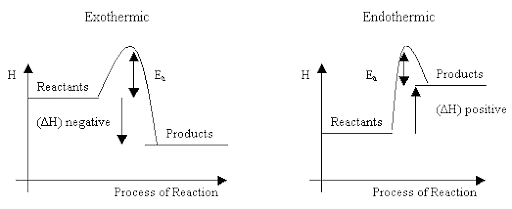
Energy Change Diagram for Exothermic and Endothermic Reactions
Things to Remember
- Enthalpy is a state function, it only depends on the initial and final state of the reaction.
- The formula for change in enthalpy is:-
dH = dU + d(PV)
- dH = d U + d n gRT, it is the most important formula to calculate enthalpy from a numerical point of view.
- Enthalpy can be affected by the physical state and allotropes of reactant and product, as well as by the solution used to carry out the chemical reaction.
- The standard enthalpy for substances, in the states in which they are found naturally abundant, is zero
- There are various types of enthalpies like the enthalpy of combustion, formation, reaction, etc.
- Enthalpy is an extensive property
Read more : Phase Transition
Sample Questions
Ques. A non-ideal gas goes from State 1(P=2atm, V=3 l, temp=95K) to State 2(P=4atm, V=5 l, temp=245K), find dH if change in internal energy(dU) is 30atm-l? 2 marks
Ans. Lets apply the formula for change in enthalpy:-
dH= dU + d(PV)
dH= dU + (P2V2 - P1V1)
Now, let us put in all the values:
dH = 30 + (4x5-2x3)
dH= 44 atm-l
Ques. An ideal gas expands Isothermally from 1L to 10L at 25 degrees celsius. Find the value of change in enthalpy? 2 marks
Ans. As we are dealing with an ideal gas and in an isothermal process internal energy of an ideal gas is zero. Let us apply the formula for change in enthalpy:
dH = 0 + (P2V2 - P1V2)
According to Boyle's law at constant pressure, P1V1=P2V2. Putting this in our equation we get:
dH = 0 + (P2V2-P2V2)
dH=0
Ques. Find whether dH>dU or dH 3 marks
H2(g) + Br2(g) → 2HBr(g)
Ans. Let’s apply the formula for change in enthalpy:
dH = dU + dngRT
For finding the relation between dH and dU, let us find out the change in no. of moles in the following reaction:
dng= n(p) - n(r)
dng = 2- 2
=0
Putting this value in the main formula, we get
dH = dU + 0
dH = dU
Ques. Find the value of dH-dU for the following reaction at 298 K (R=8.314 J/mole K) 3 marks
2C6H6(L) + 15O2(g) → 12CO2(g) + 6H2O(L)
Ans. First, let us find out the change in the no. of moles:
dn(g) = n(p)+n(r)
dn(g) = 12-15
= -3
Let us apply the formula for the change in Enthalpy:
dH = dU + dn(g)RT
dH - dU = -3 x 8.314 x 298
= 7432.7 J
Ques. The enthalpy changes for the following reaction at 298 K & 1-atmosphere pressure is dH = -874000J. (R= 8.314 J/mole K) 3 marks
CH3COOH(l) + 2O2(g) → 2CO2(g) + 2H2O(l)
Calculate the internal energy changes for this reaction?
Ans. First let us find out the change in the no. of moles:
dn(g)= n(p)+n(r)
dn(g) = 2-2
= 0
Let us now apply the formula for the change in Enthalpy:
dH = dU + dn(g) RT
-874000 = dU + 0 x 8.314 x 298
dU = -874000 J
dU = -874KJ
Ques. The enthalpy changes for the reaction at 298 K & 1-atmosphere pressure is -92.38 KJ .(R=8.314J/mol K) 3 marks
N2(g) + 3H 2(g) → 2 NH 3(g)
Calculate the internal energy changes for the reaction?
Ans. The change in no. of moles is:
dn(g) = n(p)+n(r)
dn(g) = 2-4
= -2
Change in Ethalpy:
dH = dU + dn(g)RT
dH = –92.38 KJ
= -92.38 x 1000
= – 92380J
– 92380 = dU + ( -2) x 8.314 x 298
dU = – 87424.86 J
dU = -87.425
= -87.43 KJ
Ques. The enthalpy of combustion of benzoic acid [C 6H 5COOH] at 298 K & 1-atmosphere pressure is -2546 KJ/mole. Calculate the ΔU for this reaction. 3 marks
2C6H5COOH(l) + 13O2(g) → 12CO2(g) + 6H2O(l)
Ans. The change in no. of moles:
dn(g)= n(p)+n(r)
dn(g)=12-13= -1
The change in Ethalpy:
dH = dU + dn(g)RT
dH = – 2546 KJ
= -2546 X 1000 J
= -2546000 J
– 2546000 = dU + (-1) x 8.314 x 298
dU = – 2546000 + 2477.572
dU = – 2543522.43 J
dU = – 2543.522 KJ
Ques. In the following reaction find the standard enthalpy of formation of SO3 where the standard change in enthalpy of the reaction is - 1590 KJ. Given temperature = 298K and R = 8.314 J/mole K. 2 marks
1/2S8(s) + 6O2(g) → 4SO3(g)
Ans. Let us apply the formula for the dHr:
dHr = Hp - Hr
-1590 = 4Hf(S03) - 0 (as O2 is in its standard state)
Hf(SO3) = -1590/4
= 398.5 KJ/mole
Ques. The standard Enthalpy of reaction of the following reaction is -352.8 kJ/mole. If the Hf of HF is -268.3 KJ/ mole, then what will be the Hf of HCL. 2 marks
F2 + 2HCL → 2HF + Cl2
Ans. Let us apply the formula for the dHr:
dHr = Hp - Hr
-352.8 = 2(-268.3) - 2Hf(HCL)
Hf(HCL) = -352.8 + 536.6/2
= 91.9 KJ/mole
Ques. The enthalpy change for the following reaction at 298 K & 1-atmosphere pressure is -1363KJ. Calculate the internal energy changes for this reaction. 3 marks
CH3CH2OH (l) + 3O2 (g) ———> 2CO2 (g) + 3H2O(l)
Ans. The change in no. of moles:
dn(g)= n(p)+n(r)
dn(g)=2-3= -1
The change in Enthalpy:
dH = dU + dn(g)RT
( dH = -1363 KJ = -1363 x 1000 = -1363000 J)
-1363000 = dU + (-1) x 8.314 x 298
dU =- 1363000 + 2477.572
dU = – 1360522.43 J
dU = – 1360.52 KJ



Comments