



Content Curator
The First Law of Thermodynamics claims that heat is a form of energy, and thus the thermodynamic processes are subject to the principle of conservation of energy. Thermodynamics deals with the relationship of heat with other forms of energy. The different laws of thermodynamics discuss a variety of physical quantities that sets apart various thermodynamic systems. The equation for the first law of thermodynamics can be expressed as:
⇒ ΔU = q + W
Here,
- ΔU is the Change in the internal energy of the system.
- q is the Algebraic sum of heat transfer between the system and the surrounding
- W is the Work interaction of the system with the surrounding
The first law of thermodynamics talks about how energy can only be exchanged, it cannot be created nor can it be destroyed. Hence, the universe’s total energy always remains constant.
Also Check: Specific Heat Capacity
| Table of Content |
Key Terms: Thermodynamics, Heat, Energy, Work, Law of Conservation of Energy, Heat Flow, Perpetual Motion Machine, Molecules
What is First Law of Thermodynamics?
[Click Here for Previous Year Questions]
The First Law of Thermodynamics states that:
| “The total energy of a system and its surroundings remain conserved when heat is recognized as a form of energy, i.e. the total energy of the universe is conserved or constant.” |
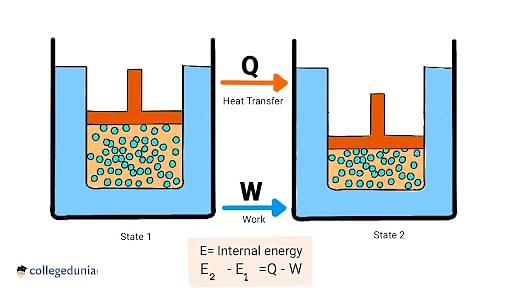
First Law of Thermodynamics
- In all physical and chemical changes, energy is neither created nor destroyed. However, it can be converted from one form to another.
- Energy, like mass, is always conserved and this internal energy is that thermodynamic property of a system that is related to the molecules of a system containing potential and kinetic energy.
- Now, when work, heat, and this internal energy interacts, there is a change in the system in the form of energy conversions or transfers.
- Yet, we can observe that even during the transformation, the energy of a system remains conserved.
- Hence, the first law of thermodynamics asserts heat as a form of energy.
- It basically means that heat cannot be created nor can it be destroyed, it can just be transferred from one location to another. The law is also regarded as the law of conservation of energy.
- For an isolated system, the energy remains constant.
| Topic Related Concepts | ||
|---|---|---|
| Thermodynamics | Carnot engine | Zeroth Law of Thermodynamics |
| Second Law of Thermodynamics | Standard Enthalpy of Formation | Application of Thermodynamics |
First Law of Thermodynamics Equation
[Click Here for Sample Questions]
The First law of Thermodynamics also states that some heat can be used to change the internal energy of a system while the rest can be used at work. Mathematically, the first law of thermodynamics formula can also be expressed as:
| ΔQ = ΔU + W |
Where,
- Q represents heat change,
- U represents internal energy change, and
- W represents work done.

First Law of Thermodynamics Equation
Note: Energy remains constant for isolated systems. Furthermore, the internal energy is a function of temperature for an ideal gas.
- Consider a gas in a cylinder.
- The walls of the cylinder separate the gas inside the cylinder from the outside.
- The cylinder’s piston allows the gas to work.
- If the gas does W amount of work and absorbs heat Q, the net flow of energy amounts to W-Q, and when energy is conserved it leads to:
⇒ ΔU = Q − W
- Now, since energy U is determined only through quantities that determine the system in equilibrium, it can be said that it is a state function where changes in energy can be determined through the initial and final state of the system.
- The gas inside may do zero work or it may do maximum work, the important consideration is that the change in the system remains consistent.
- Q and W are not state functions here as their values are determined by a particular path or process.
Read Also: Rotational Kinetic Energy Derivations
First Law of Thermodynamics Limitations
[Click Here for Previous Year Questions]
Some of the major limitations of the first law of thermodynamics include:
- The first law of thermodynamics does not say anything about the direction of the flow of heat.
- It also fails to explain whether a process is spontaneous or not.
- Heat cannot be fully transformed into work. Thus, the reverse process under the first law of thermodynamics is not possible.
- The first law of thermodynamics fails to describe why heat flows from the hot end to the cold one when a metallic rod is heated at one end alone. The first law helps quantify the energy transfer occurring during this process. However, the second law of thermodynamics offers the feasibility of the various processes. It can be explained by the example below.
Perpetual Motion Machine of First Kind (PMM1)
A machine that can constantly supply mechanical work without consuming any energy simultaneously is impossible to construct. Such a hypothetical machine is known as the Perpetual Motion Machine of the First Kind. However, these kinds of machines typically violate the 1st law of thermodynamics and have no form in reality.
Read Also:
First Law of Thermodynamics: Closed System
[Click Here for Sample Questions]
For a closed system, the work done is the product of the applied pressure and the change in volume due to that
W = − P.ΔV
Now, depending on this work interaction across boundaries, a system’s internal energy undergoes a change by increasing or decreasing.
- If the system does the work, the energy will decrease.
- If work is done on the system, the energy will increase.
The internal energy of the system is also altered but the total change in energy internally is zero as energy always remains constant in a system according to the first law of thermodynamics.
- If a system loses energy, the surroundings absorb it.
- If the surroundings release energy, the system absorbs it.
ΔUsystem = −ΔUsurroundings
Where
- ΔUsystem: total internal energy change of the system.
- ΔUsurroundings: total internal energy change of the surroundings.

Forms of energy and its Work Interactions
The first law of thermodynamics for a closed system can be illustrated below:
| Process | Internal energy change | Heat (q) | Work(w) | Examples Include |
|---|---|---|---|---|
| Adiabatic (q = 0) | +/- | 0 | +/- | Isolated system wherein heat neither enters nor leaves. |
| Constant Volume (ΔV) (isochoric) | +/- | +/- | 0 | A bomb calorimeter (i.e. pressure-isolated system). |
| Constant pressure (isobaric) | +/- | Enthalpy | − pΔV | Most of the processes take place in constant external pressure. |
| Isothermal | 0 | +/- | -/+ | No temperature change, such as a temperature bath. |
Sign Conventions
The sign conventions for Work and Heat are as tabulated below:
| Process | Work(w) | Heat(q) |
|---|---|---|
| Work done by a system | - | NA |
| Work done on a system | + | NA |
| Heat added to a system | NA | + |
| Heat removed from a system | NA | - |
Things to Remember
- The first law of thermodynamics states that the total energy of a system and its surroundings remain conserved when heat is recognized as a form of energy, i.e. the total energy of the universe is conserved or constant.
- Equation of First law of Thermodynamics: ΔQ = ΔU + W (Where, Q = heat change, U = internal energy change, and W = work done)
- The first law of thermodynamics isn’t absolute, it lacks in some aspects, one of which is that it fails to say anything about the flow of heat.
- For a closed system, the work done is: W = − P.ΔV.
Check Important Notes: Avogadro’s Law (Volume-Amount Relationship)
Previous Year Questions
- An ideal monoatomic gas is confined in a cylinder by a spring-loaded piston… [JEE Main 2014]
- A Carnot freezer takes heat from water at 0oC… [JEE Main 2016]
- The correct relationship between free energy change in a reaction and the corresponding equilibrium constant Kc is …?
- A sample of 0.1 g of water at 100°C and normal pressure (1.013 × 10⁵ Nm-2) requires 54 cal...[NEET 2018]
- Thermodynamic processes are indicated in the following diagram...[NEET 2017]
- A carnot engine having an efficiency of 1/10 as heat engine, is used as a refrigerator...[NEET 2017]
- A carnot engine whose sink is at 300 K has an efficiency of 40%. By how much should...[NEET 2006]
- A gas can be taken from A to B via two different processes… [JEE Main 2019]
- A gas is compressed from a volume of 2m3… [JEE Main 2014]
Sample Questions
Ques. “ΔU = 0 means that the process is isothermic.” Determine whether true or not. (1 mark)
Ans. Temperature can be defined as the only factor impacting internal energy. In conclusion, if ΔU = 0, thus the process will have a constant temperature or be isothermic.
Ques. What is a Perpetual Motion Machine of the First Kind? (1 mark)
Ans. A machine that can continually supply mechanical work without consuming any energy at the same time is impossible to construct. Such a hypothetical machine is termed Perpetual Motion Machine of the First Kind.
Ques. If you put 12 gals of gasoline into the tank of the car and the gasoline’s energy content is 1.3 × 10⁸ J/gal. What’s the change in the car’s internal energy if all the other factors like the car’s temperature remain constant? (1 mark)
Ans. ΔU = Q – W = Q
(1.3x10⁸ J/Gal) (12.0 gal)
1.6 x 10⁹ J
Ques. State the first law of thermodynamics. (1 mark)
Ans. The total energy of a system along with its surroundings is conserved when heat is recognized as a form of energy, i.e. the total energy of the universe is always conserved or constant.
Ques. What is a Reversible Process? (1 mark)
Ans. A process can be called a Reversible process when the stages of an operation to which it subjects can be transformed back in the opposite direction in a way that the substance can pass via the exact same conditions at which it passed in the direct process.
Ques. What is an isolated system? (1 mark)
Ans. A system is known to be isolated in case it can exchange both energy and matter with its surroundings.
Ques. Write down the equation for the first law of thermodynamics. (2 marks)
Ans. The first law of thermodynamics states that the energy of a system always remains conserved and that some heat can be used to change the internal energy of a system while the rest can be used at work. Mathematically, the first law of thermodynamics is represented as-
ΔQ=ΔU+W
Where,
- Q represents heat change,
- U represents internal energy change, and
- W represents work done.
Ques. State two limitations of the first law of thermodynamics. (2 marks)
Ans. The two limitations of the first law of thermodynamics are:
1) The law to say anything about the flow of heat.
2) The law fails to explain whether a process is spontaneous or not.
Ques. A gas with constant pressure in a system loses about 45 J of heat in the surroundings around the system. It is said that 450 J of work is done on the system. Determine the system’s internal energy. (2 marks)
Ans. As per the question, the following can be determined:
⇒ ΔU = q+w
⇒ ΔU = 45J + 450J
⇒ ΔU = 495J
Ques. If the internal energy of a system is decreased by 150J while it was doing 30J of work, how much heat is transferred? (3 marks)
Ans. ΔU = Q + W
∑ F = 0
F1 + F2 = 0
F1 – F2 = 0
Q = ΔU –W
Q = -150 – (-30) [Q= -120J]
-150 = -120 – (-30)
Ques. Compare between Isothermal Expansion and Adiabatic Expansion. (3 mark)
Ans. Consider that isothermal and adiabatic expansions of an ideal gas possess the same initial volume Vi and pressure Pi, thus it leads to the same end volume Vf. Assuming that the final pressures are Piso and Padia, then it can be said:
For isothermal expansion, Pi Vi = Piso Vf
And for adiabatic expansion, Pi Vγi = Padia (Vf)γ
Thus, Vf/Vi = Pi/Piso
And Vf/Vi = Pi/Padia
Now, for the expansion, (Vf) > (Vi) and also for all gases γ > 1, hence,
{(Vf/Vi)γ} > {Vf/Vi}
Thus, {Pi/Padia} > {Pi/Piso}
Alternatively, (Padia) < (Piso).
Check also:



Comments