



Education Journalist | Study Abroad Lead
Equal sets and Equivalent sets might sound similar as both of them follow a similar concept but have slight differences in execution. Sets in general are defined as a collection of ‘well-defined’ objects. The number of objects within a particular set is known as ‘cardinals’. The number of objects of set X is written as n(X). Equivalent sets should have the same cardinal number while equal sets should have precisely the same elements.
Read More: Math Study Material
| Table of Content |
Key Terms: Sets, Equal Sets, Equivalent Sets, Empty sets, null sets, finite sets, infinite sets, cardinality
Equal Sets
[Click Here for Sample Questions]
Two sets with precisely equal number of elements as well as same values of elements (that is, same elements) are known as equal sets. If the order at which the elements arranged are different despite having the same number and value, they are still known as equal sets.
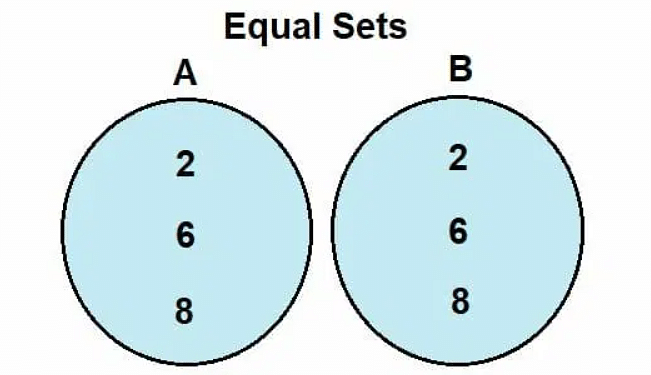
Equal Sets
Examples of Equal Sets
[Click Here for Sample Questions]
Consider E = {1, 2, 3} and F = {1, 2, 3}. Here, both the number and the value of the sets are the same, n(E) = n(F).
Consider another example where G = {5, 8, 9} and H = {9, 8, 5} here n(G) = n(H) but the order of the elements is interchanged in set H. They are equal sets.
For sets like T = {2, 3, 4, 7} and Y = {2, 3, 4}, here the cardinality of the sets are different n(T) n(Y). Despite having similar elements in both the sets, one of the sets has one element extra than the other thus these are not equal sets.
Set D = {1, 2, 3} and F = {1, 1, 2, 2, 3}, here the elements within both sets are the same. But set F has repetition of elements of set D. Such sets are also equal.
Read Also:
Equivalent Sets
[Click Here for Sample Questions]
Two sets are said to be equivalent sets when their cardinal numbers are the same.
For eg. A = {W, V, O, I} and B = {7, 9, 3, 2}, here their cardinal numbers n(A) = n(B). Equivalent sets are when the number of elements within two different sets are equal. The value of the element in each of the sets are not considered, instead only the number of elements within the set matters. For sets,
P = {1, 2, 3}
Q = {1, 2, 3, 4, 5}
R = {5, 6, 7}
S = {5, 6, 7, 8, 9}
The cardinal values of,
n(P) = n(R) and
n(Q) = n(S)
Thus, P and R form one of the equivalent sets while Q and S form another.
Read Also:
Things to Remember
- Two sets that are equal will always be equivalent.
- The only difference between equal and equivalent sets is that the equivalent set does not require the same elements in both the sets.
- Both equal and equivalent sets require the same number of elements in both the sets to qualify them as equal or equivalent sets.
- Two sets can be equal and equivalent at the same time.
- Null sets are always equivalent to each other.
- Equal and equivalent sets do not consider the order of arrangement of elements within a set.
Sample Questions
Ques. Obtain the cardinality of the following: (5 Marks)
(1) A = {days of the week}
(2) B = {two digit primes numbers}
(3) C = {multiples of 2}
(4) D = {Alphabets of English}
Ans.
- A = {days of the week}
A = {Monday, Tuesday, Wednesday, Thursday, Friday, Saturday, Sunday}
Thus n(A) = 7
- B = {two digit primes numbers}
B = {11, 13, 17, 19, 23, 29, 31, 37, 41, 43, 47, 53, 59, 61, 67, 71, 73, 79, 83, 89, 97}
Thus n(B) = 25
- C = {multiples of 2}
C = {2, 4, 6, 8, 10, 12, 14, 16, 18, 20…}
Thus as the multiples of 2 are infinite, they do not have a number of elements for the set. Such a type of set is known as an infinite set.
- D = {Alphabets of English}
D = {A, B, C, D, E, F, G, H, I, J, K, L, M, N, O, P, Q, R, S, T, U, V, W, X, Y, Z}
Thus n(D) = 26
Ques. Differentiate between Equal sets and Equivalent sets. (3 Marks)
Ans.
| Equal Sets | Equivalent Sets |
|---|---|
| Equal sets have all the elements same in both the sets. | Equivalent sets does not require to have same elements in the sets |
| All equal sets are equivalent sets | Equivalent sets may or may not be equal |
| The elements in both the sets should be precisely the same | It is not compulsory for the elements to be the same in both the sets. |
| Eg. A = {4, 5, 6} and H = {4, 6, 5} | Eg. A = {4, 5, 6} and H = {F, H, L} |
Ques. Find the pairs of equal sets, from the given sets, give reasons: (5 Marks)
A = {0}
B = {x:x > 15 and x < 5}
C = {x:x – 5 = 0}
D = {x: x2 = 25}
E = {x: x is an integral positive root of the equation x2 – 2x – 15 = 0}
Ans. The element ‘0’ which belongs to set A does not belong to any other set A, not equal.
The condition given in the set B does not satisfy any number thus the element of set B = {}
No other sets are empty thus even set B is not equal
In set C, the number 5 satisfies the given equations.
Set D contains both elements D = {5, -5}, set C just has one element of set D thus they are not equal.
Set E satisfies the equation by E = {5} Thus set C has a similar element as compared to set E.
Only sets E and C are equal sets.
Ques. Distinguish the following as equal or equivalent sets. (5 Marks)
(1) F = {9, 1, 3} and T = {1, 3, 9}
(2) R = {red, blue, yellow} and O = {3, 8, 7}
(3) V = {o, h, k, l, m, p} and J = {l, k, m, h, o, p}
(4) B = {0} and K = {a, b}
Ans.
- F = {9, 1, 3} and T = {1, 3, 9}
Equal sets as both have same cardinal number and interchanged elements
- R = {red, blue, yellow} and O = {3, 8, 7}
Equivalent sets as both the sets have same cardinal number but with different elements
- V = {o, h, k, l, m, p} and J = {l, k, m, h, o, p}
Equal sets as both have same cardinal number and interchanged elements
- B = {0} and K = {a, b}
The above sets show a difference in the number of elements within a stadium. Thus they are not equivalent nor equal sets
Ques. Which of the following pairs of sets are equal? Justify your answer. (2 Marks)
(1) X, the set of letters in “ALLOY” and B, the set of letters in “LOYAL”.
(2) A = {n: n ∈ Z and n2 ≤ 4} and B = {x: x ∈ R and x2 – 3x + 2 = 0}.
Ans.
- We have, X = {A, L, L, O, Y}, B = {L, O, Y, A, L}. Then X and B are equal sets as repetition of elements in a set does not change a set. Thus,
X = {A, L, O, Y} = B
- A = {–2, –1, 0, 1, 2}, B = {1, 2}. Since 0 ∈ A and 0 ∉ B, A and B are not equal sets.
Ques. State which of the following sets are finite or infinite: (3 Marks)
(1) {x : x ∈ N and (x – 1) (x –2) = 0}
(2) {x : x ∈ N and x2 = 4}
(3) {x : x ∈ N and 2x –1 = 0}
(4) {x : x ∈ N and x is prime}
(5) {x : x ∈ N and x is odd}
Ans.
- Given set = {1, 2}. Hence, it is finite.
- Given set = {2}. Hence, it is finite.
- Given set = φ. Hence, it is finite.
- The given set is the set of all prime numbers and since the set of prime numbers is infinite. Hence the given set is infinite
- Since there are infinite numbers of odd numbers, hence, the given set is infinite.
Ques. Give four examples of equal sets. (2 Marks)
Ans.
- W = {v, I, 9, p, 8} and U = {I, 8, v, p, 9}
- Y = {7, 8} and I = {8, 7}
- R = {all even numbers} and K = {all multiples of 2}
- F = {0, m, 3} and L = {0, m, 3}
Ques. Give four examples of equivalent sets. (2 Marks)
Ans.
A = {apple, cake, chocolate, ribbon} and B = {2, 6, 7, 8}
S = {8.1, 6.9, 4.5, 0} and J = {p, h, j, k}
D = {u, o, m} and K = {u, o, m}
N = {90, 32, 88, 44, 50} and X = {XY, BU, BI, MK, LP}
Ques. What are the real number solutions of the equation x2 + 1 = 0? (3 Marks)
Ans. x2 + 1 = 0
x2 = -1
x = -1
Such a number cannot give natural numbers as the solution
There are no real number solutions of these equations since no real number squared added to one can ever equal to ‘0’. Such types of equations are written in the form of a set using the null set {} or φ. Null set contains no elements.
Ques. Determine which of the following are empty sets. (3 Marks)
(1) C = {even numbers between 6 and 10}
(2) H = {prime numbers between 7 and 11}
Ans.
- C = {even numbers between 6 and 10}
C = {8}
n(C) = 1
set has one element thus it is not an empty set
- H = {prime numbers between 7 and 11}
H = {}
There are no prime numbers between 7 and 11 thus n(H) = 0
Thus set H is an empty set.
For Latest Updates on Upcoming Board Exams, Click Here: https://t.me/class_10_12_board_updates
Read Also:



Comments