



Content Curator
Disjoint sets are two sets A1 and A2 if their intersection A1 ∩ A2 ≡ Φ, where Φ is the empty set. In this case for example, {A, B, C} and {D, E} are termed as disjoint sets, but on the contrary {A, B, C} and {C, D, E} are not disjoint sets. Mutually exclusive or independent sets are sometimes known as disjoint sets. Two disjoint sets have the same intersection, which is the empty set.
| Table of Content |
Read More: Bayes Theorem Formula
Disjoint Set
Consider two sets A and B to better understand the Venn diagram representation of disjoint sets and let A= {2, 4, 6, 8} , B = {3, 9, 12, 10}.
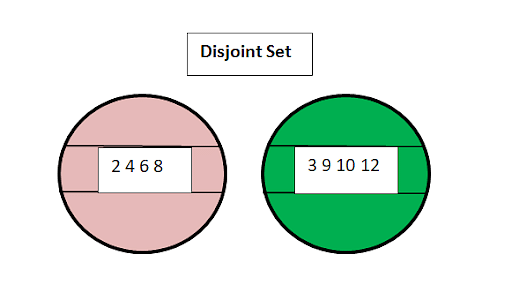
Because the two sets, A and B, do not have any crossing elements, they are disjoint sets with no overlapping regions in their Venn diagrams.
Therefore we can say that Disjoint sets are those that don't share any elements. Their intersection always yields a null or empty set.
Also Read:
Process to Determine if Two Sets are Disjoint
The intersection operation is all that is required to establish whether two sets are disjoint. There will never be a shared element between disjoint sets. As a result, the intersection of their sets will always be null. Hence the null set will be a disjoint set.
Read More:
Now taking an example we can understand the concept of disjoint set:
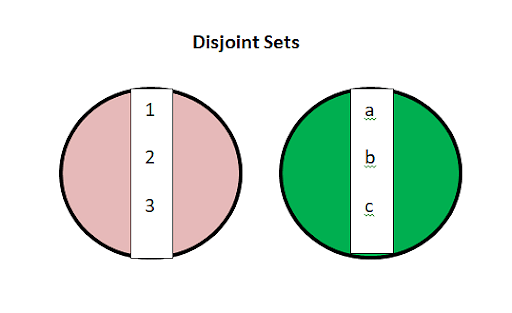
Example: Take two sets, A= {1, 2, 3} and B= {a, b, c} now through the given values construct a venn diagram and point out their relationship based on it.
Solution: Analyzing the two sets reveals that they do not contain any intersecting elements, implying that A ∩ B = Φ, Hence we can say that the set A and B are Disjoint sets.
Venn Diagram
Pairwise Disjoint Set
The pair of sets whose intersection is a null set is known as pairwise disjoint sets. There is no common element between these sets. As a result, pairwise disjoint sets and disjoint sets are the same thing.
Hence the criteria or condition for a pairwise disjoint set are as follows:
A ∩ B = Φ
Read More:
In order to equip with concept of pairwise disjoint set a following example is provided below:
Example- Take two sets, A= {1, 2, 3} and B= {5, 6, 7} Find out whether the given sets are pairwise disjoint sets not?
Solution- The basic condition for a pairwise disjoint set is : A ∩ B = Φ
Now making intersection operation on sets A and B we get;
A ∩ B = {1, 2, 3} ∩ {5, 6, 7}
A ∩ B = Φ
Therefore, the two sets A and B are pairwise disjoint sets as there is no common element in both the sets.
Read More:
Disjoint Sets Union
A binary operation on two sets is a disjoint set union. Any disjoint union's elements can be defined in terms of ordered pairs as (a, b), where b is the index of the member a's origin. We can unite all the different (distinct) components of a pair of sets using this method.
A*B = (A0(B1) A*B*
Read More:
With the help of an example the disjoint union can be understood:
Example- Given a set, A= {6, 7, 8, 9, 10} and B= {6, 7, 8, 9} determine the disjoint of union sets?
A*= {(6,0), (7,0), (8,0), (9,0), (10,0)} and B*= {(6,1), (7,1), (8,1), (9,1)},
Solution- Solving, A*B = A*B*
= {(6,0), (7,0), (8,0), (9,0), (10,0), (6,1), (7,1), (8,1), (9,1)}
Read More:
Points to Remember
- Disjoint sets is a part of unit 1 Sets and function, chapter 1 Sets and carries a total of 6 to 8 marks.
- Disjoint sets always have unique elements.
- If there is a common element in any given set then it is not a disjoint term.
- Disjoint set union is determined using the below formula: A*B = (A0(B1) A*B*
- The pair of sets whose intersection is a null set is known as pairwise disjoint sets.
Read More:
Sample Question
Ques 1. Take two sets, A= {2, 4, 6} and B= {9, 12, 15} , Find out whether the given set is a disjoint set or not? (1 mark)
Ans. Analyzing the two sets reveals that they do not contain any intersecting elements, implying that A ∩ B = Φ, Hence we can say that the set A and B are Disjoint sets as intersection set A and B is a null set.
Ques 2. Take three sets, A= {2, 3} , B= {5, 3}, C= {6, 2} Find out which set is a disjoint set among the three? (3 marks)
Ans. In Order to find the disjoint set first let us consider the intersection of the given set.
A ∩ B ∩ C = Φ
A ∩ B = {2, 3} ∩ {5, 3}
A ∩ B = {3} and ,
B ∩ C = {5, 3} ∩ {6, 2}
B ∩ C = Φ
And finally the last pair,
A ∩ C = {2, 3} ∩ {6, 2}
A ∩ C = {2}
Therefore, in this group of sets, only sets B are disjoint sets.
Ques 3. Take two sets, A= {5, 6, 7} and B= {7, 8, 9} , Find out whether the given set is a disjoint set or not? (2 marks)
Ans. Performing the intersection operation on sets A and B:
A ∩ B = {5, 6, 7} ∩ {7, 8, 9}
Analyzing the two sets reveals that they contain 7 as an intersecting elements, implying that
A ∩ B = 7, Hence we can say that the set A and B are not disjoint sets.
Ques 4. Take two sets, A= {j, k, l} and B= {m, n, o} , Find out the union of the given sets. (2 marks)
Ans. Because the provided sets A and B are disjoint, the union operation will be disjoint as well.
Solving this we get:
A U* B = {(j,0), (k,0), (l,0)} U {(m, 1), (n, 1), (o, 1)}
So, A U* B = {(j,0), (k,0), (l,0)} U {(m, 1), (n, 1), (o, 1)}
The disjoint union of the disjoint sets A and B is A U* B.
Ques 5. Determine if the given sets are disjoint sets A = {12,13} and B = {13,14}. (2 marks)
Ans. Given: A = {12,13}, B = {13,14}
Applying the intersection operation on the above sets we get;
A ∩ B = {12,13} ∩ {13,14}.
A ∩ B = Φ
Because the intersection of these two sets yielded an empty set, they are disjoint sets.
As a result, the two sets given are disjoint.
Ques 6. When the intersection of two sets yields a null set, they are considered pairwise disjoint sets. State true/false. a. False b. True (2 marks)
Ans. The correct answer is True. As the pair of sets whose intersection is a null set is known as pairwise disjoint sets. There is no common element between these sets. As a result, pairwise disjoint sets and disjoint sets are the same thing.
Ques 7. Let M= (a, b, c) and N= (e, f, g) : where M= the number of students in class 10 and N= the number of students in class 11. Examine if the given sets are disjoint sets. (1 mark)
Ans. Since the students in class 10 and 11 are not common therefore the set M and set N are disjoint sets.
Ques 8. Let A= (9pm, 10pm, 12am) and B= (Sunday, Monday, Tuesday, Wednesday). Examine if the given sets are disjoint sets. (1 mark)
Ans. Given, A= (9pm, 10pm, 12am) and B = (Sunday, Monday, Tuesday, Wednesday) are disjoint because they have no element in common.
Read More:



Comments