



Education Journalist | Study Abroad Lead
Hyperbola is a smooth curve that rests in a plane. It is made up of two pieces, called joints or branches, that are similar to each other. A hyperbola is one of the three forms of conic sections. The set of all points in a plane is known as a hyperbola. The distance between these two fixed locations in the plane will always be the same. The distance to the distant point minus the distance to the nearest point is known as the difference. The foci are the two fixed points, and the center of the hyperbola is the midpoint of the line segment connecting the foci. Hyperbolas are similar to mirrored parabolas in appearance. In this article, we will look at the equation for hyperbola, its formula, and some solved examples.
Key Takeaways- Hyperbola, Major Axis, Minor Axis, Asymptotes, Eccentricity, Vertex, Focus, Directrix, Lactus Rectum, Hyperbola Equation
What is Hyperbola?
[Click Here for Sample Questions]
Hyperbola is a smooth curve that lies in a plane and is described by geometric properties of equations for which it is the solution set. When a plane and a cone intersect, a hyperbola is formed. We can simply say that the figure obtained when a plane intersects the halves of a double cone but does not traverse the cones' apex is known as a hyperbola.
A hyperbola's limbs each have two straight arms that extend further away from its center. The arms are diagonally opposing, and they tend to converge in the limit to a common line, referred to as the asymptote of the two limbs. There are two asymptotes whose convergence lies at the midst of the hyperbola's symmetry, which can be taken to be the point that each limb reflects to build the other limb.
Also Read:
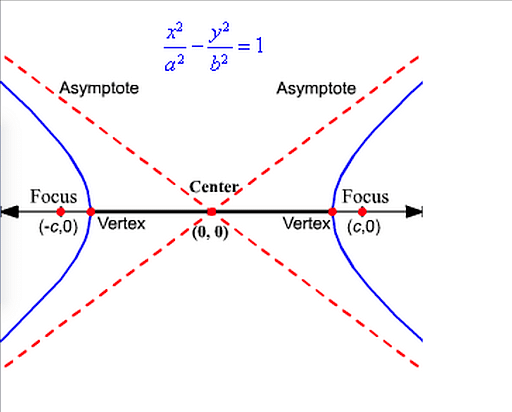
Hyperbola and Asymptote
Discover about the Chapter video:
Conic Sections Detailed Video Explanation:
Equation of a Hyperbola
[Click Here for Sample Questions]
Two foci and two vertices make up a hyperbola. The hyperbola's foci are located away from its center and vertices.
- The transverse axis is the line that runs through the foci.
- The conjugate axis is a line that passes through the center and is perpendicular to the transverse axis.
The vertices of the hyperbola are the sites where the hyperbola intersects the transverse axis.
The general equation of the hyperbola is as follows-
\(\frac{(x-x_0)^2}{a^2} -\frac{(y - y_0)^2}{b^2} =1\)
where x0, y0 = centre points
a = semi-major axis and
b = semi-minor axis
Some important things to note with regards to a hyperbola are:
- 2c will always be the distance between the two foci.
- 2a will always be the distance between two vertices. This is also the transverse axis length.
- The conjugate axis will be 2b in length. So, \(b = \sqrt{c^2 - a^2}\).

Hyperbola
Hyperbola: Solved Examples
[Click Here for Sample Questions]
Example 1: The point (4, 1/2) is intersected by a rectangular hyperbola. Determine the vertices and foci's coordinates by solving the equation.
Solution:

\(4. \frac{1}{2} = \frac{a^2}{2}\)
\(a^2 = 4 \\ x.y = 2 \\ A = (\sqrt{2}, \sqrt{2}) ; A' = (-\sqrt{2}, -\sqrt{2}) \\ c = a\sqrt{2} = 2\sqrt{2} = d(O, F) \\ F(2,2) ; F'(-2,-2)\)
Example 2: The length of the conjugate axis of a hyperbola is 8, and the asymptotes' equations are y = \( \pm \frac{2}{3}\) x. Calculate the hyperbola's equation, foci, and vertices.
Solution: 2b = 8
b = 4
\(\frac{2}{3}\) = 4/a
a = 6
\(c =\sqrt{36 + 16} \\ = 2 \sqrt{13} \\ \frac{x^2}{36} - \frac{y^2}{16} = 1 \\ A = (6,0) \\ A' = (-6, 0) \\ F =( 2\sqrt{13} , 0) ; F' = (- 2\sqrt{13} , 0)\)
Also Read Further:
Hyperbola: Some Basic Formulas
[Click Here for Sample Questions]
Some key terms and formulas related to hyperbola are:
- Major Axis- The Major Axis is the line that runs through the center, the hyperbola's focus, and the vertices. The major axis will be 2a in length. Hence the equation for the major axis will be y = y0.
- Minor Axis- The Minor Axis is a line that is perpendicular to the major axis and travels through the middle of the hyperbola. The length of the minor axis will be 2b. Hence the equation for the minor axis will be x = x0.
- Asymptotes- The Asymptotes are two bisecting lines that pass through the center of the hyperbola but do not touch the curve. The formula is as follows:
y = y0 + bax - ba x0
y = y0 - bax + ba x0
- Eccentricity- Eccentricity is the difference between a conic section that is fully circular and one that is not. Hyperbola usually has a value larger than one. For regular hyperbola, the eccentricity will be 22. The formula for eccentricity will be a2 + b2a
- Vertex: The vertex is the point on a stretched branch that is closest to the center. (a,y0) and (-a,y0) are the vertex points.
- Focus: On a hyperbola, both foci are fixed points in such a way that the distance difference between them is always constant. The two main focuses are (x0 + (a2+ b2), y0) and (x0 - (a2+ b2), y0)
- Directrix of a hyperbola: A line that is utilized to generate the curve is known as the directrix of a hyperbola. It can be defined as the line that the hyperbola curves away from. This runs perpendicular to the symmetry axis. Its formula is as follows:
x = a2/(\(\sqrt{(a^2 + b^2)}\))
Mathematics Related Links:
Important Topics for JEE MainAs per JEE Main 2024 Session 1, important topics included in the chapter hyperbola are as follows:
Some memory based important questions asked in JEE Main 2024 Session 1 include:
|
Things to Remember
- A smooth, plane-resting curve is referred to as a hyperbola. When a plane and a cone intersect, a hyperbola is formed.
- Two foci and two vertices make up a hyperbola. The hyperbola's foci are located away from the center and vertices.
- The transverse axis is the line that runs through the foci.
- The conjugate axis is a line that passes through the center and is perpendicular to the transverse axis.
- The points on the hyperbola's vertices where it contacts the transverse axis are called vertices.
- Key terms related to hyperbola are major axis, minor axis, asymptotes, eccentricity, vertex, focus, and directrix of a hyperbola.
Read More: Difference between hyperbola and parabola
Sample Questions
Ques. What does the hyperbola equation mean? (3 marks)
Ans. The collection of all points in a plane system whose distances in the plane are constant from two fixed points is known as the Hyperbola equation. The distance to the 'farther' location minus the distance to the 'near' point is referred to as the 'difference.' The foci are the two fixed points, and the hyperbola's midpoint is the midway of the line connecting the foci.
Ques. Define Latus Rectum of the hyperbola? (2 marks)
Ans. A hyperbola's latus rectum is a line that runs perpendicular to the transverse axis through any of the foci and has endpoints on the hyperbola. The length of the latus rectum in a hyperbola is 2b2/a.
Ques. A hyperbola's vertices have coordinates of (9, 2) and (1, 2), and the distance between its two foci is 10. Find the length of its latus rectum as well as its equation. (5 marks)
Ans. The ordinates of the needed hyperbola's vertices are equal, according to the problem. As a result, the hyperbola's transverse axis is parallel to the axis, and the conjugate axis is parallel to the y-axis.
Hence the midpoint of the vertices ( 9 + 12, 2 + 22 ) = (5, 2)
The needed hyperbola's center is the midpoint of the vertices.
So, the center of the needed hyperbola will be (5, 2).
For required hyperbola, consider the equation (x - \(\alpha\))2a2 – (y - β)2b2 = 1
The distance between the two vertices, i.e., the distance between the points (9, 2) and (1, 2) = 8 is now the length of its transverse axis.
As, 2a = 8, so a will be 4.
Now, the distance between two foci will be = 2ae = 10.
Hence ae will be 5.
As of now, b2 = a2(e2 - 1)
b2 = a2e2 - a2
b2 = 52 - 42
b = 9
With equation (x - \(\alpha\))2a2 – (y - β)2b2 = 1, we get
(x - 5)216 – (y - β)29 = 1
9x2 - 16y2 - 90x + 64y + 17 = 0
As a result, the needed hyperbola equation is-
The length of the hyperbola's latus rectum will be 2b2/a = (2 * 9)/4 = 9/2 units.
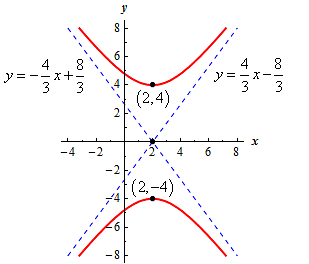
Ques. Draw the graph of the hyperbola y216 – (x - 2)29 = 1 (5 marks)
Ans. The first step is to compare our equation to the hyperbola's standard form and discover all of the crucial information. Here is the typical form of the hyperbola-
(y - k)2b2 – (x - h)2a2 = 1
When we compare our equation to this, we can see that we have the following data-
h = 2, k = 0, a = 3, and b = 4
We know that this hyperbola will open up and down because the y term is positive.
With the data we gathered in the first phase, we can determine that the hyperbola's center is (2, 0).
Hyperbola's vertices are as follows: (2, 4) and (2, -4).
The two asymptotes' equations are as follows:
y = 0 + 43 (x - 2) = 43 x - 83
y = 0 - 43 (x - 2) = - 43 x + 83
Here is the diagram of the hyperbola, completed with the points and asymptotes we discovered before.

Ques. The given equation of the hyperbola is: (x - 4)292 – (y - 2)272. Find out the following measures- Major Axis, Minor Axis, Vertex, Asymptote, and Directrix.(5 marks)
Ans. Given data x0 = 4, y0 = 2, a = 9, b = 7
Major axis- y = y0 and y0 = 2
Minor axis- x = x0 and x0 = 4
Vertex: (a, y0) and (−a, y0) are (9, 2) and (−9, 2)
y = 2 + 79x - 379 = 2 - 79x - 239
y = 2 + 0.77x + 4.1 = 6.1 + 0.77x
y = 2 -0.77x + 2.5 = 4.5 + 0.77x
Directrix x = a2/(\(\sqrt{(a^2 + b^2)}\))
= 92/(\(\sqrt{(9^2 + 7^2)}\))
= 7.1
Ques. Calculate the position of the point (6, - 5) on the hyperbola x2/9 – y2/25 = 1. (5 marks)
Ans. Given equation of hyperbola = x2/9 – y2/25 = 1
As the point P (x1, y1) lies inside, on or outside the hyperbola (x2/a2) - (y2/b2) = 1 as according (x2/a2) - (y2/b2) - 1 > 0, = or < 0.
As per the given problem, (x12/a2) - (y12/b2) - 1
= (62/9) - ((-5)2/25) - 1
= (26/9) - (25/25) - 1
= 4 - 1 -1 = 2 > 0
Hence, the point (6, -5) lies inside the hyperbola x2/9 – y2/25 = 1
Ques. Complete the square on the x and y sides of the equation and write the equation in the conventional form of the hyperbola equation 25y2 + 250y - 16x2 - 32x + 209. (5 marks)
Ans. The procedure will be the same as the one we used to write elliptical equations in standard form.
The first step is to ensure that the x2 and y2 coefficients are both one. The coefficients of the x2 and the y2 are -16 and 25, respectively. We'll factor -16 out of every phrase with an x and 25 out of every term with a y. Doing so results in,
25 (y2 + 10y) - 16 (x2 + 2x) + 209 = 0
Let's get started on filling in the blanks on the square. To begin, half the coefficients of the x and y terms must be squared, then those numbers must be added or subtracted in the proper places as follows:
(10/2)2 = (5)2 = 25 ; (2/2)2 = 1
25 (y2 + 10y + 25 - 25) - 16 (x2 + 2x + 1 - 1) + 209 = 0
After that, we must factor the x and y terms and add all of the constants together.
25 ((y + 5)2 - 25) - 16((x + 1)2 -1) + 209 = 0
25 (y + 5)2 - 16(x + 1)2 + 209 - 625 + 16 = 0
25 (y + 5)2 - 16(x + 1)2 - 400 = 0
Make sure to multiply -16 by x terms and 25 by y terms before adding the constants together.
To complete the equation, we'll first shift the 400 to the other side.
25 (y + 5)2 - 16(x + 1)2 = 400
We'll need a one on the right side of the equation to convert this into standard form. To get this, simply divide everything by 400 and simplify the terms a little.
25 (y + 5)2400 - 16 (x + 1)2400 = 1
Ques. Draw the graph of the hyperbola (x + 3)24 – (y -1)29 = 1. (5 marks)
Ans. The first step is to compare our equation to the hyperbola's standard form and discover all of the crucial information. Here is the typical form of the hyperbola-
(x - h)2a2 - (y - k)2b2 = 1
When we compare our equation to this, we can see that we have the following data- h = -3, k = 1, a = 2 and b = 3
We know that this hyperbola will open right and left because the x term is positive.
We can see that the centre of the hyperbola is ( 3, 1 ) using the information we discovered in the first phase.
( 5, 1 ) and ( 1, 1 ) are the vertices of the hyperbola.
The two asymptotes' equations are as follows:
y = 1 + 32(x + 3) = 32x + 112;
y = 1 - 32(x + 3) = - 32x - 72
Here is the diagram of the hyperbola, completed with the points and asymptotes we discovered before.
Ques. Determine the equation of the hyperbola which is centred at (0, 0), passing through the point (2, 3), and having √3 eccentricity. (3 marks)
Ans.
\(\frac{c}{a} = \sqrt{3} \\ \frac {\sqrt{a^2 +b^2}}{a} = \sqrt{3} \\ P(2, \sqrt{3}) \\ \frac{4}{a^2} - \frac{3}{b^2} = 1 \\ \frac{a^2 + b^2}{a^2} =3 \\ b^2 = 2a^2 \\ \frac{4}{a^2} - \frac{3}{b^2} = 1 \\ \frac{4}{a^2} - \frac{3}{2a^2} = 1 \\ a^2 = \frac{5}{2} \\ b^2 = 5 \\ \frac{2x^2}{5} - \frac{y^2}{5} = 1\)
Ques. Calculate the coordinates of the intersection point(s) between the hyperbola x2 - 2y2 = 1 and the line x + y − 1 = 0. (3 marks)
Ans:

\(\begin{Bmatrix} x^2 - 2y^2 =1 \\ y =1 -x \end{Bmatrix}\)
x2 - 4x + 3 = 0
P = (3, -2)
P’ = (1,0)



Comments