



Content Curator
Estimating square root is a concept of finding the root of a particular number; in this the number is divided in a different way than normal division method. It is not even a long-division method. We first group the number and then divide the first group with the nearest square of the divisor. Later on, we add up the divisor and repeat the step by taking other grouped numbers along with the remainder.
Key Terms: Square root formula, remainder, divisor, division method, prime factorization method
Estimating Square Definition
[Click Here for Sample Questions]
We mainly estimate the square of a number in two conditions:-
- The root of the number is difficult to find because the squared number presented is quite long and hard to evaluate by trial-error.
- The root of the number is difficult to find because the number provided is not a perfect square. In this case, we take the nearest value and put forth an approximate value.
(Root of the number means the square root of a number. When a number is multiplied by itself, the product is a square. Square root means if a particular number (dividend) is divided by divisor and the quotient obtained is equal to the divisor with remainder zero, the divisor is the square root of the number)
There are various methods to evaluate the square root of a number, whether perfect or not.
Estimating Square Formulas
[Click Here for Sample Questions]
There is no exact formula available for finding the square of numbers. Generally, we use square root (√) notation on numbers to signify the same. However, there are various methods to utilize for finding the square of a number.
√225 = 25, √16 = 4, √121 = 11, etc.
Estimating the square of the number involves the following steps:-
Method 1: Division Method
Step:1: Take the number, say 7624.7824, and start grouping it.
So, out of 7624.7824, 76 is the first group, 24 is the second, 78 is the third and 24 is the fourth. We always start grouping from last. You can see the bar on the grouped digits.
Step:2: Now, let us divide the number with the nearest square root available. See the example to understand:-
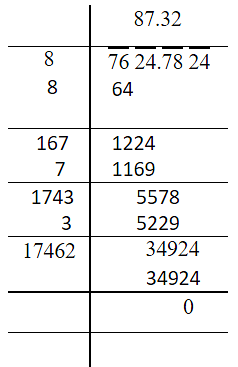
First, we will evaluate group1: check which number can give the nearest or less than that square to 76. 9 X 9 is 81>76.
So, we will go for 8 x 8 = 64<76.
After subtracting 64 from 76 with quotient 8, we need to bring down the other group now (24) along with the remainder 12.
Read more: Long-division method for Square root
Also, add 8 in the divisor. You will get 16.
Make a blank space beside 16. Here, your next number will come which will provide the nearest or less than equal square to 1224.
We will go for 167 x 7 = 1169 because 168 x 8 = 1344 which is more than 1224.
After subtracting, you will get a remainder. Now, bring the third group down. As it is after decimal point, put a decimal point in quotient too after 87. Again add 167 + 7 = 174_ with a blank space. Repeat the steps.
You will soon get a zero remainder and a quotient of 87.32. This is the square root of the number.
Method 2: Estimation on Number Line
If the division method seems somehow difficult to you, go for the estimation of squaring of numbers based on the number line.
For example, you have a number, say 140. How will you estimate its square root?
Let’s consider making a bracket.
- Find the number that gives a square less than 140 (lower limit)
- Find the number that gives a square more than 140 (upper limit)
11 gives 121 and 12 gives 144.
So, between 11 to 12, the square root of 140 should lie. Start by 11.5 from the middle path.
As 12 x 12 is nearest to 140 (144 is the square), take a few steps ahead to be 11.8
This will give around 139.24 which is approx near to 140.
Method 3: Prime Factorization Method
Here, you can use prime factorization to find all the factors of the number and then sort them. See here:-
Let’s say the number is 4225.
Therefore, prime factorization will be like this:-

4225 = 5 x 5 x 13 x 13
The number should be repeated even times and then grouped. As 5 is two times, we will club and take 5 once. If 5 would have been 4 times, we would have clubbed and taken 2 times 5. The same applies to 13. It can be understood by the LCM and HCF methods.
Thus, 5 x 13 = 65 is the square root.
However, do understand that Method 3 will be appropriate for those numbers that are perfect squares because when common factors will be unavailable even times, you will have to choose either Method 2 or Method 1 to find square root.
Estimating Square Examples
[Click Here for Sample Questions]
Let’s see some of the examples of finding square root of various types of numbers:-
- Decimal Numbers:
- √0.0064
8 is the square root of 64. There are four decimal places (club them), so, there will be 2 decimal places for square roots. Thus, 0.08 because 0.08 x 0.08 = 0.0064.
- √0.016
4 is the square root of 16 but the decimal places are odd. So, we will use long-division.
By long division, we get 0.1264 as the square root.
- Non-square and Square Numbers
- √73
8 x 8 = 64 and 9 x 9 = 81. So, the root should lie between 8 and 9. Thus, start from 8.5. As 73 is nearer to 9, move towards 9 a few steps on the number line to be 8.6.
8.6 x 8.6 = 73.96 (approx) {8.5 is also correct as 8.5 x 8.5 = 72.25 (approx)}
- √2025
Do prime factorization in this way:-

Thus, 2025 = 5 x 5 x 3 x 3 x 3 x 3
(Club two times 5 and 4 times 3)
Square root = 5 x 3 x 3 = 45.
(Long-division can also be used)
- Fractional Numbers
- √81/100
9 x 9 = 81 and 10 x 10 = 100. So, root is 9/10 = 0.9
Read more: Sample questions PDF for practice
Things to remember
[Click Here for Sample Questions]
Here is a list of important things mentioned below to keep in mind:-
- Square root means the factor of a number; when it is divided you obtain the original number again.
- You can find square roots for real numbers. If it is not a perfect square, you get an approximate value.
- There are three methods available for finding the square root of a number: Prime factorization, long-division, and estimation on the number line.
- Long-division method is the best way because it can give accurate results for long and complex perfect squares as well as non-perfect square numbers.
Estimating Square Sample Questions
Ques. √326
Soln: Make a bracket from 18 to 19 because 18 x 18 = 324 and 19 x 19 = 361. Thus, start from 18.5 on the number line.
As 326 is nearer to 324 (square of 18), move few steps towards 18 to become 18.1 as 18.1 x 18.1 = 327.61 (approx) {you may also consider 18.05 because 18.05 x 18.05 = 325.8 (approx) }
Ques. √111
Soln: Use the long division method to find the square root in this way:-

It is a non-square number. So, the approx square is 10.53.
Ques. Find √44 till 2 decimal places
Ques.√1.69 x 5.76
√1.69 x 5.76
= √169x576/100x100
=√13x13x24x24/10x10x10x10
=13x24/10x10
=1.3x2.4
=3.12
√1.69x5.76 = 3.12
Ques. Find the right range for __ <- √23 < ___
Soln:√16 = 4
The perfect square just above 23 is 25:
√25 = 5
√23 lies between √16 and √25, so √23 lies between 4 and 5.
Finally, include the negative signs.
Therefore,

Ques.There is a ladder 6 feet away from the wall while the top of the ladder is at 10 feet. Find the length of the ladder (An approximate whole number).
Hint: Pythagoras theorem = (Length of ladder)^2 = (base)^2 + (perpendicular height)^2

(Length of ladder)^2 = (6)^2 + (10)^2
Soln: In the figure, AC is the ladder, AB is the wall.
Using pythagoras theorem, we have:
h2 = 102 + 62
h2 = 100 + 36 = 136
h = √136 ft
Now, we know that 121 < 136 < 144.
Also, 112 = 121 and 122 = 144
Thus, the nearest whole number to which √136 can be approximated is 12.
Thus, required length of the ladder is 12 feet approx.



Comments