



Education Journalist | Study Abroad Lead
Gallium is the third element in the thirteenth column of the periodic table. It's categorized as a post-transition metal. Gallium atoms have 31 electrons and 31 protons in the outer shell, with 3 valence electrons. It's well-known as a metal with a melting point just above room temperature, meaning that gallium can actually melt in your palm. It is relatively non-toxic in its elemental form, which means that, unlike mercury, it can be handled safely. On the other hand, Gallium holds a plethora of fascinating secrets. It can combine with other metals to make remarkable alloys. It has the ability to disintegrate metals like aluminium, as well as give them characteristics that were previously unknown to the rest of the world. In this article, we will learn more about the element gallium, understand its properties, and see its position in the periodic table.
| Table of Content |
Read More: Periodic Properties Of Elements
What is Gallium?
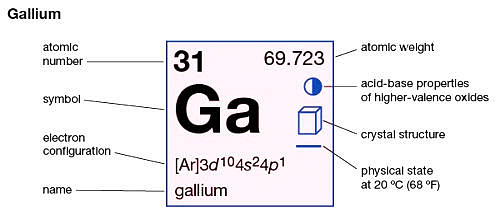
Gallium, like boron, aluminium, indium, and thallium, is a metal in the 3A group of elements. It has an atomic mass of 69.72 g.mol-1 and is a chemical element. Gallium has an atomic number of 31. It is neither a transitional metal nor a semimetal. At regular pressure and temperature, it is thought to be a soft metal. Ga is the symbol for Gallium. Its chemistry is comparable to that of aluminium. Gallium (III) nitrate is formed when gallium reacts slowly with hydrochloric acid, with sulfuric acid, and swiftly with nitric acid.
Gallium Element
Discovery of Gallium
- Dmitri Mendeleev, a Russian chemist, predicted the existence of gallium and its principal features before it was discovered. He gave the hypothetical element the name eka-aluminum because he thought it would be found below aluminium on the periodic table.
- Gallium was discovered in 1875 in Paris by French chemist Paul E. Lecoq de Boisbaudran using a spectroscope. It was discovered as a novel element because of its now-famous spectrum (two violet lines).
De Boisbaudran first extracted gallium from a zinc blende ore found in the Pyrenees, obtaining only 0.65 grams from 430 kilos of ore. By electrolyzing gallium hydroxide in potassium hydroxide solution, he was able to extract gallium. The name is derived from the Latin word 'Gallia', which means France.
Also Read:
Gallium in the Periodic Table
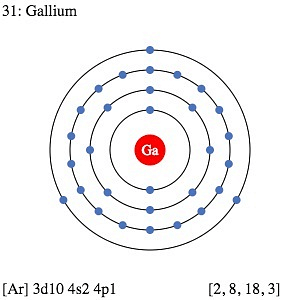
Gallium is a chemical element with the symbol Ga and the atomic number 31. It's on the right side of zinc and on the left side of germanium. Gallium is found in the boron group of the periodic table, below aluminium and above indium. Aluminum and indium, particularly indium, have similar physical and chemical properties. Because gallium has three valence electrons, the gallium +3 ion is the most common. The electronic configuration of gallium is 1s22s22p63s23p63d104s24p1. It has a 1.81 electronegativity.

Gallium in the periodic table
Physical Properties of Gallium
- Gallium is a soft metal with a lustrous finish.
- The color of pure gallium is silvery-blue.
- Gallium has a boiling point of around 2200oC and a density of 5.907 gm/cm3, which is similar to that of water. It is the only element that has such a large melting and boiling point ratio.
- Gallium does not exist in its elemental or natural form in nature. It must be removed by smelting or some other method.
- It's not really metal-like.
- Gallium readily adheres or sticks to glass or porcelain.
- It has a delicate texture and may be easily cut with a knife.
- Gallium also possesses alloying qualities, making it simple to combine with metals such as aluminium and zinc. It may easily diffuse across zinc, aluminium, and steel metal limits. The Galinstan alloy, which consists of gallium, tin, and indium, is a well-known gallium alloy.
- Gallium is also difficult to crystallize.
- It has a very low melting point of roughly 29oC. As a result, if your body temperature is higher than 30 degrees Celsius, a portion of it may melt in your hands.
- The Ga element also has the ability to supercool, which is an intriguing property. Gallium's melting point is roughly 29oC, thus it will most likely start to solidify below that temperature. In the case of Gallium, however, this is not the case. It may cool down without solidifying and maintaining its liquid-like structure.
Read More:
Supercooling is a chemical phenomenon in which a substance can cool below its freezing point without forming.

Galium melts in your hands
Chemical Properties of Gallium
| Atomic Number | 31 |
| Group | 13 |
| Period | 4 |
| Block | P block |
| Electronic configuration | 1s22s22p63s23p63d104s24p1 |
| State at room temperature | Solid |
| Atomic Mass | 69.723 |
| Density | 5.907 gm/cm3 |
| Boiling Point | 2200oC |
| Melting Point | 29oC |
| Isotope | 69Ga, 71Ga, 67Ga |
Gallium is a chemically reactive element. It is less reactive than alkali metals. Gallium is the only non-radioactive metal that is not extremely reactive like Caesium and Rubidium or very toxic like Mercury among the four non-radioactive metals that are liquid at ambient temperature (Mercury, Caesium, and Rubidium). Gallium is largely inert in water and air, however, it interacts with both alkaline and acid.
Atomic Structure of Gallium
Isotopes of Gallium
An isotope is a chemically related element with the same atomic number as another but different atomic weights. The existence of additional neutrons accounts for the disparity. Chemically, isotopes are similar, yet there are physical distinctions. Gallium contains up to 25 different isotopes. Only two of these, 69Gallium and 71Gallium, are stable. The former is the most common and accounts for the majority of its natural presence. Gallium also has various radioactive isotopes (isotopes that release radioactive radiations), the most well-known of which is 67Gallium. Gallium's physical properties are greatly reliant on the temperature factor.
Also Read:
Applications of Gallium in Today’s World
- Gallium is most commonly used in electronics as gallium arsenide (GaAs) and blue LEDs as gallium nitride (GaN). Gallium arsenide is a semiconductor that has superior characteristics to silicon, making it ideal for defense and aerospace applications. It is, however, far more expensive than silicon.
- Short-wave infrared cameras (SWIR) with InGaAs sensors are known as SWIR cameras. Thermal images are created by SWIR cameras, which can see through glass. The market for these cameras, which are used to inspect a variety of products such as solar cells or production and have night vision, is fast expanding.
- Gallium easily wets and adheres to glasses. This aids in the creation of excellent mirrors.
- Gallium is used similarly to Mercury in medical thermometers since it is a liquid metal at ambient temperature.
- Gallium is a metal that easily alloys with other metals. Some gallium alloys can be used to replace harmful mercury alloys. The plutonium used in nuclear devices is also stabilized with a gallium alloy.
- The use of gallium alloys to cool machines and other electrical devices such as computers is another application.
- Gallium is widely employed in biomedical applications. Gallium salts are utilized in a variety of medicinal therapies. Some chemicals also have anti-cancer effects.
- Gallium is being used in research studies to treat inflammation, cancer, and other disorders.

Gallium used in LED Lights
Amazing Facts related to Gallium
- The periodic table's founder, Dmitri Mendeleev, is well-known for predicting the presence and properties of the element gallium a few years before it was discovered.
- When handling gallium metal, gloves are occasionally used — not because it is dangerous, but to avoid having to wash off the "gallium stains." It also leaves a stain on the glass.
- Most gallium compounds, like aluminium, are colorless.
- When a blob of liquid gallium in water oscillates between oxidation and reduction in the presence of both an oxidizing and reducing chemical, it can resemble a "beating heart" similar to mercury.
Read More: Combustion and Flames
- Gallium is one of the few chemicals that expands when it freezes.
- Anything constructed of aluminium, even aluminium cans, will be destroyed by a small amount of gallium. It also eats away at steel, leaving it brittle.
- Although it can melt in your palm, it will not boil unless heated to 4,000 degrees Fahrenheit - the highest temperature range of any element.
- It combines with Indium and Tin to generate a liquid at temperatures much below room temperature.
- Because of its high boiling point and low melting point, gallium is utilized in high-temperature thermometers.
- When compared to other metals, gallium has one of the widest ranges of liquid states.

Appearance of Gallium
Things to Remember
- Gallium (atomic number 31) is a chemical element. Highly pure gallium is coated with a dazzling silvery tint, whereas solid gallium is a blue-gray metal with an orthorhombic crystalline structure.
- It does not exist in nature in its purest form, and its compounds do not serve as a major extraction source.
- It is solid at normal temperature, but when exposed to caesium, mercury, or rubidium, it turns liquid (when heated slightly).
- Gallium (III) compounds are easily formed when gallium interacts with most strong acids. Common gallium (III) compounds include chloride, nitrate, and sulphate.
- Gallium chloride is a highly corrosive substance.
- Gallium is used in blue and green LEDs, mobile phones, and pressure sensors for touch switches, among other things.
- Gallium nitride is a semiconductor material. It has a number of characteristics that make it extremely adaptable.
Read More:
Sample Questions
Ques. Is gallium a metal or a non-metal? (2 marks)
Ans. Gallium is, without a doubt, a metal. It is never classed as a metalloid or a nonmetal. It's also not a transition metal. It's referred to as a post-transition metal. The best approach to examine its metallic characteristics is while it is liquid and free of oxidized debris.
Ques. Is gallium poisonous? (2 marks)
Ans. Gallium metal is non-toxic in its basic state and is deemed safe to play with and handle. Gallium compounds are minimally poisonous; they are not harmful, but they should not be inhaled or consumed. It is suggested not to consume elemental gallium, although little amounts inadvertently consumed are unlikely to be dangerous.
Read More: Variable Valency
Ques. What is the source of Gallium if it is not found naturally? (1 mark)
Ans. Gallium is a byproduct of the production of other metals. As a result, it is removed by smelting or passing an electric current through various gallium compounds.
Ques. What is the importance of gallium discovery? (2 marks)
Ans. Gallium was discovered as a new element in 1873. Gallium was a significant discovery since it is a major component of transistors and an important element for alloys. Gallium is different from other metals in that it has one of the widest liquid ranges of any metal.
Ques. Is it possible to keep liquid gallium in a glass container? (1 mark)
Ans. As liquid gallium expands by 3.1% when it freezes, it cannot be maintained in a glass or metal container. Gallium has the widest variety of liquids of any metal.
Read More:
Ques. What are some of the applications for gallium? (5 marks)
Ans. In the semiconductor industry, pure gallium is used.
- Integrated circuits and electronic chips are made with pure gallium.
- Lasers make use of gallium compounds as well.
- It's widely utilized in the production of LEDs.
- Gallium readily absorbs moisture and sticks to glasses. This aids in the production of high-quality mirrors.
- Gallium, like Mercury, is utilized in medical thermometers because it is a liquid metal at room temperature.
Ques. Why does gallium corrode aluminium? (3 marks)
Ans. Gallium has a number of qualities that influence the properties of aluminium and other metals. It starts by forming an amalgam, or alloy, with aluminium. Gallium penetrates the metal's aluminium oxide passivation layer, causing the crystal structure to be disrupted and the metal to become brittle. This is known as gallium-induced structural collapse. Mercury has the same effect on aluminium, but because of mercury's toxicity, this experiment is rarely done. As a result, it is illegal to transport gallium on flights.
Ques. Does gallium have a high or low boiling point? (2 marks)
Ans. Gallium is abundant in our solar system, with a weight abundance of 40 parts per billion. Gallium has a wider temperature range than any other element, making it a liquid. Solid gallium has a low melting point of 29°C and an abnormally high boiling point of 2,204°C.
Also Read:



Comments