



Education Journalist | Study Abroad Lead
Giardia is a tiny unicellular parasite (germ) that is present on the surface of the soil, food, contaminated water, feces of organisms infected by giardiasis, etc. Giardiasis is a diarrheal disease caused by the same parasite (giardia). Giardiasis is caused by the entry of giardia into the organism by the simple method of swallowing the parasite through contaminated food or water. Drinking recreational water (water in lakes, rivers, or pools) is the main cause of giardiasis, that is why contact with infected organisms should be prohibited for precautionary purposes. The lifecycle of giardia is simple as it just consists of two stages which are the trophozoite and the cyst. In this article, we will have a look at the giardia life cycle and its two stages.
| Table of Content |
Giardia
Giardia is found worldwide in contaminated water, food, the surface of the soil, surfaces contaminated with feces of infected organisms. The site of infection in humans is the duodenum and upper part of the jejunum, both places are of the small intestine. Giardia survives outside the body with the help of a tough outer shell, the shell also provides structure and tolerance against chlorine disinfectant. Giardia exhibits in two morphological forms, which are;
-
Cyst: oval cyst
The cyst has many internal fibers and is covered by a thick wall. Each cyst can give rise to two trophozoites by the process of excystation in the intestinal tract of the host organism.
-
Trophozoite
The trophozoite is a binucleate form of giardia and has four pairs of flagella with suction disks.
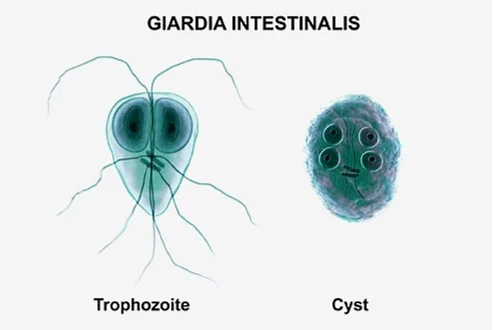
Giardia
Also, Read: Difference between Cilia and Flagella
Life cycle of Giardia
If we see giardia in the feces of the infected person, we will find both cyst and trophozoite forms of giardia. The cysts are more resistant in an open environment that is why are responsible for the transmission.
- Giardia cysts are the infective stage of Giardia intestinalis. Very few cysts can infect the animal and cause giardiasis, the cysts are transferred in the animal body by simple ingestion with food, water, or by indirect means like if the cysts get attached with the hand or other body parts and then get attached to the food that is to be ingested. They are quite resistant to chlorination, freezing, and even UV exposure.
- After the cyst is ingested the acid in the animal’s stomach will produce excystation, in which flagella will come out of the cyst wall. The flagella usually break out in the small intestine (duodenum). Excystation will produce two trophozoites from each cyst.
- After the trophozoites are formed the trophozoites will reproduce asexually by longitudinal binary fission, some of them will float freely and some will get attached to the intestinal wall with the help of their suckers or flagella.
- After some time, some of the trophozoites will perform encystation and produce cysts. Encystations occur after the trophozoites come in contact with the bile salts and fatty acids of the body. Encystation occurs when the parasites ascend towards the colon, the cysts found in the colon indicate the non-diarrheal feces.
- Both trophozoites and cysts are then transferred to the feces and are very infectious. The transmission of giardiasis can also occur from the infected person or animal to the healthy person or animal.

Giardia Life Cycle
This whole cycle continues in the same manner unless the measures are taken for stopping the transmission.
Giardiasis
Giardiasis is a pathogenic disease caused by the entry of pathogen giardia. Giardiasis can be chronic and sometimes life-threatening too in the case of infants of most mammals. The disease is common in dogs, ruminants, pigs the infection is usually caused at a young age. Giardia intestinalis enters the host in the trophozoite form and then enters the small intestine, gets attached to the wall of the small intestine in the duodenum part with the help of flagella, and then get essential nutrients for its survival from the host’s blood and body and after encystation inside the intestine, the giardia transforms into cyst form with rigid outer covering.

Giardasis
The cyst is then exiting the host body with the feces and it can live up to 2 weeks in the outside environment with the help of its outer covering. One of the most common ways for transmission is through the untreated water that people usually drink while traveling, hiking, camping, etc. Giardiasis in small organisms (young organisms) can cause serious weight loss and chronic or intermittent(recurring) diarrhea. Feces becomes soft, pale, and contain mucus and fats due to mucin production. The infected person may also vomit. The infected organisms can become nonresponsive to the antibiotics.
Boiling water and ammonium steam can be used as a disinfectant. It inactivates the cysts present in the environment. For the efficiency of the process, the methods are to be done for more than 5 minutes, and then rinsing should be done. The animal’s feces cannot be disinfected for sure. Therefore, it is preferred to consider animal feces to be contaminated for at least 1 month. The easiest method to inhibit the further transmission of pathogens is to clean and let the place be dry enough. Domestic animals should be treated with antiprotozoal drugs and proper hygiene is also must to stop the transmission of giardia.
Read More: Unicellular Organisms
Things to remember
- Giardia is a microbial parasite that causes a diarrheal disease known as giardiasis.
- Diplomonadida is the order of giardia.
- The site of action for giardia in animals is their small intestine (generally the duodenum part).
- Giardia completes its full life cycle in two stages namely – trophozoites and cyst.
- The cyst is underdeveloped and lacks flagella but is more rigid, hard and can survive in adverse situations.
- The trophozoites develop flagella and suction disks to facilitate grabbing and sucking nutrients in the host body.
- The main precaution that should be taken to avoid giardiasis is to maintain cleanliness and proper sanitation and to maintain distance from the diseased pets.
- Dehydration should be taken seriously, especially in toddler or infant stage patients as giardiasis in a young person can be death threatening.
Also Read:
Sample Questions
Ques. What are the habitats of giardia? (3 marks)
Ans. Giardia is mainly found in wet places and water bodies like rivers, lakes, pools, etc. giardia are also found in the animal poop, the surface of the soil, contaminated water, food, and surfaces touched by the infected person are not safe too.
Ques. What is giardia? (5 marks)
Ans. Giardia is a single-celled parasitic micro-organism that is well known for causing giardiasis in host animals by entering their stomach and intestine through their mouth. Giardia exhibits in two morphological forms, which are;
- Cyst: oval cyst: The cyst is a four nucleate and has many internal fibers and is covered by a thick wall. Each cyst can give rise to two trophozoites by the process of excystation in the intestinal tract of the host organism.
- Trophozoite: The trophozoite is a binucleate form of giardia and has four pairs of flagella with suction disks.
Ques. What should be done by the government to control the transmission of giardiasis in developing countries? (5 marks)
Ans. Giardia is found in large numbers in developing and underdeveloped countries because of their poor infrastructure for drainage systems and more slum areas, where garbage (waste) and water accumulate at a place providing a medium for the cyst stage to survive and reproduce. And then the cyst comes in contact with the kids and other people resulting in giardiasis.
The government should take the situation seriously and work on the sanitation facilities for the poor people and should take care of the hygiene properly by appointing people for the selected area to take care of the cleanliness in their local areas and not letting water stay at spots. Also, leveling of public grounds and roads should be prioritized.
Ques. Explain the life cycle of giardia in the host body and outside the host body. (5 marks)
Ans. Giardia cysts are the infective stage of Giardia intestinalis. Very few cysts can infect the animal and cause giardiasis.
- The cysts are transferred in the animal body by simple ingestion with food, water, or by indirect means like if the cysts get attached with the hand or other body parts and then get attached to the food that is to be ingested.
- After the cyst is ingested the acid in the animal’s stomach will produce excystation after which flagella will come out of the cyst through the wall of cysts. The flagella are usually formed in the small intestine (duodenum). Excystation will produce two trophozoites from each cyst.
- After the trophozoites are formed the trophozoites will reproduce asexually by binary fission, some of them will float freely and some will get attached to the intestinal wall with the help of their suckers or flagella. After some time, some of the trophozoites will perform encystation and produce cysts.
- Encystations occur after the trophozoites come in contact with the bile juice of the body. Encystation occurs when the parasites ascend towards the colon, the cysts found in the colon indicate the non-diarrheal feces if the same cysts are present in the feces.
- Both trophozoites and cysts are then transferred to the feces and are very infectious, the transmission of giardiasis can also occur from the infected person or animal to the healthy person or animal.
Ques. Describe the diagnosis process of giardiasis? (5 marks)
Ans. Giardia is suspected to persist if anyone is feeling weak and excretes slimy feces with mucus. Giardiasis is considered very serious if the weight gain in the animals of less than 6 months is reduced. It can be diagnosed when the oval trophozoites are found in the feces, also cysts in the feces prove the infection, the identification can be done by iodine straining, as intermittent excretion is also possible so the preferred number of examinations is three and it is preferred to be performed in a week.
Ques. What are the preventive measures of Giardiasis? (3 marks)
Ans. Giardiasis is a pathogenic disease caused by the entry of a pathogen known as giardia. Giardiasis can be chronic and sometimes life-threatening too in the case of infants of most mammals. Giardiasis is a protozoal infection that can be seen in the mammals of the entire world. The disease is common in dogs, ruminants, pigs the infection is usually caused at the young age
Preventive measures: Boiling water and ammonium steam can be used as a disinfectant. It inactivates the cysts present in the environment. For the efficiency of the process, the methods are to be done for more than 5 minutes, and then rinsing should be done.



Comments