



Education Journalist | Study Abroad Lead
Gymnosperm refers to a group of plants that produce seeds that are not enclosed within the ovary or any fruit. The seeds covered are not enclosed within any case. The word gymnosperm is derived from two Greek words namely “gymnos” which means named and “Sperma” meaning seed. These plants form on the scales or leaves, or also near the end of the stalk which gives it a cone-like structure. Gymnosperms belong to the kingdom classification known as “Plantae” and its subkingdom is “Embrophyta”. Gymnosperms plants remain exposed even when they are fertilized before it develops into a seed after fertilization. Gymnosperm consists of trees like conifers, gnetophytes, and also species of the Gynkgophyta family.
Read about: Polyembryony and its occurence in gymnosperms
What are Gymnosperms?
[Click Here for Sample Questions]
Gymnosperms are plants in which the ovules are not enclosed like angiosperms. The stem of a gymnosperms tree can be either branched or un-branched. Gymnosperms also lack the ability to produce any fruits or flowers.
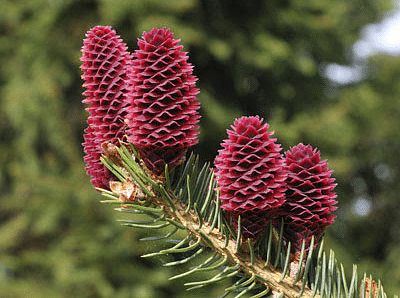
Gymnosperms
They are well known to survive in dry and moist weather conditions. Gymnosperms are believed to be the first vascular plants. The vascular system present in gymnosperm allows it to transport water throughout the plant. Its origin is estimated to be around 208-245 million years ago. It consists of trees such as cycads, gnetophytes, conifers, and ginkgoes. Some other recognizable trees and shrubs are spruces, pines, ginkgoes, and firs.
Also read: Economic Importance of Gymnosperms
Characteristics of Gymnosperms
[Click Here for Sample Questions]
Gymnosperms are identified by the following characteristics:
- Gymnosperms are known for not being able to produce flowers.
- After fertilization, the seeds which are formed have no covering nor are they are formed within a fruit. They are naked.
- Typically speaking they are mostly found in colder regions especially in snowfall occurring areas. For example firs and pines. They are also found in hot and moist weather conditions.
- They are known to form needle structured leaves in their plants.
- Gymnosperms are generally perennial (stay for 2 or 3 years) and form trees or bushes.
- Parts of gymnosperms cannot be divided and differentiated between ovary, style, and stigma
- With the absence of the stigma, they can be directly pollinated by wind or through birds.
- The male gametophytes produce two gametes. However, only one is functional.
- They form cones with reproductive structures.
- The seeds are known to contain endosperm which stores food for the growth and development of the plant.
- Gymnosperms are considered to be the first vascular plants. These plants have vascular tissues which help in the transportation of nutrients and water through Xylem and Phloem.
- Gymnosperms are known for their xylems which do not have any vessels along with the phloem which lacks sieve tubes as well as companion cells.

Characteristics of Gymnosperms
Classification of Gymnosperms
[Click Here for Sample Questions]
Gymnosperms can be mainly classified into 4 types: -
Cycadophyta
These gymnosperms are also known as Cycads. They are dioecious (each plant is either male or female completely). These gymnosperms were seed-bearing plants but unfortunately, most of them are extinct. They were estimated to flourish in the Jurassic and the Late Triassic Era. These are considered relics from the past.
- They have large feather-like compound leaves with thick trunks and small leaflets attached to a single central stem.
- Their height ranges from a few centimeters to several meters.
- Cycadophytes are usually found in the tropics and sub-tropics regions.
- They have evolved and have adapted to grow in dry and arid conditions in oxygen-poor environments.
- These plants can live up to years due to their very slow growth process.
- Cycadophytes rely, for pollination, on the insects in order to carry the male cones to the females.
- The roots of cycads are dominated by bacteria that are photosynthetic and are known as cyanobacteria. These bacteria produce neurotoxins and poisons which accumulate in the plant’s seed. They are not harmful but instead provide protection against fungal and bacterial parasites.
- Cycad seeds are called toxin because they are fatal to humans if injected.

Cycadophyta
Ginkgophyta
Ginkgophyta is another class of gymnosperms with only one living species. All the other species of this class are extinct and there’s been no record of them ever since. They are also known as Ginkgo trees. These plants are exclusive to parts of China in a natural growing environment. These plants can live very long with an estimation of about thousands of years. In the Ginkgophyta species, trees that are older and thicker have deeper roots compared to normal trees.
- These kinds of gymnosperm trees live and flourish well in sunlit regions and places that can provide both lots of water with more soil drainage.
- These trees are characterized by large fan-sized leaves which change colors during autumn.
- The tallest of these trees range till 160 feet.
- These types of trees have a range of applications that spans from cooking to medicinal uses.
- According to scientists, the leaves of these subtrees have been proven effective by ingesting them for memory-related disorders like Alzheimer’s, MCI (Mild Cognitive Impairment), NPH (Normal Pressure Hydrocephalus).
- Gingko trees are known to be very resilient to pollution and also against diseases and insect infestations. They were the only living thing to survive within a two-mile radius of the Hiroshima bombing.
- These plants either consist of male or female cones.

Ginkgophyta
Gnetophyta
Gnetophyta species are also relics from the past. Only 3 known members of this genus exist till date. Gnetophytes usually consist of tropical plants, shrubs, and trees. They can be recognized and characterized by their flowery leaves with soft coating. Gnetophyta has 3 genera namely Ephedra, Gnetum, and Welwitschia.
- Gymnosperms which belong to the Ephedra genus can be found in the form of shrubs in the regions of American Highland and also in the lower and cool region of Himalaya situated in India.
- Ephedra species contain medicinal properties and they are the main source of decongestant drug ephedrine. They have thin stems and scale-like leaves.
- Gnetum species can be found in tropical rain forests. They have a wide and flat-leaf which represents the leaves of flowering plants.
- They are generally shrubs and trees out of which the woody vines are the most common ones which go around and climb other trees.
- The male and female cones are kept on separate trees. The vascular tissues and structure of Gnetum are similar to that of flowering plants although they are not.

Gnetophyta
Coniferophyta
These are the most common species in the gymnosperm family. The trees are evergreen and they do not shed their leaves in winter. They include some of the largest and oldest trees on Earth. Conifers are monoecious (Both sexes can be found on the same tree).
- Another distinctive feature is its needle-like leaves. These needle leaves have wax coatings over them to prevent water loss in dry climatic conditions.
- The pines have single needles leaf or a cluster of needle leaf found on the stem.
- Conifers have been vital economically as they are a great source for the lumber industry and its related products.
- It also includes all forms of paper which are made from the bark and the wood of Conifers.

Coniferophyta
Examples of Gymnosperms
[Click Here for Sample Questions]
Following are some of the examples of gymnosperms:
- Araucaria
- Abies
- Cycas
- Juniperus
- Cedrus
- Picea
- Thuja
- Pinus
- Larix
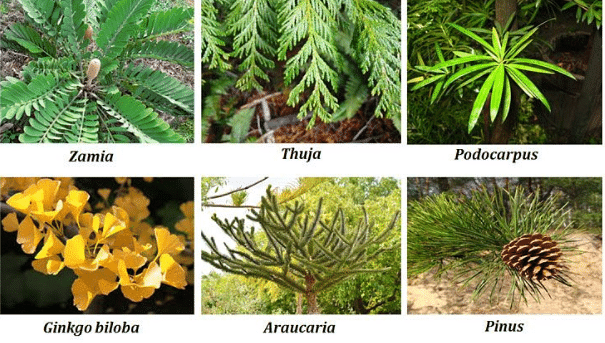
Examples of Gymnosperms
Gymnosperms Life Cycle
[Click Here for Sample Questions]
The life cycle of gymnosperms is known to be both haploid and diploid (they can reproduce by alternating their generations). They have a sporophyte dominant cycle. The reproductive organs are usually cones.
- Male cones: They have microsporophylls that contain microsporangia. Microsporangium produces haploid microspores. Some of these microspores form into male gametes called pollen grains and the rest degenerate.
- Female cones: Megasporophylls forms cluster and form female cones. They possess ovules containing megasporangium.
The pollen grain reaches the egg through wind or through birds or any other pollinating agent and the pollen grain releases a sperm. Zygotes are formed as the result when a male and a female gametophytes fuse together and form another cell which in turn is called a zygote.

Lifecycle of Gymnosperms
Things to remember
[Click Here for Sample Questions]
- Gymnosperms belong to sub kingdom Embophyta and are non-flowering plants.
- The seeds are not enclosed in the ovary or in any fruit. They are exposed to the leaf life structures in gymnosperms.
- Their further classification can be done as Coniferophyta, Cycadophyta, Ginkgophyta, and Gnetophyta.
- Gymnosperms are mostly found in boreal and temperate forests.
- They are of great value and display key features. Gymnosperms have an absence of flowers whereas open and naked seeds are present.
- The main source of pollination is wind and they majorly cover tall trees with some little shrubs.
- Gymnosperms have a tap root system. Some of these roots are involved with fungi and other microbes. These plants are also vascular with both xylem and phloem present.
- Ovary, Style, and stigma cannot be further be distinguished in gymnosperms.
Also read:
Sample Questions
Ques. What are gymnosperms? (2 marks)
Ans. Gymnosperms are a type of seed-producing plant in which the seeds have no covering and are naked. Gymnosperms also do not produce any flowers or fruits.
Ques. Do gymnosperms have an embryo? (1 mark)
Ans. The ovule becomes the seed encasing the embryo and the endosperm in a seed coat.
Ques. How are gymnosperms different from angiosperms? (2 marks)
Ans. Flowering plants are known better by the name of Angiosperms and Non Flowering plants are better known by the name of Gymnosperms. Angiosperms have seeds enclosed in an ovary whereas gymnosperms have naked seeds.
Ques. How are the gymnosperms classified? (3 marks)
Ans. Gymnosperms are classified into 4 categories which are:
- Cycadophyta
- Ginkgophyta
- Gnetophyta
- Coniferophyta.
Ques. Where are gymnosperms found? (2 marks)
Ans. Gymnosperms are usually found in the colder regions with snowfall. Trees like pine, conifer usually grow there with leaves having a wax coating. Some trees like Cycads are found in the dry and tropical regions.
Ques. Which stage dominates the life cycle of gymnosperms? (1 mark)
Ans. The haploid stage is the dominant stage in the life cycle of the gymnosperm. It develops from a spore and produces haploid gametes.
Ques. What is the nature of Endosperm? (1 mark)
Ans. Endosperms in gymnosperm are haploid in nature.
Ques. How are ovules arranged in a gymnosperm? (3 marks)
Ans. Angiosperms have ovules present inside the carpel which is the ovary part of the flower which is attached to the placenta whereas in Gymnosperms the Megasporophylls contain the ovules and they are not born in the placenta.
Ques. Why gymnosperms are called softwood? (3 marks)
Ans. The main feature that differentiates the hardwood of angiosperms from the softwood of conifers is the Vessel elements. Gymnosperms are called so because there is the absence of thick-walled vessels making them softwood plants. Due to the absence of vessel elements, it lacks the tough nature of wood because the vessel provides strength to the wood.



Comments